
International Student Resources
The Office of International Student Services is dedicated to helping international students find their path to success, academically, personally, and professionally. The buttons below will help new and continuing students navigate services and important information while at PCC and beyond!
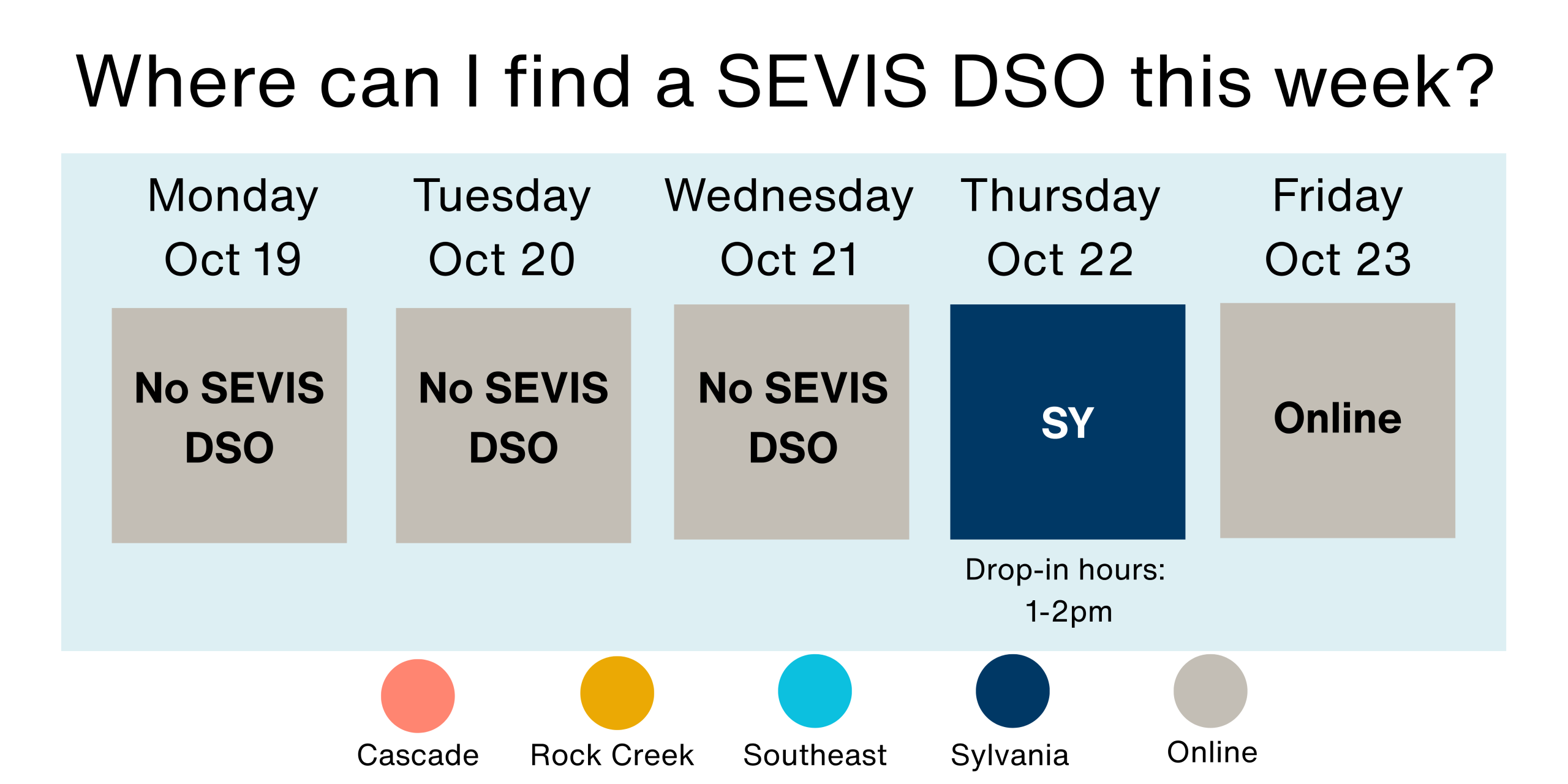
Weekly DSO Locations
Important Updates
GOVERNMENT UPDATE: Rule Change PAUSED – End of Duration of Status
The U.S. government was sued over the rule to end the Duration of Status (D/S). Yesterday, a U.S. judge paused the changes to F-1 student visa rules while a lawsuit continues.
What does this mean?
No F-1 visa rules will change yet. Some or all of the changes could still go into effect in the future, depending on how the court rules in the lawsuit.
What happens next?
The next court date to review the rule change is October 2, 2026. We will email when we have any updates about this rule.
If you are pursuing an Associate degree and you need more time to complete your current Associate degree at PCC, please schedule an appointment with your academic advisor and then submit the Request Form for “I-20 Extension.” Meeting with your academic advisor is required.
GOVERNMENT UPDATE: End of Duration of Status
The U.S. government enacted a new rule to end the Duration of Status. We are still working to understand exactly how the new rule affects F-1 students. Therefore the information provided could change in the next couple of weeks or months, as we learn more about this rule.
DISCLAIMER: The information provided is not legal advice and it should not be interpreted as such.
NOTE: The majority of F-1 students, who are following the U.S. government rules and completing the ESOL program or Associate degree within a reasonable time, should be able to successfully extend their stay in the U.S. if needed. Students who routinely fail their classes or are not making academic progress towards completing their program should consult with an immigration attorney.
UPDATES FOR F-1 STUDENTS WHO ARE IN THE U.S. ON or AFTER SEPTEMBER 15, 2026
If you are outside of the U.S. or planning to leave and re-enter the U.S. on or after September 15th, you will be subject to the new rule. This means you will receive a new I-94 with an Admit Until Date (AUD). Your AUD will be your I-20 Program End Date plus a 30-day grace period.
Read UPDATES FOR ALL F-1 STUDENTS below for important information about the AUD.
UPDATES FOR F-1 STUDENTS WHO ARE IN THE U.S. BEFORE SEPTEMBER 15, 2026
If you will not leave the U.S., the new rule will partly apply to you during a transitional period. If you depart and re-enter the U.S. any time after September 15, 2026, the new rule will fully apply to you (read more above in UPDATES FOR F-1 STUDENTS WHO ARE IN THE U.S. ON or AFTER SEPTEMBER 15, 2026).
- Your I-94 Record will not be updated with an Admit Until Date (AUD), but your assumed AUD will be the Program End Date on your most recent I-20 plus the 60-day grace period. Read UPDATES FOR ALL F-1 STUDENTS below for important information about the AUD.
- Upon completing your program of study (ESOL level 8 or an Associate degree), you will still have a 60-day grace period.
- If you apply for OPT before March 18, 2026, you will not need to apply for an Extension of Stay with USCIS. This applies to students graduating with an Associate degree after the Fall 2026, Winter 2027, and Spring 2027 terms, assuming that Spring 2027 graduates apply for OPT on the earliest dates possible.
UPDATES FOR ALL F-1 STUDENTS BEGINNING ON SEPTEMBER 15, 2026
Limits on changes in the first year: F-1 students are no longer eligible to transfer, change their major, or change their education level within the first academic year (3 terms), without approval for “extenuating circumstances” exception from SEVP.
NOTE: We do not know all the items that could qualify as an “extenuating circumstances” exception.
Options to Remain in U.S. Beyond Program End Date or Admit Until Date: When the Program End Date or Admit Until Date approaches, if an F-1 student:
- needs an I-20 extension to continue their studies at PCC
- wants to transfer to another school, or
- wants to apply for OPT, then
F-1 students must also apply for an Extension of Stay with USCIS, using Form I-539 and paying the appropriate fee, or travel and re-enter with a new I-20.
NOTE: We are still learning if travel and re-entry is an option for students applying to OPT.
- If you earn an Associate, Bachelor, Master, or Doctorate degree in the U.S. after September 15, 2026, you are not eligible to begin another Associate degree at PCC or any other school in the U.S. Read more below under STUDENTS INTERESTED IN LIMITED ENTRY PROGRAMS.
All academic constraints of the rule change will be applied after September 15, 2026 moving forward. It is not applied retroactively. For example, if you have been studying ESOL in the U.S. for 1 year, the 24-month limit applies starting the Fall 2026 term (read more below in “ESOL STUDENTS WHO WANT TO CONTINUE STUDYING IN THE US”) Students who have already received a Bachelor or Master degree in the U.S. before September 15th can still pursue an Associate degree. However, this will not be possible in the future.
ESOL STUDENTS WHO WANT TO CONTINUE STUDYING IN THE U.S.
English language studies (called ESOL at PCC) are now limited to 24 months of study total by the U.S. government, including a vacation term. Beginning on September 15th, studying ESOL for more than 24 months in the U.S. is no longer possible, at any school in the U.S. After you complete 24 months of English language studies, you must do one of the following:
- Request a Change of Education Level to begin an Associate degree at PCC
- Transfer to another school for a program that is not focused on English language studies
- Depart the U.S.
With a Change of Education Level or to transfer to another school, you must submit an Extension of Stay application to USCIS by completing the Form I-539 with a fee payment or travel and re-enter with your new I-20 at the Associate degree level.
NOTE: We are still working to understand how and what the process would be for ESOL students who complete their ESOL studies within 1 or 2 terms.
STUDENTS INTERESTED IN LIMITED ENTRY PROGRAMS (Nursing, Radiography, etc.)
Under the new rule, we believe that a Change of Education Level will not be possible for students who want to start a new Associate degree after completing another Associate degree.
If you are taking prerequisite classes for a limited entry program, like Nursing or Radiography, then you must complete your prerequisite classes before you complete an Associate degree. This means you might have to take prerequisite classes during your vacation term.
If you are admitted to a limited entry program after September 15, 2026, contact the oiss@pcc.edu to understand if you need to take additional steps to extend you stay with USCIS.
NOTE: We are still working to understand if these programs could be considered a “higher level” of education under the new rule. We will email F-1 students with updated information when we have any to share.
TRANSFERRING TO ANOTHER SCHOOL
If you complete a program, when you transfer, you must start at a “higher level” of education. For example, if you complete an Associate degree at PCC, you can only begin a Bachelor degree or higher at your transfer school. You cannot start another program at the Language Training (ESOL) level or at the Associate degree level.
- Within 1st Academic Year
Transfers within the first year of study (3 terms) in the U.S. are no longer allowed, without approval for “extenuating circumstances” exception from SEVP.
NOTE: We do not know what could qualify as an “extenuating circumstances” exception at this time. More information to come.
- Before Program End Date or Admit Until Date
The process will remain unchanged. However, if you need to study longer than the Program End Date on your PCC I-20 or Admit Until Date on your I-94, you must request an Extension of Stay, or travel and re-enter with a new I-20. - Near or After Program End Date or Admit Until Date
Transferring to another school will require an immediate application for an Extension of Stay, or travel and re-enter with a new I-20.
STUDENTS CURRENTLY ON OPT or AWAITING FOR OPT APPROVAL
If you are still waiting for OPT to be processed, no action is needed.
After the Card Expires date on your EAD card, you must do one of the following, before the end of your grace period:
- Transfer to a new school – You must submit an Extension of Stay application to USCIS (I-539) with a fee payment, or travel and re-enter with a new I-20.
NOTE: We believe that you will not be eligible to begin a new Associate degree if you do not receive a new I-20 for that program before September 15th.
- Depart the U.S.
- Apply for a Change of Status – Work with an immigration attorney for this option before the Card Expires date on your EAD card. The OISS and PCC cannot advise on anything outside of F-1 status.
DEPENDENTS
F-1 students applying for an Extension of Stay, who have dependents, must apply for an Extension of Stay for every dependent.
If you have questions, please
- email the SEVIS team at oiss@pcc.edu
- schedule an appointment with them, or
- join us tomorrow, Wednesday, August 19 at 2pm on Zoom for a D/S Rule Change Info Session. (Click here to join)
DOCUMENT UPDATE: Documents to Carry With You
You should carry a paper copy and a digital copy on your phone of the following documents whenever you leave your house. These are the documents that show that you are in the U.S. in legal F-1 status.
- Most recent I-20 signed by you in pen
- I-94 Record
- EAD card (for students with off-campus work authorization), especially when working off-campus
GOVERNMENT UPDATE: Additional Vetting at Visa Appointments
During the visa screening process, applicants will be asked to share their social media accounts, which must be set to “public”. Refusal to share your social media profiles or make them public could result in additional review and possibly a visa refusal.
Consular officers are instructed to look for the following items in your social media:
- hostility towards the citizens, culture, government, institutions or founding principles of the United States
- advocacy for, aid or support for foreign terrorists and other threats to U.S. national security
- support for unlawful antisemitic harassment or violence
- crimes committed in your home country
- inconsistent information compared to what you provided during your visa application.
GOVERNMENT UPDATE: Curricular Practical Training
In August 2026, the U.S. government sent updated guidance messages to all U.S. colleges and universities about Curricular Practical Training (CPT). Many schools across the U.S. canceled CPT authorization or paused issuing new CPT authorization, pending review of this guidance.
PCC is working with immigration attorneys to create a new CPT policy. We will update all F-1 students when the new policy is approved.
Until the new CPT policy is approved, the OISS will stop issuing CPT authorization for classes that are not required for the completion of the degree or program.
GOVERNMENT UPDATE: Travel Ban & Pause in USCIS Benefits
F-1 students and their F-2 dependents who are citizens from the following countries are banned from entering the U.S. without “national interest” exception. Most PCC students and applicants in F-1 status or seeking F-1 status will not qualify for the “national interest” exception.
As of December 2, 2025, the U.S. president issued a Policy Memorandum, pausing all applications for asylum and any applications for any benefits requested from USCIS by citizens of the 39 countries on the banned list, which seems to include OPT, Severe Economic Hardship, and Change of Status. There are immigration attorneys who are fighting this policy in court, but we do not know if or when USCIS will begin processing these requests again.
Below are the currently banned countries:
- Afghanistan
- Angola
- Antigua and Barbuda
- Benin
- Burkina Faso
- Burma (Myanmar)
- Burundi
- Chad
- Republic of the Congo (Congo Brazzaville)
- Cote d’Ivoire
- Cuba
- Dominica
- Equatorial Guinea
- Eritrea
- Gabon
- The Gambia
- Haiti
- Iran
- Laos
- Libya
- Malawi
- Mali
- Mauritania
- Niger
- Nigeria
- Palestinian Authority Travel Documents
- Senegal
- Sierra Leone
- Somalia
- South Sudan
- Sudan
- Syria
- Tanzania
- Togo
- Tonga
- Venezuela
- Yemen
- Zambia
- Zimbabwe
PCC UPDATE: Tuition & Insurance Increases
Tuition (starting Summer 2026)
Tuition for non-resident students (including F-1 international): $298 per credit
Fees – remain the same
Student Activity Fee: $4.25 per credit
Institutional Technology Fee: Remains $7.35 per credit
College Service Fee: Remains $15 per term
Lab Fee: Remains up to $45 per course
Health Insurance (starting Fall 2025)
Cost with LewerMark: $739.59 per term
REPORTING UPDATE: Government Requirements of OISS
To be able to issue I-20s and have F-1 international students at PCC, the OISS is required to report certain information about students to the U.S. government. In general, we update information in the SEVIS system, like your major, education level, address, phone number, etc.
Occasionally, the Department of Homeland Security might request additional information, like your financial documents, transcripts, class modality, transfer information, Reduced Course Loads, employment authorizations, etc.
We haven’t received many requests like this in the past, but we may see more in the future.
If we receive a request from the government, we cannot withhold the information without losing the ability to have F-1 students study at PCC. If we receive a request like this, we will email you to tell you.
RISKS UPDATE: Protests & Criminal Activities
Protests & Criminal Activities
Freedom of speech and expression are typically awarded to all in the U.S. under the first amendment of the U.S. Constitution. However, based on the current actions of the U.S. government, we recommend that you, as an F-1 international student, do not participate in political activities such as demonstrations, protests, or documentation of these events on social media.
Any history with police involvement can be reviewed and affect your immigration status. Therefore, it is important that you abide by all U.S. laws.
If you participate in any of the following activities, you could be removed from the U.S. and not allowed in the U.S. in the future:
- Engaging in any unlawful activity – There are many U.S. and state laws. Below are some crimes that can affect your status:
- Stealing: even small items or items with low value
- Having or using marijuana while on a non-immigrant visa
- Having or using a gun (firearm) while on a non-immigrant visa (in most cases)
- Driving while under the influence of drugs or alcohol, driving recklessly, or driving with a suspended or revoked license
- Participating in activities that promote or involve violence or destruction of property – Avoid protests, in case they become violent.
- Participating in activities that advocate the use of force, violence, or other unlawful means in opposition to the Government of the United States.
- Violating any law of the United States relating to espionage or sabotage, or to violate or evade any law prohibiting the export from the United States of goods, technology, or sensitive information – If you have access confidential or sensitive information through your education or work, do not share this information outside of the organization.
Download the “Know your rights” cards in your preferred language.
RISK UPDATE: Scams
You may receive emails, texts, or phone calls from people who claim to be from the U.S. government, police, or other government officials. If you receive emails, texts, or phone calls asking for money or your personal information (including questions about your status), do not follow their instructions. Contact the OISS and we can help you determine if it is real or a scam.
- NEVER share personal or financial information to unknown people.
- Government officials or police officers will NEVER ask you to provide credit/debit or gift card numbers, wire transfers, bank routing numbers, or to make bitcoin deposits for any purpose.
- Government officials will use mail or the email you provided when you applied to contact you. Always verify the email address of a sender. The email address they use should end in “.gov”.
- Phone number used by scammers can look like real government offices, like the Department of Homeland Security (DHS). You can ask them to contact your DSO or check SEVIS for your information.
Read about DHS scams, common scams and how to report them. You can also read more about scams on the Federal Trade Commission’s website in multiple languages.
TRAVEL UPDATE: Domestic Travel Recommendations
As an F-1 international student with an active SEVIS Record, you should not be detained or arrested while traveling within the U.S.
However, if an ICE officer asks about your status and for your paperwork, tell them that you are an F-1 international student and show them your most recent I-20 and I-94 Record. These are the documents that show that you are in legal status in the U.S.
For students on OPT: show your EAD (or receipt notice for a pending OPT application).
TRAVEL UPDATE: International Travel Recommendations
If you are a citizen from one of the countries on the travel ban list, we highly discourage any travel outside of the U.S.
For all other students, it is still risky to travel internationally if you want to return to study in F-1 status. While many PCC students in F-1 status have left and successfully returned, we cannot predict what changes the U.S. Government will enact, if those changes would affect your ability to return to the U.S., or when any such changes could occur.
Therefore, we still recommend students do not travel internationally, unless it is necessary.
If traveling is necessary, make a plan on what will happen if you are not able to return to the U.S. Travel with items that are most important to you. If you have a friend or roommate that is staying in the U.S., make a plan on what they will do with your belongings if you are not able to return. Making a plan before you go is the best way to ensure that you are prepared for the consequences that you might not be able to return to the U.S. as expected.
Archived Emails
- Updates to PCC’s CPT Policy & Information about Traveling Inside the U.S. & ICE (sent 10/02/2026)
- Update to Major Government Rule Changes for F-1 Students (sent 09/15/2026)
- UPDATE: How does End of Duration of Status affect you? (sent 08/18/2026)
- UPDATE: Major Government Rule Changes – End of Duration of Status (sent 07/17/2026)
- Tuition & Fees Update Starting Summer 2026 (sent 04/30/2026)
- PCC Strike Ends (sent 3/31/2026)
- Strike Transfer Back-up Plan Tool (sent 3/21/2026)
- Strike Back-up Plan Process and Zoom Invitation (sent 3/17/2026)
- Strike Impacts & Zoom Invitation (sent 3/12/2026)
- F-1 Status & Possible Strike (sent 2/24/2026)
- Your safety and resources during recent federal law enforcement activity (sent 1/9/2026)
- New Presidential Proclamation for Updated Travel Ban (sent 12/17/2025)
- End of Fall Term Reminders (sent 12/12/2025)
- Recent Tax Email from PCC: PLEASE READ (sent 11/08/2025)
- ICE Scam Updates & U.S. Laws (sent 10/17/2025)
- Visa Appointment Updates (sent 07/31/2025)
- Visa Appointments Resumed (sent 06/23/2025)
- Presidential Proclamation Travel Ban (sent 06/06/2025)
- Pause in Visa Appointments (sent 05/30/2025)
- Update and Community Meeting Space Tues, May 6th 12pm-2pm (sent 05/01/2025)
- Tuition & Fee Update : Starting Summer 2025 (sent 04/18/2025)
- Concern RE: Visa Revocations and SEVIS Terminations (sent 04/11/2025)
- Important reminders & Tips for International Students (sent 04/03/2025)
- Check your F-2 dependents have the correct documents (sent 03/28/2025)
- Visa Interview Waiver Update (sent 03/07/2025)
- Recent F-1 Student Questions Answered (sent 01/31/2025)
- F-1 Updates, Reminders, & Resources (sent 01/24/2025)
- Supporting Our F-1 Students Post-Election (sent 11/26/2024)
- SEVP Alert re Scammers Using SEVP Phone Numbers to Target International Students
Resources
F-1 Visa
- I-901 Fee Fee paid by all nonimmigrant students and exchange visitors that fund the Student and Exchange Visitor Program (SEVP) and SEVIS. This fee is separate from visa fees and school SEVIS administration fees.
- I-94 International travelers visiting the United States can apply for or retrieve their I-94 admission number/record (which is proof of legal visitor status) as well as retrieve a limited travel history of their U.S. arrivals and departures.
- Study in the States Offers free government resources that explain the rules and regulations governing the nonimmigrant student process in the United States.
Legal Services
- AILA (American Immigration Lawyers Association) The American Immigration Lawyers Association (AILA) is the national association of more than 15,000 attorneys and law professors who practice immigration law.
- SOAR Immigration Legal Services Recognized by the U.S. Department of Justice as an authorized provider of immigration legal services, SOAR’s attorney-driven legal program has a staff of two attorneys and a Department of Justice accredited representative. SOAR Immigration is now available on-campus! NOTE: You must make an appointment using this sheet.
-
- Rock Creek (Bldg 2, Rm 244): First Thursday of each month, 9am-4pm
- Cascade (SU 304): Second, Third, and Fourth Thursday of each month, 9am-4pm
- CLEAR Clinic The CLEAR Clinic provides free legal assistance (among other services) and referrals to full-service immigration attorneys for other legal needs.
- IRCO (Immigrant and Refugee Community Organization) The Immigrant and Refugee Community Organization (IRCO) serves the holistic needs of Oregon’s immigrants, refugees and mainstream community members.
- Catholic Charities Portland Catholic Charities’ Immigration Legal Services (ILS) program is a nonprofit law program providing low-cost consultations and legal representation to immigrants and refugees throughout Oregon and southwest Washington.
- Lutheran Community Services NW Refugee and Immigrant Services – Safe Route Helps refugees, immigrants and asylum seekers rebuild their lives in a new country.
- Portland Refugee Support Group is a non-profit focused on re-empowering refugees, asylum seekers, and newcomers to the community through a trauma-informed care, culturally responsive, and human-centered approach.
PCC
- PCC Counseling Services Free, short-term counseling to currently enrolled students (excluding Community Education). Service eligibility begins two weeks prior to a given term. In counseling, personal concerns are discussed and new ways of addressing issues are explored. Many concerns are resolved within eight sessions or less.
- PCC Multicultural Centers Founded to address institutional racism and the unique needs of students of color at PCC. Offer programs, tutoring, advocacy, and other support services focused on students of color. All students welcome.
- PCC Women’s Resource Centers WRC staff are here to offer connection, resources, and advocacy to support the success of all women and gender minority students. All genders are welcome.
- PCC Queer Resource Centers QRCs provide advocacy, education, leadership development, programming, and other services for students with marginalized genders and sexualities to create an inclusive and intersectional campus climate promoting gender justice, sexual liberation, and equity for all people. All students welcome.
- PCC Illumination Project Innovative student leadership and education program designed to foster a climate of equality, compassion, justice, and respect for all people in the PCC academic community and the community-at-large. Student participants write and act in plays to demonstrate social justice issues in their own lives.
- PCC Office of Equity and Inclusion Creates a college climate that demonstrates PCC’s commitment to civil rights, diversity, equity, and inclusion. OEI investigates claims of discrimination and harassment and provides training, tools, and policies to avoid and address these issues.
- PCC is a sanctuary college committed to making our college community a safer space, and doing all we can to protect student rights and privacy under the law.
External
- National Suicide Hotline 1-800-273-TALK (8255)
- National Sexual Assault Hotline 1-800-656-HOPE (4673)
- Call to Safety (Domestic Violence/sexual assault) 1-888-235-5333
- Trans Lifeline 1-877-565-8860
- Trevor Project LGBTQ Support 1-866-488-7386
This page is maintained by the OISS Director.