
Anderson Conference
Anderson 2026 – Conference Archive & Resources
The 2026 Anderson Conference explored the impact of artificial intelligence on teaching and learning in higher education. The day opened with a keynote by Dr. Bonni Stachowiak, Dean of Teaching and Learning at Vanguard University, and continued with sessions led by PCC faculty and staff examining AI through lenses of equity, ethics, accessibility, pedagogy, policy, and professional practice.
Throughout the conference, participants engaged in practical demonstrations, cross-disciplinary dialogue, and critical reflection on how AI is reshaping classroom practice and institutional decision-making. Resources from the event — including presentation slides, recordings (where available), and curated materials — are provided below to support continued learning and application.
Presentations and recordings
 Did They or Didn’t They?: The RWC’s Perspective on Artificial Intelligence in an Age of Anxiety
- January 31, 2026
- The Reading and Writing Center (RWC) addresses the impact of AI on teaching and evaluation.
 What Works Well in Online Teaching: Building AI Best Practices Together
- January 31, 2026
- Learn about the latest updates to PCC's "What Works Well in Online Teaching" resource, featuring strategies and collaborative faculty guidance for integrating ethical AI practices into online courses.
 Artificial Intelligence and Natural Stupidity
- January 31, 2026
- Juliet Pursell and Gale Czerski explore the ethics and dangers of artificial intelligence, focusing on its environmental footprint, creative copyright concerns, and internal biases.
 Supporting Deaf Students as a Second Language Development through Al
- January 31, 2026
- Presenter: [Rosemary DiSiervi] Summary This session explores how AI can support d/Deaf students in developing English skills through accessible, bilingual, […]
 Beyond Decorative: Chicanx & Latinx Communities as AI Prompts
- January 30, 2026
- Generative AI often flattens Chicanx and Latinx identities into narrow stereotypes, erases diverse populations, and commercializes sacred traditions like Day of the Dead Ofrendas. Meanwhile, algorithms frequently censor social justice content. To counter this, presenters advocate for critical AI literacy, ethical tech development, and community-grounded pedagogical practices in higher education.
 The Hidden Labor of Neurodivergent Students: Reimagining AI Through Tourette Syndrome and a Culture of Care
- January 30, 2026
- Automated AI proctoring and classroom monitoring systems create structural barriers for neurodivergent students by flagging involuntary movements, such as tics, as suspicious. This session explores how remote surveillance reinforces normative behavioral assumptions, places unfair burdens on disabled learners, and why higher education must shift toward trust-based, equity-centered assessment practices.
 Is AI Use Primarily a Cognitive Offloader or a Cognitive Amplifier in Student Learning?
- January 30, 2026
- Philosophy faculty discuss whether artificial intelligence acts as a cognitive offloader or an amplifier in education.
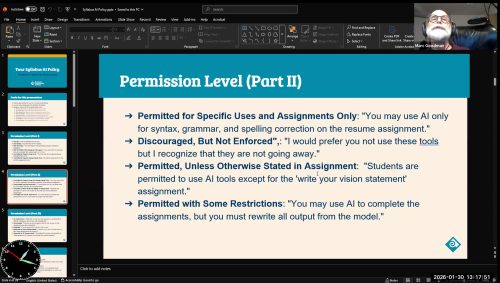 Designing Your Syllabus Al Policy: A Cross-Disciplinary Workshop
- January 30, 2026
- Marc Goodman’s workshop guides educators in crafting discipline-specific syllabus AI policies.
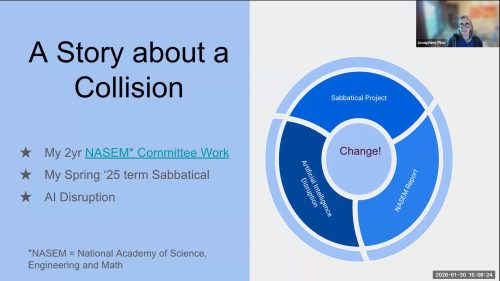 Leveraging a Framework for Effective & Equitable Teaching in an Al World
- January 30, 2026
- Biology Instructor Josephine Pino explores how generative AI impacts flipped classrooms and course design.
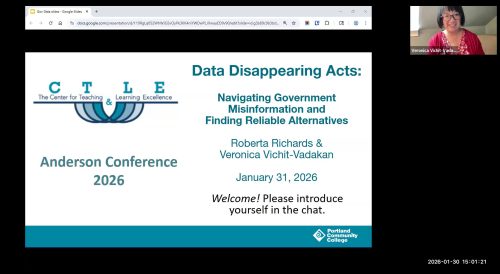 Data Disappearing Acts: Navigating Government Misinformation and Finding Reliable Alternatives
- January 30, 2026
- PCC Librarians Roberta Richards and Veronica Vichit-Vadakan discuss the removal and alteration of federal government data in public health and climate science. They introduce PCC Library resources—including Statista and specialized guides—to help faculty and students locate verified statistics, archived records, and trustworthy alternative data.
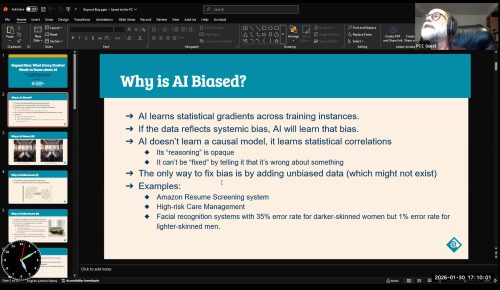 Beyond Bias: What Every Student Needs to Know About Al
- January 30, 2026
- In this presentation, CIS Department Chair Marc Goodman examines how AI engineering, tokenization, and engagement-driven architectures shape model accuracy. Moving beyond basic data bias, he breaks down hallucinations, retrieval-augmented generation (RAG), and reinforcement learning. Goodman reveals why chatbots prioritize persuasion over objective truth and shares practical strategies to teach critical AI fact-checking skills.
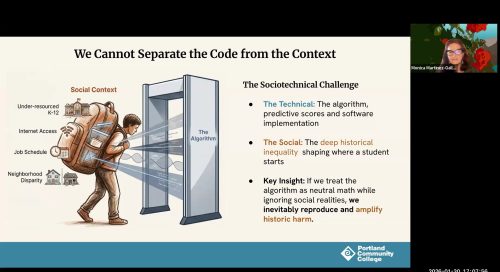 Will Al Elevate Student Achievement and Equity or Will Poorly Executed Al Drive Poorer Outcomes and Wider Academic Gaps?
- January 30, 2026
- In an interactive roundtable, Portland Community College presenters explore how AI impacts student achievement, equity, and practice. Treating AI as a socio-technical issue, PCC rejects automated proctoring and plagiarism detection to avoid algorithmic bias. The session emphasizes "backstage learning"—valuing process over final products—alongside compassionate human care teams, data privacy, and ethical institutional governance.
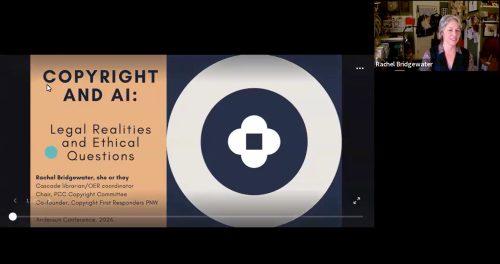 Al and Copyright: Legal Realities and Ethical Questions
- January 30, 2026
- Cascade Faculty Librarian Rachel Bridgewater examines the intersection of copyright law and generative AI.
 Higher (order) Education: The Role of Colleges in Teaching the Cyborg Student
- January 30, 2026
- As AI evolves into reasoning agents, higher education must reframe technology from an external threat to an extension of student cognition. While AI simplifies synthesis, it risks superficial "informational collages." Consequently, colleges must shift focus toward teaching epistemic hygiene, metacognition, source validation, and complex project design rather than policing tool usage.
 Did They or Didn’t They?: The RWC’s Perspective on Artificial Intelligence in an Age of Anxiety
- January 30, 2025
- Reading and Writing Center coordinators share strategies for navigating generative AI by prioritizing student agency, authentic voice, and metacognitive growth over surveillance.
- View more Presentations and recordings...