
In Residency: Writing Rituals, Old Emails, and the Luxury of Time
Posted by karah.kemmerly
by PCC instructor Charlotte Deason Robillard
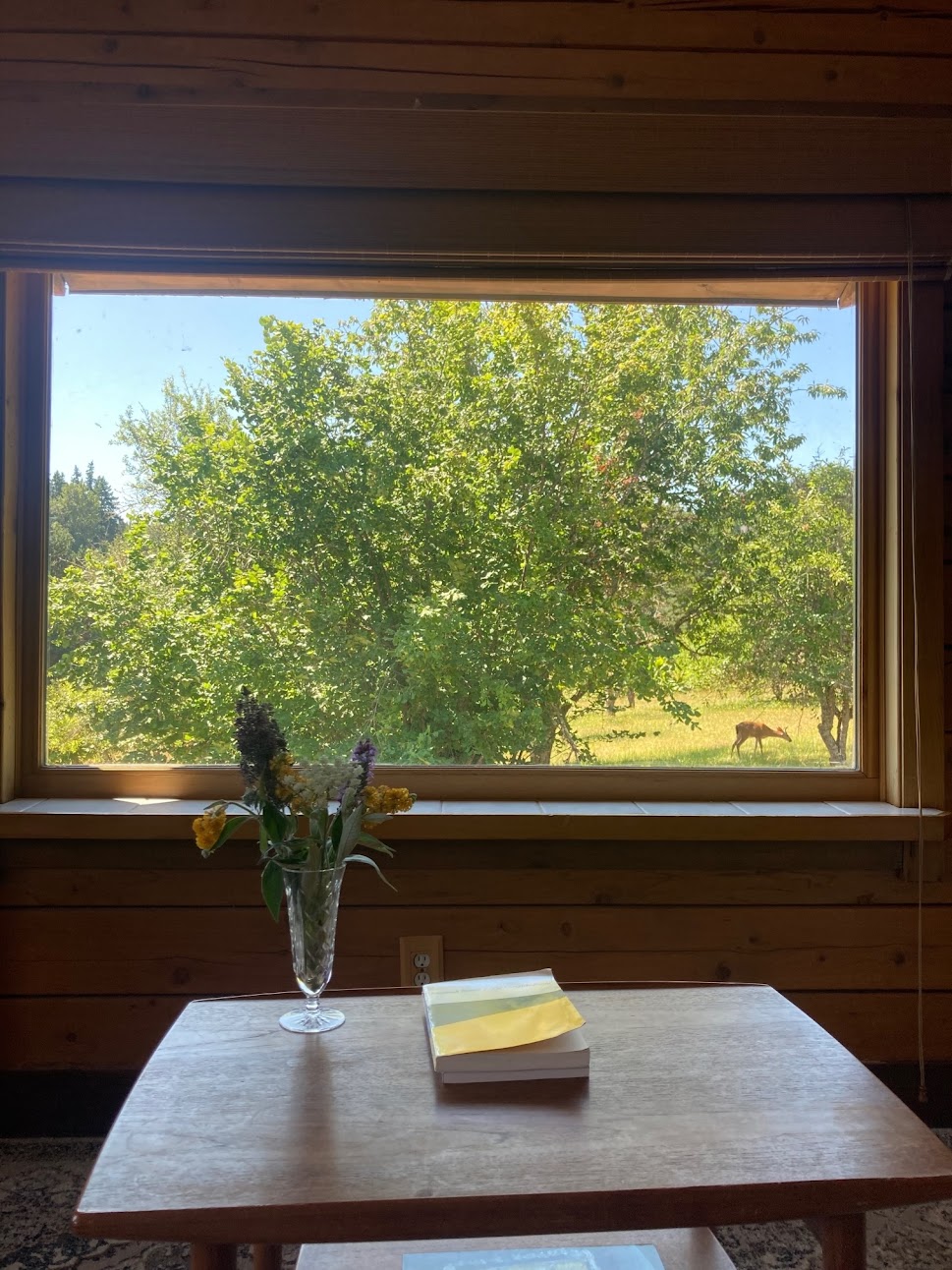
Each day this week, I’ve had my coffee and breakfast at a small mosaic table on an octagonal porch overlooking an orchard. As I eat my croissants and scrambled eggs, a squirrel gluts herself on an unripe apple in the tree across from me, and a juvenile deer is doing what can only be described as playing in the sunlit field to my left. He munches at the grass for a few seconds before leaping and bucking with joy and abandon. At 41, I have dutifully taken up bird watching like a prince on whom the kingdom was foisted, knowing his day would come eventually, and taking up the scepter with dignity when the time comes (the scepter, binoculars, in this scenario). I make notes in my journal of all the sensory details, unsure what, if anything, they will become.
This type of morning, without the city sound of garbage trucks or the neighbors’ dogs, without my cat begging for food, and with no looming to-do list, is only possible because I am in the middle of a brief writing residency. My days are luxuriously free and aesthetically inspiring. A few days in, I have found my rhythms and routines, and I get why writing residencies are a thing: the luxury of time, the novelty of location, the ever-so-slight pressure to produce something good.
Despite being a writing instructor, my own writing practice is relatively new to me. I attribute this mainly to the fact that until my late 30s, I was working so much that I didn’t really have time to write. I studied literature in graduate school, and the bulk of the writing I produced consisted of long academic essays and — I’ve come to realize recently — emails with my friends. When I decided two years ago to start working more seriously on my own writing, I did not have a specific goal in mind. I just knew I had ideas, and I finally had the time to write them down. Over the past two years, I have written fitfully and at random. Usually I just wake up one morning with an idea and work on it until I realize I am hungry and it’s 2pm. Though I’ve written poetry and toyed with fiction in the past, my strength is nonfiction. It’s no surprise that after teaching students to write essays for 13 years, I gravitate towards the genre myself. While the fitful and random writing process worked for a while, it is not conducive to consistency or habit, and as I’ve gradually set more goals for myself (publishing more, posting monthly to substack), I’ve had to consider what it means to have a writing practice, how to write even if the muse hasn’t paid her visit.
Much of my writing reflects on the past. My own past and those I shared it with. Lately, my research (if you can call it that) largely revolves around re-reading old emails, which serve as a time capsule for what I thought, how I wrote, and who I was friends with at any given time from 2004 to 2011 (at which point smartphones, texting, and social media overthrew the personal email empire). Looking through old emails has become the closest thing to a writing ritual that I have. In fact, during my residency, I’ve been working on an essay about email, an ode of sorts to the last bastion of long form written communication before the fragmentation and chaos of texting and social media took over for good, before writing an email became so burdensome that people were foaming at the mouth to give it over to ChatGPT, even if it meant accelerating the destruction of the planet.
And so, here is the closest thing I have to a writing ritual. From my perch overlooking the field with the deer and the birds and the squirrels, I open old emails: between me and my best friend, between me and my mother, between me and my old roommates (who, when we were travelling, or sometimes even when we were living together, wrote each other long narratives about everything from relationships to god to climate change to Kate Bush). As I read my old writing, I am equal parts embarrassed and proud, delighted and horrified, humored and saddened. But most of all, I am heartened at this reminder that I have always been writing. And with this reminder, I can get to work.
A ritual to remind you you were always a writer
Step 1: Open your oldest email account
Step 2: Search for an email that’s as old as possible with one of your earliest acquaintances.
Step 3: Open one at random. The more decontextualized, the better (look for cryptic subject lines like song lyrics or simply “mushrooms”).
Step 4: Read the exchange in one big gulp.
Step 5: Cringe at your naivete, your sincerity, your bad writing.
Step 6: Celebrate your naivete, your sincerity, your bad writing, and your good writing (it’s there too).
Step 7: Notice how and where you were developing a voice, a point of view, perhaps even a world view.
Step 8: Marvel at the time capsule that big tech has given you in exchange for your privacy, a glimpse at your past thoughts with a to-the-minute time stamp.
Step 9: Open a blank page (digital or paper) and start writing.