
Homepage
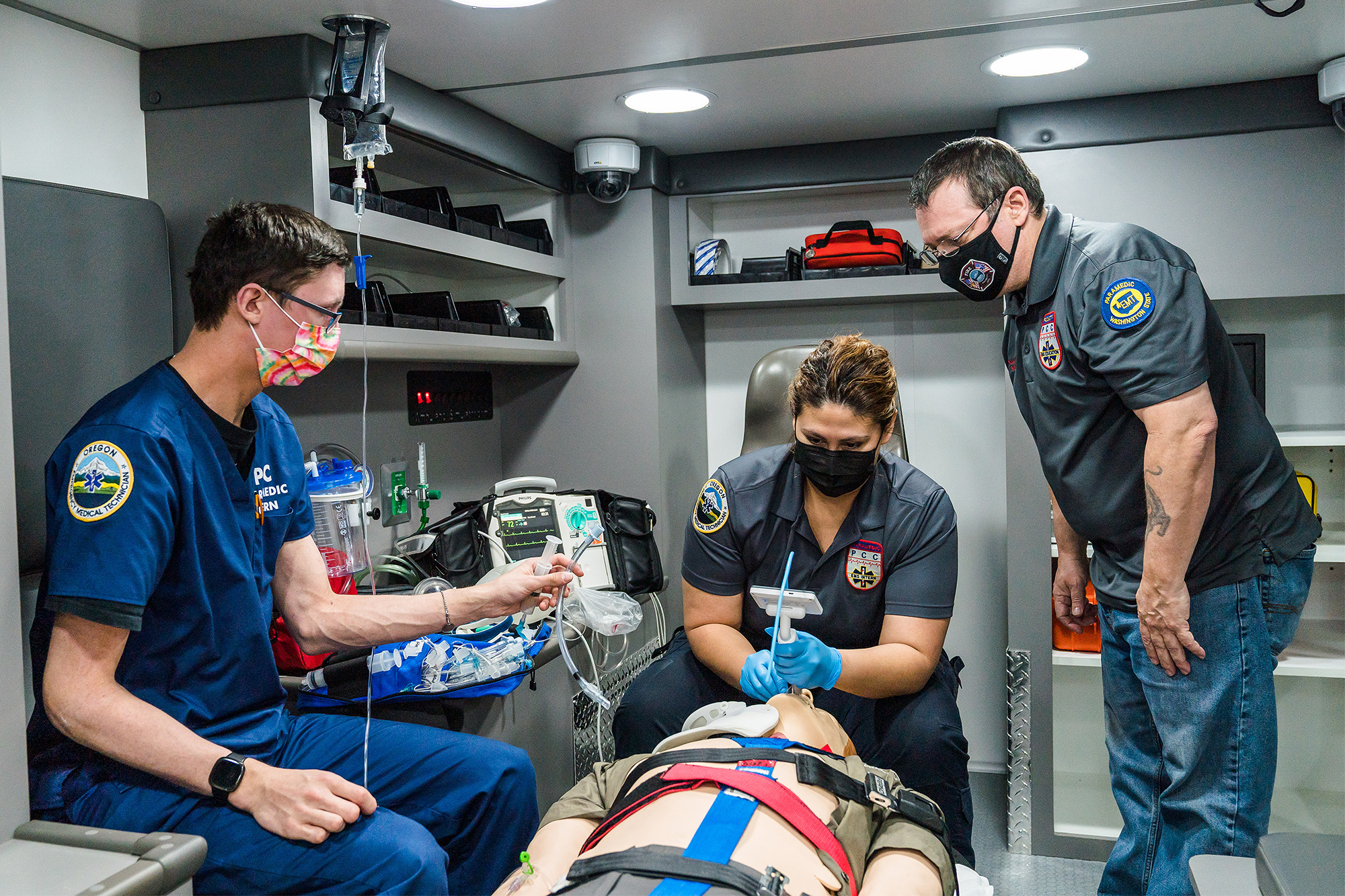
Emergency medical technicians (EMTs) and paramedics provide timely, effective care to critically ill and injured patients and transport them to appropriate medical facilities. They assess patients, deliver emergency treatment, and provide critical support during medical emergencies, accidents, and other urgent situations. Working alongside firefighters, law enforcement, and other health care professionals, they play an essential role in protecting community health and safety.
PCC’s emergency medical services (EMS) programs prepare students with the knowledge and hands-on skills needed to respond to emergencies and provide patient care in demanding situations. Whether you’re beginning your training as an EMT or pursuing paramedic education, you’ll build the skills needed to serve your community and make a difference when every second counts.
Why choose Emergency Medical Services (EMS) at PCC?
PCC’s Emergency Medical Services program is the largest in the state of Oregon. Our facility is also home to the Fire Protection Technology program. This multidisciplinary environment enhances the integration of all emergency services.
Accreditation
Portland Community College’s Emergency Medical Technician (EMT) courses and paramedic program are accredited by the Oregon Department of Education, Higher Education Coordinating Commission (ODE/HECC), and designated by the Oregon Emergency Medical Services and Trauma Systems Program to provide training at these levels.
The Portland Community College Paramedic program is accredited by the Commission on Accreditation of Allied Health Education Programs (CAAHEP) upon the recommendation of the Committee on Accreditation of Educational Programs for the Emergency Medical Services Professions (CoAEMSP).
- CAAHEP
355 – 113th St. N, #7709
Seminole, FL 33775 - CoAEMSP
8301 Lakeview Parkway, Suite 111-312
Rowlett, TX 75088
214-703-8445
To file a complaint with CAAHEP, see complaints regarding CAAHEP-accredited programs.
Paramedic program goal
To prepare paramedics who are competent in the cognitive (knowledge), psychomotor (skills), and affective (behavior) learning domains to enter the profession.
PCC, as a CAAHEP-accredited paramedic program, is required to track and report outcome measures annually to the Committee on Accreditation for the Emergency Medical Services Professions (CoAEMSP). The most current CoAEMSP Annual Report was for the calendar year 2025.
| Outcome | 2023 | 2024 | 2025 |
|---|---|---|---|
| NREMT cognitive exam 1st-time pass rate | 90% | 67% | 100% |
| NREMT cognitive exam pass rate within 3 attempts | 90% | 83.3% | 100% |
| NREMT practical exam pass rate | 100% | Not applicable | Not applicable |
| Program retention rate | 90.9% | 86.7% | 76.5% |
| Graduate positive job placement rate | 90% | 92.3% | 92.3% |
Award information
| Award | Length (attending full-time) | Financial aid eligible | Currently accepting students? |
|---|---|---|---|
| Associate Degree: Emergency Medical Technician – Paramedic | 2 years | Limited entry, see how to apply to Emergency Medical Services | |
| Associate Degree: Fire/Paramedic | 2 years | ||
| Certificate: Emergency Medical Services – Paramedic | 1 year | ||
| Career Pathway Certificate: Emergency Medical Technician | Less than 1 year |
Locations
 Cascade
What will you learn?
Class information
In PCC’s Emergency Medical Services (EMS) program, you’ll learn to assess, treat, and transport patients in emergencies. You’ll build skills in:
- Assessing adult and pediatric patients
- Managing airways and breathing
- Responding to cardiac arrest with CPR and automated external defibrillation
- Controlling bleeding, bandaging, and splinting
- Providing medical and trauma care
- Communicating clearly with patients, teammates, and dispatch, in person, by radio, and in writing
What will you do?
As an EMT or paramedic, you’ll provide immediate care to people who are ill or injured, often in high-pressure situations. You’ll rely on strong communication skills and sound judgment to make quick decisions and work with patients, teammates, and other responders. Your duties may include:
- Airway and ventilation management
- Automated external defibrillation
- Bandaging and splinting
- Bleeding control
- Cardiac arrest
- Childbirth
- CPR
- Extrication
- Lifting and moving patients
- Medical assessment and management
- Medication administration
- Patient assessment (pediatric and adult)
- Trauma assessment and management
EMTs and paramedics are employed by numerous agencies, both public and private, emergency and non-emergency. These may include:
- Ambulance companies
- Care centers
- Educational institutions
- Fire departments
- Hospitals
- Law enforcement
- Recreational facilities
- Search and rescue squads
- Transfer services and others
Positions range from volunteer services to part- and full-time employment.
Next steps
Applying to PCC is free and only takes a few minutes.Apply nowLimited entry awards have an additional application process. See each award page for all prerequisite requirements.
Not quite ready to apply?
We can help you get the info you need.