
Fire Academy
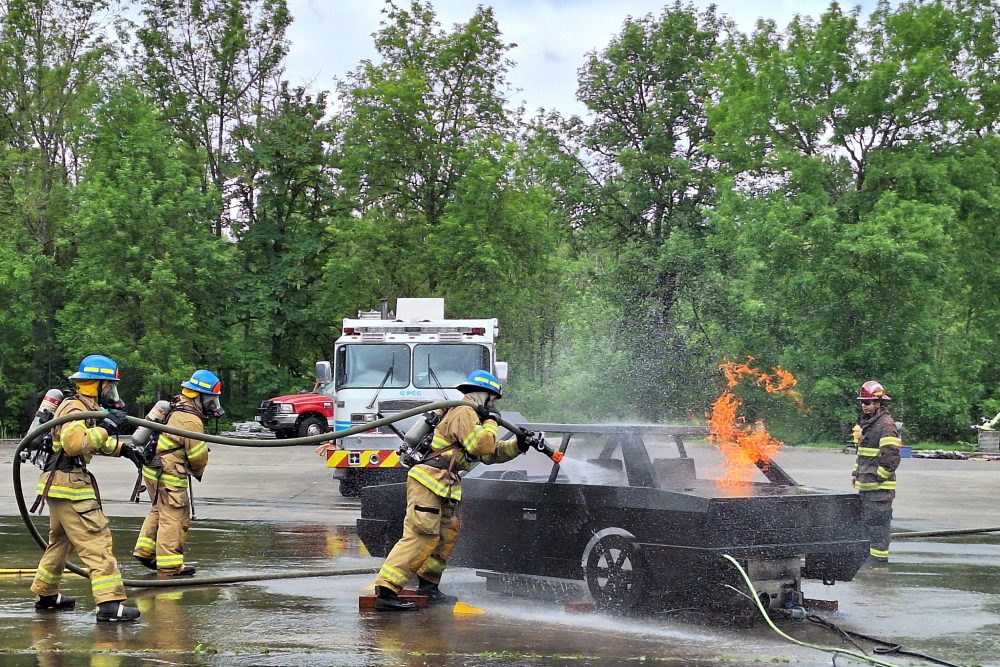
PCC’s Fire Academy prepares students for careers in the fire service through two hands-on courses: FP 111: Fire Academy Part 1 and FP 112: Fire Academy Part 2. Combining classroom instruction, skills training, physical conditioning, and live fire exercises, the academy helps students develop the knowledge, technical skills, professionalism, and teamwork needed to succeed as firefighters.
Throughout the academy, you’ll train alongside your classmates in realistic emergency response scenarios while learning the procedures, equipment, and techniques used by today’s fire service professionals. The curriculum follows nationally recognized standards established by the National Fire Protection Association (NFPA), providing a strong foundation for entry into the profession.
Students who successfully complete both courses are eligible to take the IFSAC Firefighter I and Firefighter II certification examinations. FP 111 and FP 112 are required courses in PCC’s Fire Protection Technology Career Pathway certificate, Fire Protection Technology AAS degree, and Fire/Paramedic AAS degree.
Program details
What will you do?
As a Fire Academy student, you’ll build the knowledge and technical skills used by firefighters every day, then apply them in realistic training scenarios using the tools, equipment, and procedures of the modern fire service. Working independently and as part of a team, you’ll:
- Operate firefighting tools, equipment, ladders, hoses, and self-contained breathing apparatus (SCBA)
- Perform fire suppression, search and rescue, ventilation, forcible entry, and salvage and overhaul operations
- Respond to structural fires and other emergency incidents following established fire ground procedures
- Practice firefighter safety, teamwork, and emergency communication in live fire training and drill ground exercises
- Meet the knowledge and skills outlined in the NFPA Fire Fighter I and II standards
- Prepare for entry-level employment in the fire service and continued training in fire and emergency medical services
Is the Fire Academy right for you?
You don’t need previous firefighting experience to get started – the academy is designed to teach foundational skills from the ground up. That said, it’s a physically and mentally demanding program that reflects the realities of the profession. During training, you’ll be expected to:
- Climb ladders and work at heights
- Wear PPE and SCBA throughout training exercises
- Perform physically demanding activities while carrying firefighting equipment
- Work in confined spaces and low-visibility environments
- Follow established safety procedures and instructor direction at all times
Because firefighters routinely work in these conditions, consider whether a fear of heights, claustrophobia, or exercise-induced asthma could affect your ability to safely participate in training. All students must also complete an OSHA-required respirator medical evaluation before using SCBA and other respiratory protection equipment; students who do not receive medical clearance cannot participate in required activities involving respiratory protection.
Students who have already completed EMS 105: Emergency Medical Technician (EMT) Part 1, EMS 106: EMT Part 2, and FP 123: Hazardous Materials Awareness and Operations often feel better prepared for the Fire Academy. The EMT courses build a foundation in patient assessment and emergency medical care, which matters because firefighters respond to medical emergencies as often as they respond to fires. FP 123 teaches you to analyze an incident, detect the presence of hazardous materials, use the DOT Emergency Response Guidebook, and initiate protective actions before you start live training. With these fundamentals behind you, you can focus your energy on the hands-on skills, physical conditioning, and live fire exercises that make up the academy.
If you have questions about the physical expectations of the Fire Academy or whether the program is a good fit for you, contact the Fire Protection Program team at fire-protection-certification-group@pcc.edu.
What classes will you take?
FP 111: Fire Academy – Part 1 (8 credits)
FP 111 introduces the fundamental knowledge and skills required of entry-level firefighters, covering:
- Fire department organization and operations
- Firefighter health and safety practices
- Personal protective equipment (PPE)
- Fire department communication systems
- Self-Contained Breathing Apparatus (SCBA) operation
- Basic firefighting techniques
- Knot tying and rope operations
- Equipment hoisting and handling
FP 111 enrollment requirements
Before enrolling in FP 111, students must meet with Fire Protection Academic Advisor Michelle Butler, complete IRW 90 or WR 90 and MTH 20, and attend the mandatory orientation day, where they will take the candidate physical ability assessment (CPAT), receive personal protective equipment (PPE), and complete general paperwork. Students who do not attend orientation will be dropped from the course.
*Please note these prerequisites are changing starting fall term 2027.
What to expect from the Fire Academy candidate physical ability test
Preparing for the CPAT? PCC’s Physical Education program offers a variety of classes to help you build the strength and endurance you need. You can also use drop-in fitness hours at every campus. If you need a CPAT prep workout or have questions about the test, contact Rebekah Spencer Sims at rebekah.sims@pcc.edu.
The example below gives you a general idea of what to expect on the Fire Academy physical ability test. The program may change the test as needed.
- Event 1: Military Press
- Equipment: Two 25 lb dumbbells
- Steps: Pick up one 25 lb dumbbell in each hand. While standing, complete 15 military presses without resting. Each repetition must be a complete motion. Half-completed repetitions are not counted.
- Event 2: Weighted Stair Climb
- Equipment: StepMill set to 60 steps per minute (level 6) and a 50lb vest
- Warm-up: You will have a 20-second warm-up at 50 steps per minute. You may hold the handrail to find your balance and cadence. If you dismount or fall off the StepMill during the warm-up, you will need to remount, and the warm-up will start over.
- Climb: When the warm-up ends, you will be told the test has begun. Climb for 3 minutes at 60 steps per minute. You may touch the wall or handrail only momentarily, for balance.
- Finish: The proctor will tell you when 10 seconds remain. At that point, grab the handrail and step down. You will be directed to a marked box where the extra shoulder weight will be removed.
- Event 3: Farmer’s Carry
- Equipment: Two 25 lb kettlebells, or equivalent tools (such as a chainsaw or extrication tools)
- Steps: Remove each weight or tool from the cabinet one at a time and place them on the ground. Pick up both and walk around the drum. The course is 75 feet out and back. When you return to the cabinet, place both on the ground, then return them to the cabinet one at a time. Follow the marked line throughout. Running is not permitted.
- Event 4: Hose Pull
- Equipment: 150 feet of dry hose, pulled straight
- Steps: Start inside the taped box. Grab the nozzle end of the hoseline and walk it to the marked line across from you. Walk the hoseline back to your starting position and assume a tripod position (on the ground with one knee down and one knee up). Pull the hoseline until all 150 feet is behind the starting line. You must stay in the tripod position the whole time you are pulling.
Running is not permitted while extending the hoseline.
- Event 5: Sledgehammer
- Equipment: 10 lb sledgehammer and a wooden spacer
- Steps: Strike the middle of the red circle with the sledgehammer until the buzzer sounds. You may position yourself however works best for you, but you must stay behind the wooden spacer. This event is not timed, and there is no minimum or maximum number of swings. When the buzzer sounds, place the sledgehammer on the ground and wait for further instructions.
FP 112: Fire Academy – Part 2 (8 credits)
FP 112 builds on the skills gained in FP 111 with a focus on advanced firefighting operations, including:
- Fireground operations and fire company evolutions
- Advanced firefighting techniques
- Live-fire training exercises
- Team-based emergency response operations
The Fire Academy is typically offered twice each year, during the fall and spring terms. Students must enroll in FP 111 and FP 112 concurrently during the same term. Class availability and schedules may vary, so be sure to check the current Fire Protection class schedule.
Express your interest in the Fire Academy
Interested in joining a future Fire Academy cohort? Complete the interest form below to connect with the Fire Protection program team. Submitting the form allows us to send you important updates about upcoming academy dates, enrollment requirements, orientation information, and next steps.