
Behavioral Health micro-credential
Contact us
Cendy Cruz, Program Specialist
If you would like more information about the program, please fill out the information form.
PCC’s Family and Human Services program is proud to offer a micro-credentialing series in Behavioral Health.
This micro-credential program is open to all students, with priority given to students majoring in and pursuing degrees or certificates in Family and Human Services and/or Addiction Counseling.
The micro-credential provides students with foundational tools to support mental health, deepen trauma-informed care, and elevate their understanding of behavioral health. These courses establish a solid base and knowledge for students to confidently pursue a Behavioral Health degree in Family and Human Services and/or Addiction Counseling.
Courses
The micro-credential includes six stand-alone courses that together bring an advanced set of skills in mental health and suicide first aid for both youth and adults
 The micro-credential can be completed in one academic year or less (three terms). Students will meet with an advisor to plan out their courses and help them stay on track, but overall, the classes do not need to be taken in any particular order.
All HUS courses are fully online, online + remote (via Zoom), or online + in-person. Depending on the class, they will only meet 1–3 times during the term, usually on Fridays and/or Saturdays (some classes meet throughout the week over the term). Students must ensure they will be available to attend these meeting days. PCC posts all classes well before registration begins.
- For example, MHFA classes only meet one time during the entire term via Zoom (Friday or Saturday); however, the one meeting day is a whole day of training and is required to receive MHFA certification and pass the course.
HUS 102: Mental Health First Aid: Adult
Provides key skills to help adults who are developing a mental health problem or experiencing a mental health crisis. Covers mental health literacy, including identifying, understanding, and responding to signs of mental illness. Required: Full attendance is mandatory to meet adult Mental Health First Aid certification requirements from the National Council on Behavioral Health.
You’ll learn
- How to recognize potential risk factors and warning signs for a range of mental health problems, including depression, anxiety and trauma, psychosis and psychotic disorders, substance use disorders, and self-injury.
- How to use a 5-step action plan to help individuals in crisis connect with appropriate professional help.
- To examine the prevalence of various mental health disorders in the United States and the need for reduced stigma.
- To apply knowledge of available professional, peer, social, and self-help resources in order to help someone with a mental health problem, treat and manage the problem, and achieve recovery.
- To assess personal views and feelings about mental health problems and disorders.
Who should take it
- Coworkers
- Caregivers
- Faculty
- Clergy
HUS 106: Mental Health First Aid: Youth
Provides key skills to help an adolescent (12-18 years) who is developing a mental health problem or experiencing a mental health crisis. Covers common mental health disorders and potential crises, such as helping a young person who is having a panic attack, is contemplating suicide, or is struggling with substance use disorders. Full attendance is mandatory to meet Youth Mental Health First Aid certification requirements from the National Council on Behavioral Health.
You’ll learn
- How to recognize potential risk factors and warning signs of a variety of mental health challenges common among adolescents, including depression, anxiety, psychosis, eating disorders, ADHD, disruptive behavioral disorders, and substance use disorders.
- How to use a 5-step action plan to help a young person in crisis connect with appropriate professional help.
- How to interpret the prevalence of various mental health disorders in youth within the U.S., and the need for reduced negative attitudes in their communities.
- How to apply knowledge of available professional, peer, social, and self-help resources in order to help someone with a mental health problem, treat and manage the problem, and achieve recovery.
- How to assess personal views and feelings about mental health problems and disorders.
Who should take it
- Students ages 18 and up
- Faculty
- Parents or caregivers
- Advisors and counselors
- Academic and career advisors
- Campus clergy
- Coaches and athletic personnel
- Administrators
HUS 108: ASIST: Applied Suicide Intervention Skills Training
Provides key skills to recognize, intervene, and assist those at risk for suicidal thinking and behavior. Includes identifying appropriate support strategies to keep an individual safe.
You’ll learn
- To understand how personal and societal attitudes affect views on suicide and interventions.
- To provide guidance and suicide first aid to a person at risk in ways that meet their individual safety needs.
- To identify the key elements of an effective suicide safety plan and the actions required to implement it.
- To appreciate the value of improving and integrating suicide prevention resources in the community at large.
- To recognize other important aspects of suicide prevention, including life promotion and self-care.
Who should take it
- Students ages 18 and up
- Faculty
- Parents or caregivers
- Advisors or counselors
- Academic and career advisors
- Campus clergy
- Coaches and athletic personnel
- Administrators
HUS 104: Trauma-Informed Care
Introduces the core principles of trauma-informed care. Explores the types of trauma and their effects on clients and human service professionals. Audit available.
You’ll learn to:
- Articulate a basic understanding of trauma-informed care.
- Articulate the principles of trauma-informed care.
EMS 100: Intro Emergency Medical Services
Covers the skills needed to perform CPR and operate an Automated External Defibrillator (AED). Includes citizen-level first aid for providing initial care to individuals who are injured or suddenly become ill when help is not immediately available. Prerequisites: (WR 115 and RD 115) or IRW 115 and MTH 20 or equivalent placement.
Electives
AD 123E: Smoke, Chew, Vape: Reduce Use
Presents an overview of nicotine addiction and specific evidence-based practices that have been demonstrated to contribute to successful nicotine cessation efforts. Audit available.
Upon completion of this course, students should be able to:
- Identify the impact of one’s value system toward nicotine use.
- Summarize key concepts in the treatment of tobacco and nicotine use.
- Articulate practices that foster connection with others who use nicotine.
- Provide referrals for nicotine reduction and cessation.
HUS 105: Intro to Crisis Intervention
Introduces a theoretical and practical approach to understanding crisis intervention. Addresses crisis intervention techniques and community resources. Audit available.
You’ll learn to:
- Articulate an understanding of crisis intervention strategies.
- Explain available community resources to support individuals in crisis.
Coming Winter 2027 HUS 211: 5 Needle Protocol Training: 5NP Technician Certification
Addresses needle use and safety, delivery of the 5NP intervention, the history and benefit of the protocol including certification, and registration as 5NP Technicians. The 5NP is a field-based intervention appropriate for both human service practitioners, addiction counselors, and allied health practitioners. 5NP technicians are specifically trained in the protocol and do not need to be a licensed acupuncturist, but rather certified as a 5NP technician and registered with the Oregon Medical Board.
Upon successful completion of this course, students will be able to:
- Practice accessible, safe, and ethical 5NP treatment, including universal precautions, supplies, and safety protocols.
- Demonstrate effective, trauma-informed, ethical, and responsive communication with clients.
- Articulate the history, theory, benefits, and principles behind the 5NP treatment.
- Prepare to register as a 5NP Technician with the Oregon Medical Board (OMB).
Who should apply?
The micro-credential is a great fit for anyone looking to expand their tools and knowledge in behavioral health and/or seeking to promote or work within the Family and Human Services (HUS) or Addiction Counseling (AD) fields.
This program is open to all students; however, applicants majoring in or seeking a degree or certificate in HUS and AD will have priority. If you already have a degree or certificate in these subject areas, or are working in these fields, your application will be prioritized as well.
The application for this program is a two-in-one application, meaning it is for both the scholarship and admittance.
- If you are not a current PCC student, please be sure to apply to PCC first.
- If you were a PCC student and have not taken a class in the last three terms, you may need to reapply. For assistance or questions on this, please contact Student Services Navigation.
The application for this program can be found towards the bottom of this page in the “how to apply” section.
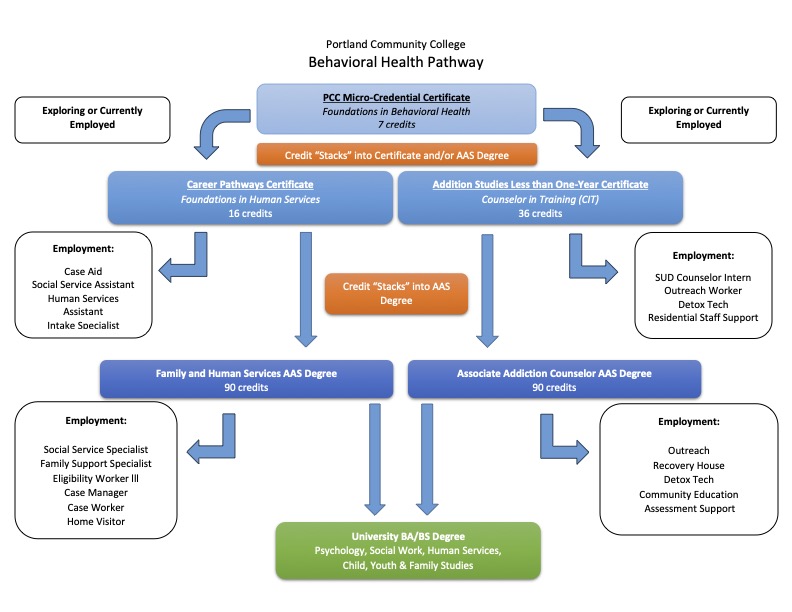
To see how the credits from the micro-credential will fit in your HUS or AD degrees or certificates, see the adjacent image on the right.
Text version of the graphic
- PCC micro-credential certificate: Foundations in Behavioral Health: 7 credits, credit “stacks” into certificate and/or AAS degree. Both are designed for students who are exploring or currently employed.
- Career Pathways certificate: Foundations in Human Services: 16 credits. Employment: case aide, social service assistant, human services assistant, and intake specialist. Credit “stacks” into AAS degree.
- Family and Human Services AAS degree: 90 credits. Employment: social service specialist, family support specialist, eligibility worker III, case manager, case worker, and home visitor.
- University BA or BS degree: Addiction studies, social work, human services, and child, youth, and family studies.
- Addiction Studies less than one-year certificate: Counselor in Training (CIT) – 36 credits. Employment: SUD Counselor Intern, Outreach Worker, Detox Tech, Residential Staff Support. Credit “stacks” into AAS degree.
- Associate Addiction Counselor AAS degree – 90 credits. Employment: outreach, recovery house, detox tech, community education, and assessment support.
- University BA or BS degree: Addiction studies, social work, human services, and child, youth, and family studies.
- Career Pathways certificate: Foundations in Human Services: 16 credits. Employment: case aide, social service assistant, human services assistant, and intake specialist. Credit “stacks” into AAS degree.
Scholarship
Thanks to the US Department of Education, this program is grant-funded and offers a scholarship for students to complete this micro-credential! The scholarship will cover all tuition and fees associated with this program, including textbooks, and PCC parking passes or a TriMet pass. Completing the micro-credential will be at no cost to you!
The scholarship will cover up to three consecutive terms from your starting term. For example, if you begin in spring term, the scholarship will cover spring, summer, and fall. If you complete the program sooner, that’s no problem!
Note: the scholarship will only pay for the classes that are part of this program, along with any textbooks or parking passes. The funds are not retroactive, which means they will not pay for any of the classes you have already taken. It will only cover the classes you will be taking after being awarded.
If you are receiving financial aid or other scholarships, that is no issue; however, we strongly encourage students to connect with the Financial Aid office before applying to this program or after admission. Financial aid can help you determine whether or not this program and scholarship will affect your financial aid in any way.
Requirements
Program and scholarship requirements:
- Must be a PCC student.
- If you are not a current PCC student or are no longer an active PCC student, you will need to apply to PCC first. Then, apply to the program.
The scholarship is open to all students, but priority is given to Family and Human Services and/or Addiction Counseling majors, or those completing a degree or certificate in these areas.
If you already have a degree or certificate in Family and Human Services (HUS) or Addiction Counseling (AD), or are working in these fields, your application will be prioritized.
The application for this program can be found towards the bottom of this page in the “how to apply” section.
Instructors
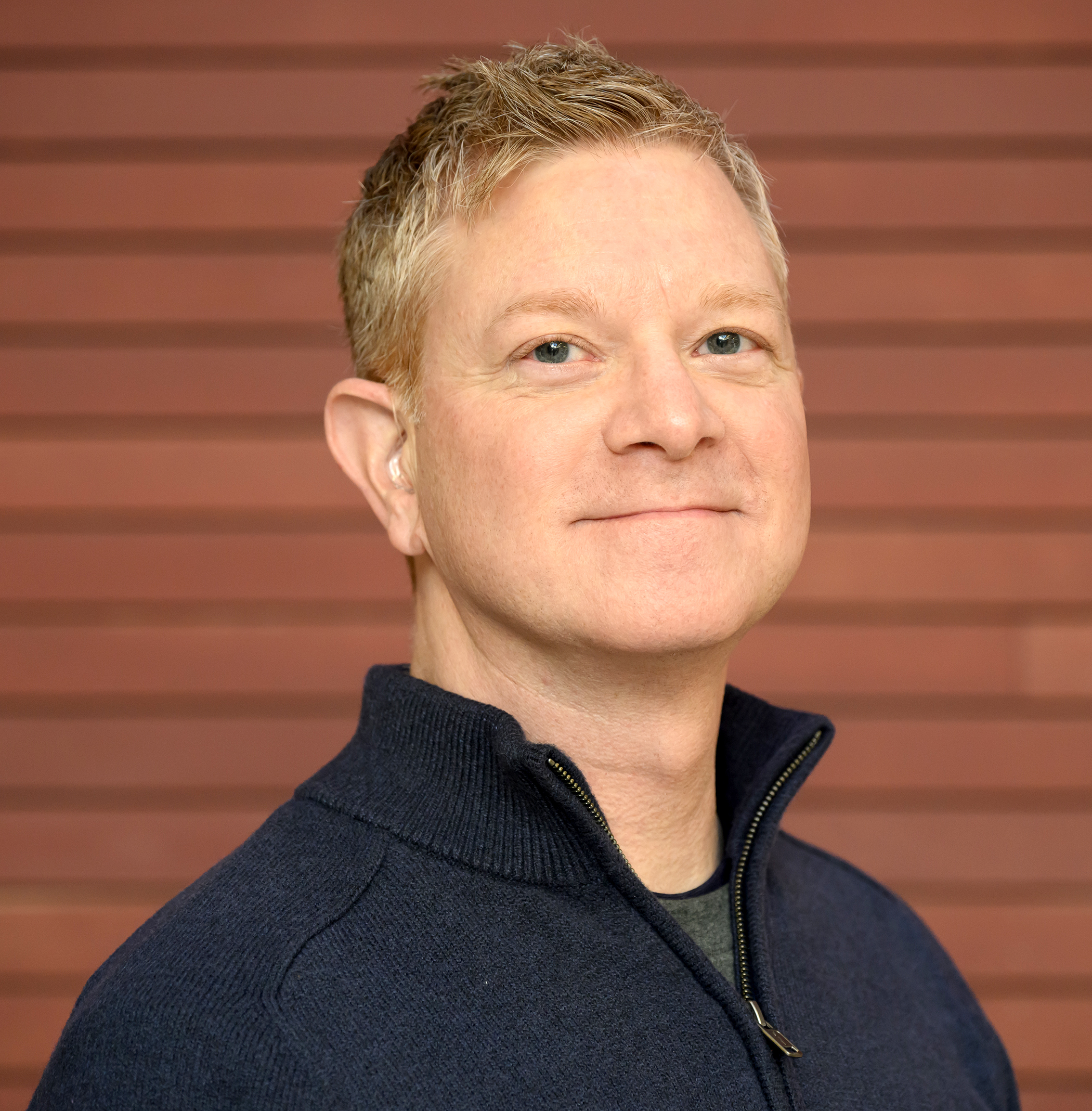
Andrew S. Garland-Forshee, PhD, HS-BCP, QMHP-C, RYT-500, CTSS
Dr. Andrew Garland-Forshee has over 25 years of experience in the fields of education, family services, and social and human services. These experiences range from at-risk youth programs, early education environments, parenting education, and early childhood laboratory settings. He currently serves as Department Chair of the Family & Human Services and Addiction Counseling programs.
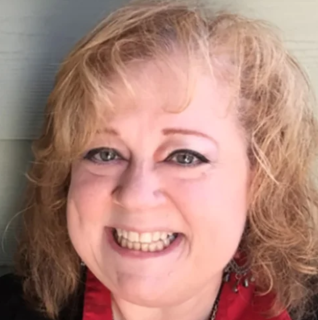
Sally Guyer, MSW, HS-BCP
Sally Guyer has 30 years of experience working with children, youth, and families in a variety of settings. Sally is also the clinical director for an adoption agency and provides training and consulting throughout the Pacific Northwest. Sally has spent her professional life dedicated to helping families and children, especially children with trauma backgrounds. Sally has recently been named as one of the top MHFA instructors in Oregon.
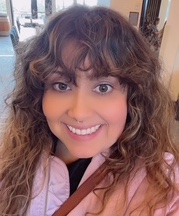
Martha Ochoa-Leyva, MA, LPC
Martha Ochoa-Leyva was born in Mexico and immigrated to Oregon as a child with her family. She is a descendant of the Nayhult people, and this is how she centers her work, using her ancestors’ wisdom to guide healing, knowledge, and community justice. Martha holds a Master’s in Clinical Mental Health Counseling from George Fox University and a Bachelor’s in Psychology with a minor in Legal Studies from Western Oregon University. She has worked in multiple support areas, ranging from tenant-landlord rights to teen and young parent home visiting, Head Start, LGBTQAI+ affirming care, school-based mental health, and K-12 professional development, and is a part-time faculty at PCC in the Family and Human Services Program.
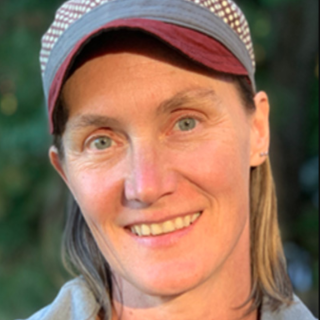
Jill Tuleya, MA, E-RYT, C-IAYT
Jill Tuleya has been with PCC since 2012 and teaches adult, youth, and higher education mental health first aid courses for Human and Family Services (HUS) and Community Education. Jill is also the MHFA coordinator for HUS.
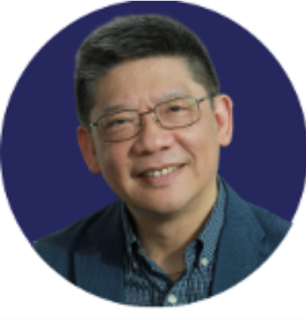
Sik Yin Chan, EdD, MSW, LCSW, CFSW
Sik Chan: With over 25 years as a social work administrator and practitioner, 17 years of teaching experience, and a strong research and evaluation background, integrating theories and research into practice has always been Dr. Chan’s passion. Currently, he is an adjunct instructor in the Family and Human Services program and a therapist with Real Life Counseling. Dr. Chan has experience working with adults of all ages and their families and is a bilingual and bicultural licensed clinical social worker.
Dr. Chan has a Doctor of Education from Concordia University. He received a Master of Social Work from Portland State University, a Graduate certificate in Gerontology, and a BA degree in Social Work from Concordia. He obtained a license to practice clinical social work in both Oregon and Washington states, and he is also a certified financial social worker.
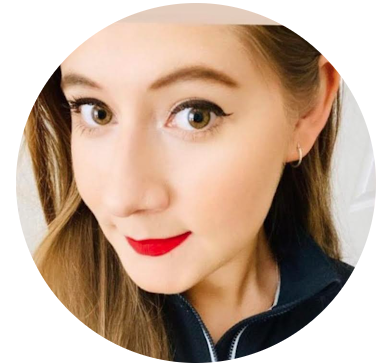
Cecilia Martinez, MEd
Cecilia Martinez: Hi! I’m Ceci from El Paso, Texas, a border city that’s deeply influenced how I connect with people. I’ve taught special education and worked with families and community groups to create more inclusive spaces. I’m also a bilingual mental health first aid instructor, which allows me to support both English- and Spanish-speaking communities in having open conversations about mental health. Outside of work, I love baking, sharing comfort through my recipes, and running, which helps me recharge, stay focused, and push myself toward new goals.
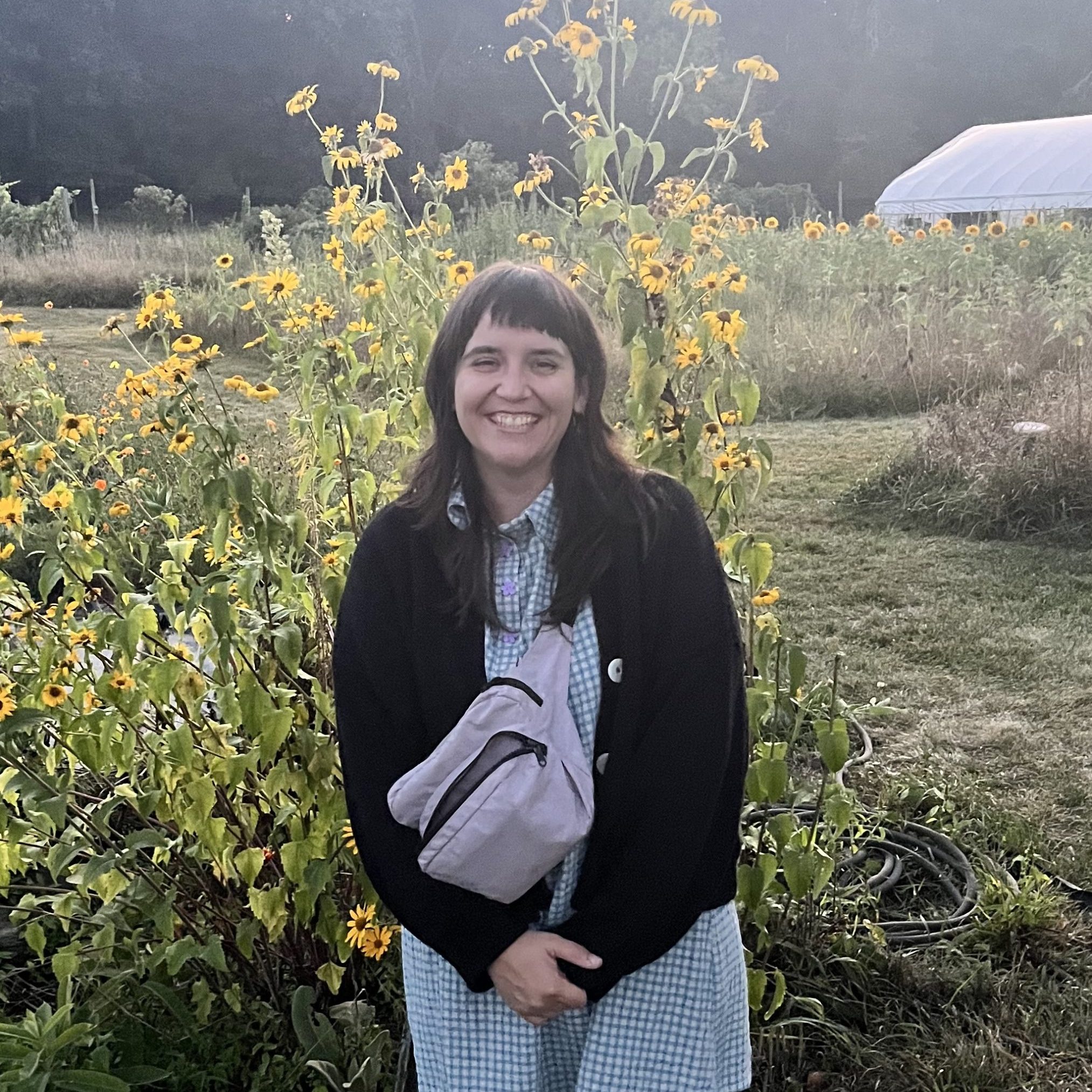
Shea Selby, MEd
Shea Selby is certified in mental health first aid (MHFA) for youth and adults in English and Spanish. Her professional history revolves around education, program development, and case management. She is a former public educator with a Master’s in Teaching and Curriculum. She currently works as the Early Childhood Education program navigator.
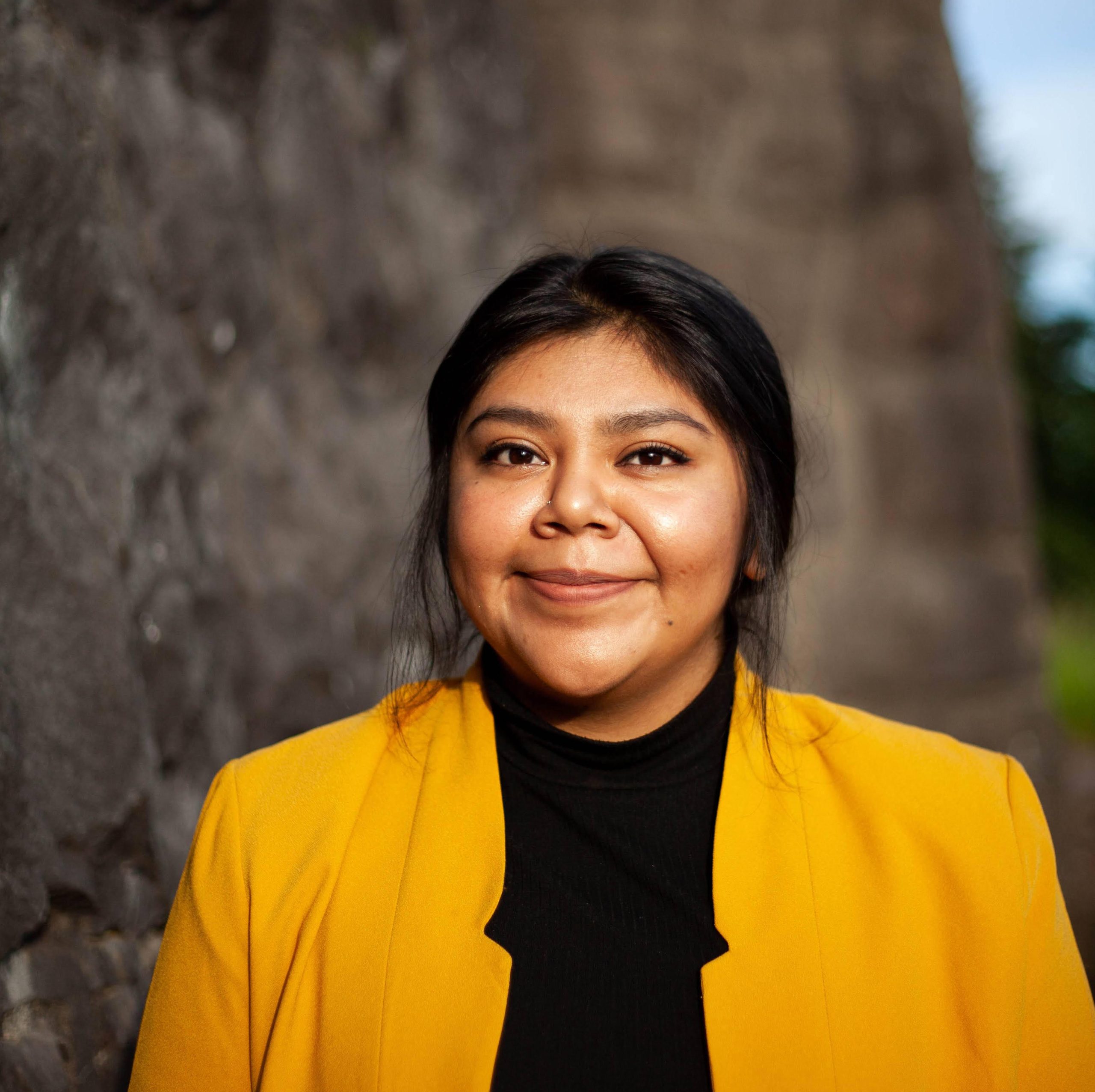
Cendy Cruz, BSW, CHW
Cendy Cruz is a newly certified mental health first aid (MHFA) instructor for both MHFA youth and adults. She is also certified to teach these courses in English and Spanish!
Cendy is a first-generation student with a Bachelor’s in Social Work from Portland State University. She was also recently certified as a traditional community health worker (CHW) this year. Her personal background fills her passion to serve her community, do the work, and to continuously seek any educational opportunities, professional development, and overall growth. A few fun facts: Cendy was born and raised in Oregon, enjoys the outdoors, family time, audiobooks, movies and TV shows, and absolutely adores her three-year-old dog named Zuri.
Already completed all courses?
If you have already completed all of the courses at PCC or in the community (through an organization or company), you can still receive the micro-credential certificate of completion!
Please fill out this application form and upload your certificates (usually given upon completing a course or renewal) and transcript. Our team will review your documents and send you your certificate of completion once approved, or they will follow up with you if we need additional information.
"*" indicates required fields
How to apply
The first step is for students to enroll at PCC and be admitted before applying for the micro-credential. Once admitted to PCC, please be sure to complete the online orientation and other tasks required to complete the enrollment process.
However, students may skip this step if:
- They are already admitted to PCC and are currently taking a course.
- Have been admitted within the last year and have taken a course in the last three terms.
Next steps
Applying to PCC is free and only takes a few minutes.Apply now
Apply to this program
Once you have applied to PCC, you can apply to this program by filling out the application form.