
One small step, one lifelong passion: How Apollo 11 launched Jim Todd’s career
Story By Hannah Ma, photos by Ric Getter and NASA.
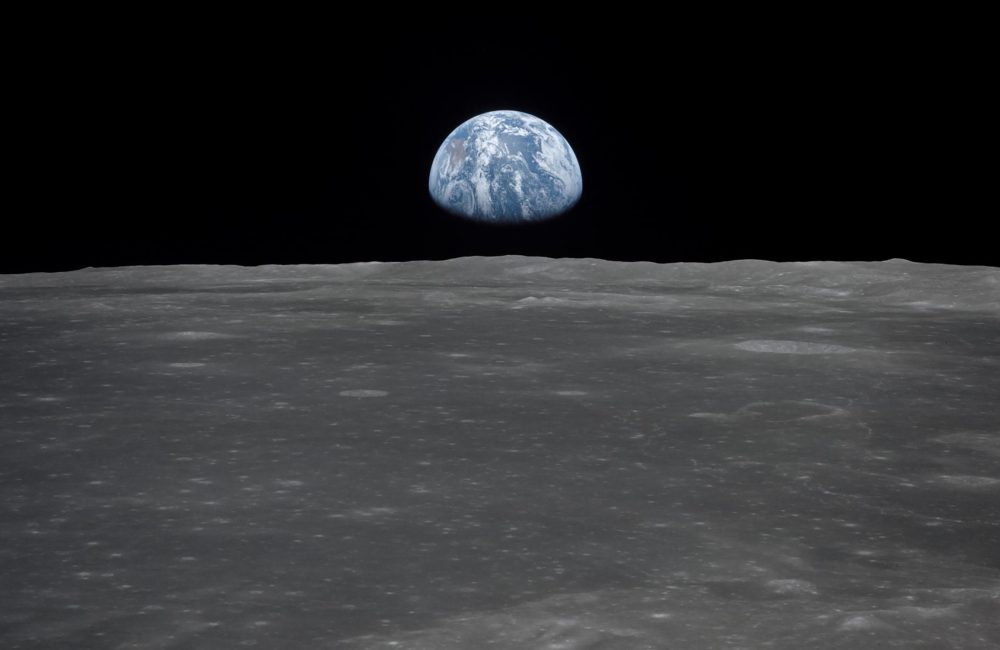
View from the Apollo 11 spacecraft shows Earth rising above the moon’s horizon in 1969. Courtesy of NASA.
On the first day of class, Portland Community College instructor Jim Todd asks his students: “What is your favorite astronomical memory?”
For Todd, who is also the director of Space Science Education at the Oregon Museum of Science and Industry (OMSI), a life-changing moment came when he discovered his lifelong passion in the night sky.
Todd was eight years old, living in Nebraska, when he witnessed the historic moon landing of 1969. NASA’s Apollo 11 mission was a global media event that froze audiences before their televisions. He remembers that moment as vividly as if it were yesterday.
“With Apollo, we had never done it before,” he recalled. “That’s why the world stopped, because we were watching the one, the only … accessed with the black-and-white TV. It was broadcasting from the moon, and that’s all we had.”
Seeing Apollo 11 astronaut Neil Armstrong take humanity’s first step on the lunar surface was the moment that sparked his love for astronomy. He even kept a poster of Apollo 8’s Earthrise photograph framed on his wall. It was a reminder of what President Kennedy once said: “We choose to go to the moon in this decade and do the other things, not because they are easy, but because they are hard…”
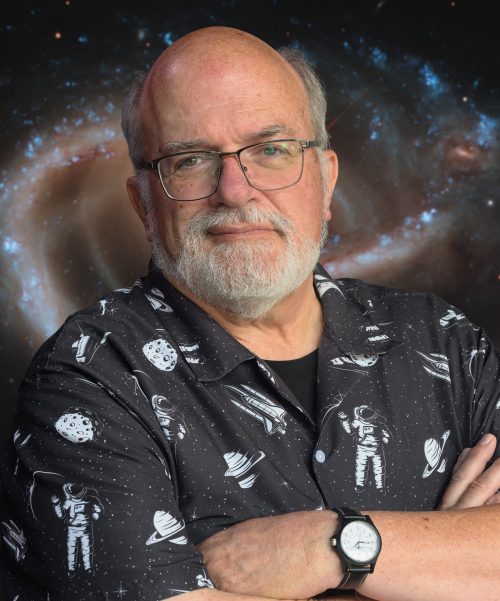
Jim Todd — OMSI’s director of space science education and PCC instructor.
Watching humanity make its first mark beyond Earth was a bright spot in his life, Todd said. It meant that anything was possible. That is the sentiment Todd continues to echo to the next generation of students inspired by the wonders of outer space.
In April 2026, Todd had the chance to witness a new chapter in space exploration with NASA’s recent Artemis II mission. For him, it was a marvel seeing humanity’s return to the moon, an echo of Apollo 11’s legacy that left an indelible mark on his generation.
“Artemis, to me, is that we’ve been able to go back to human exploration,” he explained. “It’s not so much space travel, but human exploration. To learn how to work in that environment.”
Todd shares that enthusiasm in his teaching. Space exploration is always at the heart of discussions in his classrooms, and this wonderment is shared by his students closely following Artemis II’s pioneering journey around the far side of the moon – the farthest humans have traveled into deep space.
Space missions like these remind him of what he loves most about astronomy.
“I enjoy sharing, talking about it, and getting excitement, sharing my passion to get people to understand what it means to us. It’s fascinating,'” said Todd, who currently teaches astronomy and “The Solar System” at PCC where he has been teaching space science since 2015. Outside of the classroom, he also serves as the President of the Rose City Astronomers.
He feels incredibly fortunate to have a hobby as a job, he added.
“I love teaching,” he said. “That’s because I’m sharing my knowledge and passion. But also I can see and hear students fascinated by it. I mean, yes, it’s for credits – but sometimes it’s more than that.”
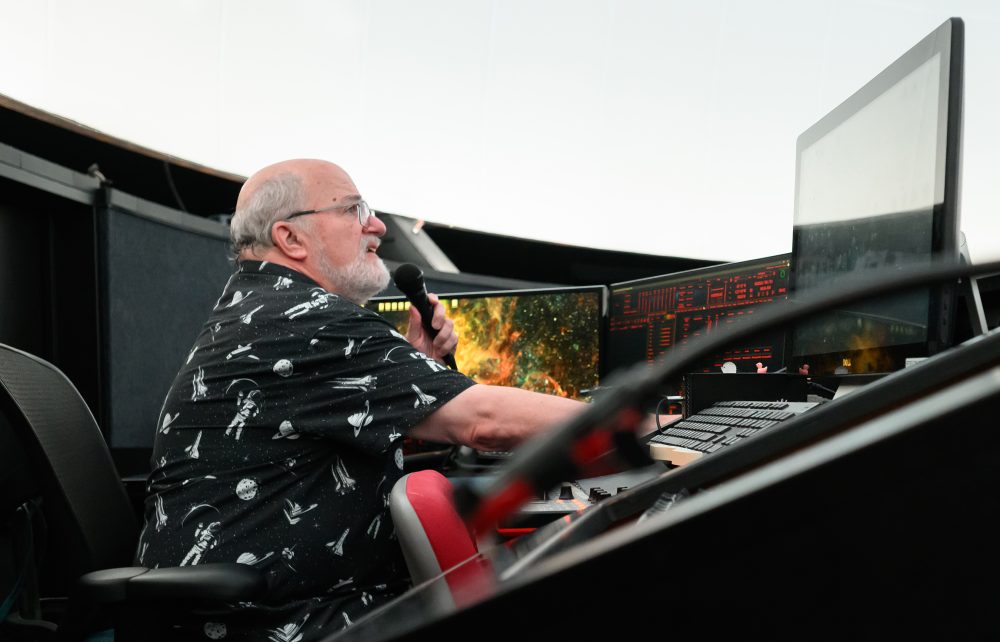
Jim Todd operates the planetarium’s imagery at OMSI.
While astronomy hasn’t been a major part of the Earth science curriculum, Todd views his role at PCC and OMSI as a resource.
“You hope to be an inspiration and resource. And to learn more about what’s happening out there,” he said. “We try our best to try to get people excited, and we’re fortunate to have a vehicle like the OMSI Planetarium or Star Parties to share that knowledge with the public. That should be our goal.”
With that mission at the heart of his teaching, Todd emphasizes why space science education matters to society.
“It was always a challenge to get into space. Going into space had brought us a tremendous amount of understanding about our environment, where we live, and our solar system and beyond. We get a better understanding about where we live and how things got started and where we’re going to be in the future.
“There’s still going to be many people questioning: why are we doing this?” he continued. “Why are we spending so much money on this venture? It’s in the name of science. And it’s also in the name of humanity. Humanity being able to survive in an environment like space. Someday we’re going to need it.”
An investment in space pays off. “For every dollar we put in space, we get three dollars back.”
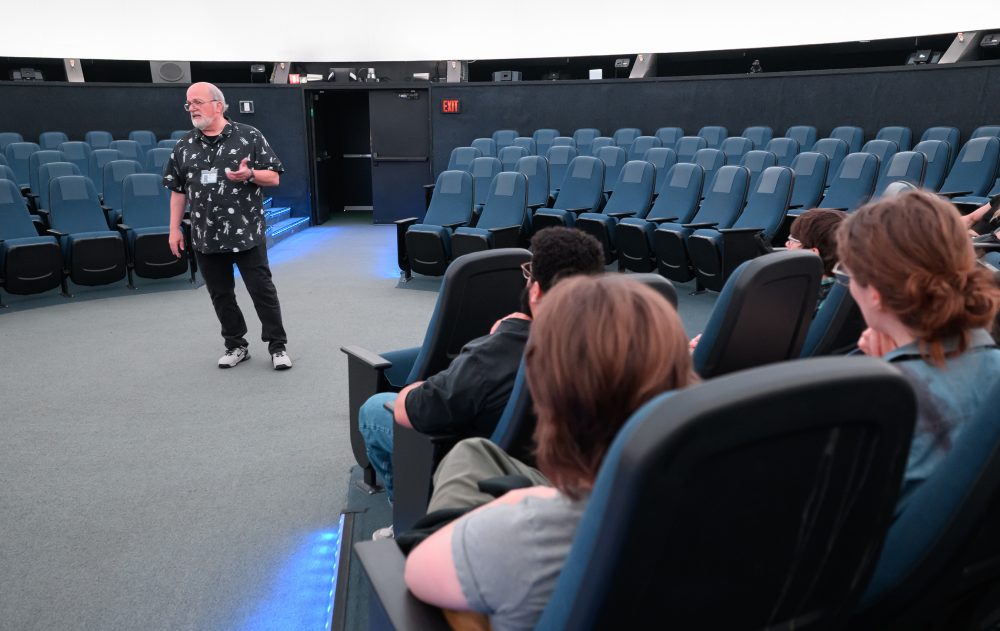
Todd teaches his general science, GS107, class at OMSI’s planetarium.
The generational influence is palpable among his students. For many, witnessing the Artemis II mission felt inevitably like the “Apollo 11” of their generation.
“It was exciting,” described Todd. “It was something away from the stuff that’s happening in our society right now. And it gives us some kind of a sense of hope. It’s that we have something to look forward to. We have something to achieve.”
That message resonates across generations. Space missions like Artemis II continue to be a bright spot in the lives of the millions of people watching them happen in real time. And they may even be the inspirational spark for another “Jimmy” to shoot for the moon.
He said, “There’s going to be another Jimmy like me who will see this and say, ‘I’m really fascinated with this. I want to go study this. I want to get a career in this.’”
After over 40 years of sharing his love for the cosmos, Todd’s message for those aspiring to pursue space science shines as bright as the stars: “Read up on anything you can get your hands on. Follow it. Ask questions. Take classes. Get involved in community events. Continue to work hard in math and science. And you’ll learn something from that.”
For more information visit pcc.edu/programs/physics or explore PCC’s Geology and General Science (GGS) Programs at pcc.edu/programs/geology.
 Hannah Ma is a Business student based in Portland, Oregon. She enjoys pursuing her curiosity about the world and expressing it through her writing. Hannah graduated from Portland Community College with an Associate of Science in Business degree in 2026 and is completing her Bachelor’s degree at Oregon State University.