
PCC spaces: Collegewide space utilization audit
 As part of the one-college model, Portland Community College is evaluating how space is used and managed to support student success, sustainability, and long-term growth. In partnership with Arcadis, PCC conducted a comprehensive space utilization audit to assess current use of classrooms, Career Technology Education (CTE) learning spaces, offices, and shared areas, identifying opportunities for improved space management across the college.
About the project
This project supports the college’s shift toward a more coordinated, collegewide strategy for managing classrooms, offices, and shared spaces. The goal is to help PCC operate more efficiently and better align space use with academic and operational priorities using a data-driven approach.
Read the full Space Utilization Audit Report
- Appendix 7.0: Table of Contents
- Appendix 7.1: Rock Creek Campus, Building 2 – Program Analysis
- Appendix 7.2: Scheduling Parameters
- Appendix 7.3: Facilities Plan Phase 1 Space Utilization Report Comparison
- Appendix 7.4: Campus and Building Plans Complete Book
- Appendix 7.5: Space Survey
- Appendix 7.6: Computational Analysis
Background
PCC is committed to better understanding space use across the college. To gather insights, the college has conducted three major audits – in 2017, 2022, and this most recent study in 2025 – as part of its ongoing comprehensive facilities planning.
These audits support PCC’s efforts to understand and adapt to evolving space needs, shaped in part by the rise of hybrid instruction, which now comprises 40% of all courses. Like many higher education institutions nationwide, PCC is seeing lower space utilization as a result of the COVID-19 pandemic and changes in learning and working patterns, including hybrid work and the growing use of virtual meetings, both on and off campus. The continuous growth of Career Technical Education (CTE) programs also underscores the need for flexible, responsive, and coordinated space planning.
Data collection and coordination
The PCC space utilization audit involved extensive data collection and coordination, incorporating CAD, Revit, and campus building plans, alongside Astra Schedule data for classes and events. However, leveraging scheduling data to understand utilization was challenging since not all space use is captured in Astra Schedule. By analyzing data from multiple sources and academic terms, the audit identified space utilization patterns that underscore the importance of transitioning scheduling and space management systems to the one-college model – a central recommendation of this report.
In addition to these methods, PCC implemented Occuspace, a technology that uses sensors to collect real-time occupancy data by detecting Bluetooth and WiFi signals. This technology provides valuable insights into space usage, helping to identify patterns in occupancy and informing adjustments to optimize space allocation and enhance user experiences. By integrating Occuspace data, PCC aims to make data-driven decisions for more effective space management across its campuses. The integration of Occuspace data supports smarter, data-informed decisions about space use across campuses.
Bookable Learning Space available at Rock Creek Building 2
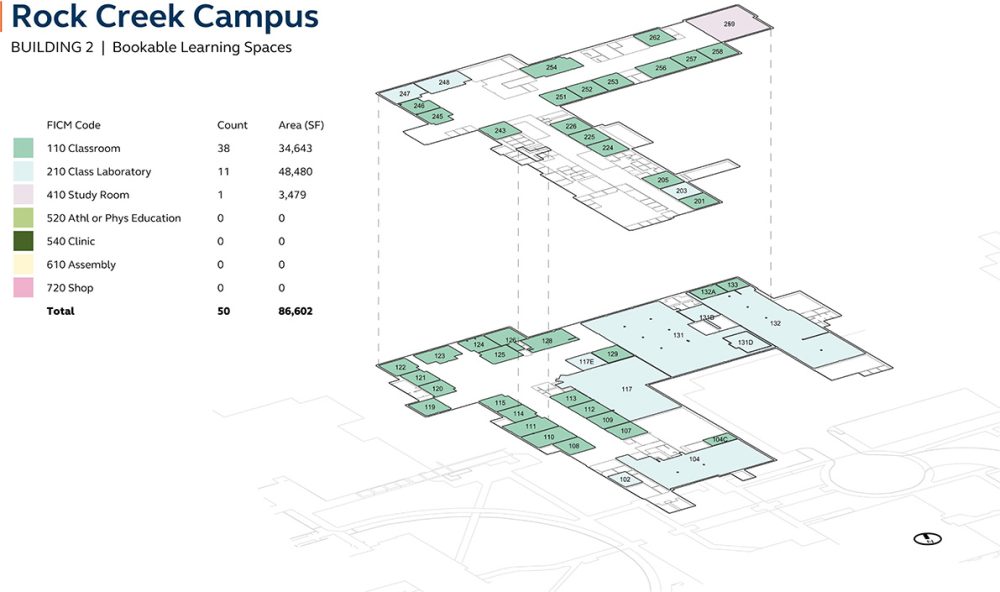
This diagram illustrates the bookable learning spaces identified in Rock Creek Campus Building 2, shown in color. Not all spaces in a building can host scheduled classes (e.g., hallways, restrooms, cafeterias); spaces not shown in color represent administrative, operational, or student support areas and are not considered bookable learning spaces.
Download the Bookable Space Diagram »
Findings
The analysis of space utilization data at PCC highlights challenges and opportunities for improvement across both classroom and office environments. The findings reveal that even during peak periods, classroom utilization reaches just 50% at the most active campus, with a lower average across the rest of the college.
Office space presents similar challenges. PCC currently has more than 330,000 square feet of office space, most of which is directly managed by individual departments or campuses. Without a centralized system, coordination of space is challenging, which limits the college’s ability to utilize the space in ways that best fulfill PCC’s mission of supporting student success.
Recommendations
Based on the audit’s findings, PCC is considering the following recommendations to guide future space planning efforts:
- Centralized scheduling: Improve coordination, streamline operations, reduce conflicts, and allow for more detailed data collection to inform space management.
- Integration of academic and facility planning: Leverage space management data to better align academic and facilities planning, ensuring space decisions support educational and strategic goals.
- Investment in space management infrastructure: Hire a Space Manager to oversee collegewide space use and ensure consistent management practices.
- Proactive space management: Adopt new space management strategies to optimize utilization and increase operational efficiency.
- Formation of a Space Committee: Establish a committee to develop policies, review requests, and support transparent decision-making.
Space management matrix
This matrix provides a comprehensive overview of existing challenges, recommended strategies, actionable steps, and anticipated benefits related to PCC’s space management practices. Organized into four key focus areas – scheduling, data collection, decision-making, and implementation – the matrix highlights opportunities to improve coordination, enhance data-driven planning, optimize utilization, and ensure more transparent, strategic use of collegewide space resources. Download the space management matrix »
| Focus area | Existing | Recommendations | Action items | Benefits |
|---|---|---|---|---|
| Scheduling |
|
|
|
|
| Data collection |
|
|
|
|
| Decision-making |
|
|
|
|
| Implementation |
|
|
|
|
In collaboration with campus stakeholders, the college will continue using data-driven decision-making to manage spaces that foster student success, faculty innovation, and institutional sustainability.