
Nursing, associate degree
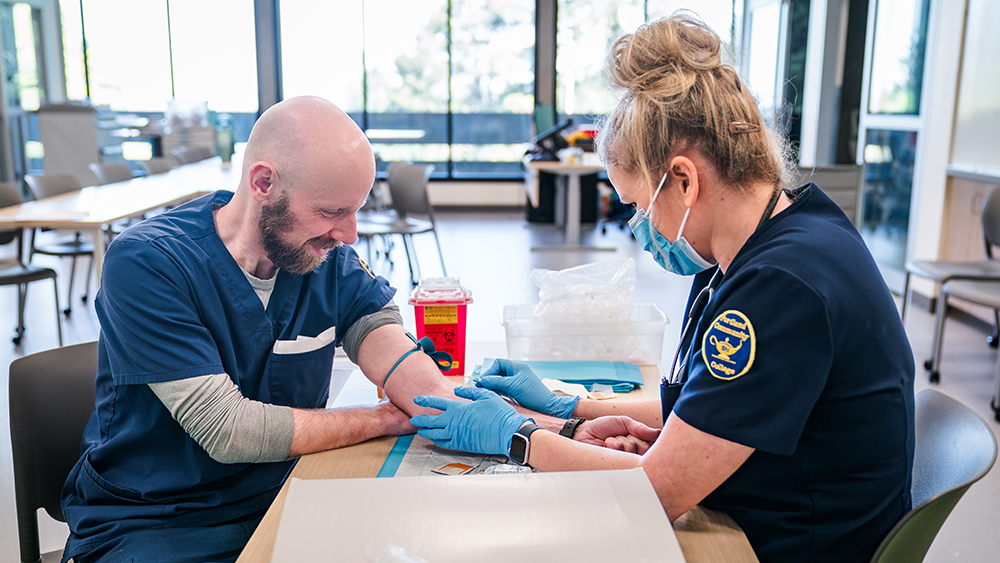
In PCC’s Nursing program, you will learn the knowledge and skills required for an entry-level nursing job. Our program is designed to prepare you to be licensed as a registered nurse (RN). RNs deliver nursing care in a variety of health care settings.
The Oregon Employment Department forecasts Portland area nursing employment will increase 20.5% through 2027.
Why choose Nursing at PCC?
Salary
The Oregon Employment Department reports Portland area registered nurses earn from $39.40 to $64.43 per hour. The average annual salary is $106,086.
Over 95% of Portland Community College nursing graduates passed the National Council Licensure Examination for Registered Nurses in each of the three most recent years. See our student achievement data for details.
Approval and accreditation
The PCC Nursing program is approved by the Oregon State Board of Nursing.
The associate degree nursing program at Portland Community College at the Sylvania Campus located in Portland, OR, is accredited by the:
Accreditation Commission for Education in Nursing (ACEN)
3390 Peachtree Road NE, Suite 1400 Atlanta, GA 30326
404-975-5000
The most recent accreditation decision made by the ACEN Board of Commissioners for the associate degree nursing program is Continuing Accreditation. View the public information disclosed by the ACEN regarding this program.
Award information
| Award | Length (attending full-time) | Financial aid eligible | Currently accepting students? |
|---|---|---|---|
| Associate Degree: Nursing | 2 years | Limited entry, see how to apply to Associate of Applied Science: Nursing |
Learn more about Nursing and all 2 awards available »
Locations
 Sylvania
What will you learn?
PCC’s nursing program is designed to develop a variety of medical, technical, and clinical judgment skills such as:
- Analysis
- Communication
- Counseling
- Evaluation
- Intervention
- Intravenous therapy
- Medication administration
- Physical assessments
- Planning
- Sterile techniques
- Supervision
- Teaching
Courses
Course listing for the 2025-2026 catalog year.
| Pre-Program Requirements | Credits | |
|---|---|---|
| BI 231 | Human Anatomy & Physiology I 1 | 4 |
| BI 232 | Human Anatomy & Physiology II 1 | 4 |
| BI 233 | Human Anatomy & Physiology III 1 | 4 |
| BI 234 | Microbiology 1 | 5 |
| FN 225 | Nutrition 1 | 4 |
| MTH 95 or MTH 98 |
Intermediate Algebra 1 or Math Literacy II |
4 |
| PSY 215 | Human Development 1 | 4 |
| WR 121 | Composition I (WR121=WR121Z) Z | 4 |
| WR 122 | Composition II (WR122=WR122Z) Z | 4 |
| General Education: 2 Social Science courses | 6 | |
| Any Lower Division Collegiate course | 2 | |
| First Term | ||
| NRS 110 | Foundations of Nursing- Health Promotion | 9 |
| NRS 232 | Pathophysiological Processes I | 3 |
| Second Term | ||
| NRS 111 | Foundations of Nursing in Chronic Illness I | 6 |
| NRS 230 | Clinical Pharmacology I | 3 |
| NRS 233 | Pathophysiological Processes II | 3 |
| Third Term | ||
| NRS 112 | Foundations of Nursing in Acute Care I | 6 |
| NRS 231 | Clinical Pharmacology II | 3 |
| General Education: 1 Arts and Letters course | 3 | |
| Fourth Term | ||
| NRS 221 | Chronic II | 9 |
| Fifth Term | ||
| NRS 222 | Acute Care II | 9 |
| Sixth Term | ||
| NRS 224 | Integrative Practicum I | 9 |
| Total Credits | 108 | |
- 1
These courses must be completed within seven years prior to application for the Nursing AAS program. Any MTH course for which MTH 95 or MTH 98 is a prerequisite will satisfy the MTH 95/MTH98 requirement.
- Z
This course is part of Oregon Common Course Numbering. The following courses are equivalent:
WR 121 and WR 121Z
WR 122 and WR 122Z
What will you do?
As a nurse, your responsibilities will vary depending on where you choose to work. Your exact job activities will vary from day to day, depending on the type and condition of the clients under your care. However, each day will call for careful observation, decision-making, and problem-solving. Providing nursing care is both challenging and rewarding.
Who will hire you?
There are hundreds of nursing employers in the Portland area:
- Birthing centers
- Clinics
- Community hospitals
- Emergency departments
- Extended care facilities
- Health departments
- Home health care agencies
- Intensive care units
- Medical centers
- Nursing homes
- Physicians’ offices
- Rehabilitation centers
- Schools
You will be able to work just about anywhere your imagination takes you. Nurses are found in cities, rural areas, overseas, in the armed forces, at home, in institutions, and in industry.
Next steps
See how to get into this program.Get started now
Not quite ready to apply?
We can help you get the information you need.