
Work-Based Learning Essentials
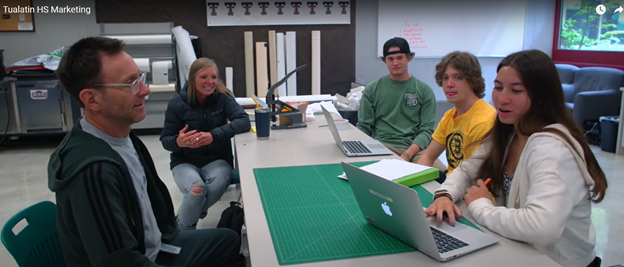
Tualatin HS Marketing students consulting with a client on t-shirt design.
Fulfilling Futures: Equipping Graduates with Skills and Purpose
Strong Work-Based Learning (WBL) systems prepare real-world ready graduates.
WBL in Oregon’s CTE Programs of Study
In 2024–25, CTE students engaged in the following types of WBL experiences:
- Clinical, Internship, or Practicum: 5875
- School-Based Enterprise: 7878
- Cooperative Work Experience: 13233
- Registered Youth/Pre-Apprenticeship: 116
- Service Learning: 6046
- Workplace Simulation: 24381
Defining high-quality WBL
WBL experiences must meet the following criteria:
- Align with CTE Program of Study curriculum and instruction
- Include sustained interaction with industry and business professionals
- Lead to earning of credit or outcome verification
- Offered in-person, virtually, or in a simulated workplace setting
High-quality WBL also embeds equity and continuous improvement.
What the Data Shows
The 2024-25 WBL data reflects the real work happening across classrooms and communities throughout Oregon.
- CTE Statewide WBL Participation: 54%
Compared to statewide enrollment, CTE programs showed:
- Strong WBL representation with Latino/a/x and non-binary gender learners
- Opportunity area in WBL with students with disabilities and Black/African American learners
Moving Forward
You play a critical role in creating the systems that allow students to graduate with real-world experience. We invite you to:
- Celebrate the work your programs are already doing to connect students to meaningful WBL!
- Deepen your understanding of Oregon’s WBL types and quality criteria.
- Reflect on which students currently have access to WBL opportunities in your programs.
Identify one way your school or district could strengthen or expand equitable access to high-quality WBL experiences – helping move Oregon toward the 2025–26 56.4% WBL target.
WBL Resources
- Check out the newly updated Work-Based Learning Handbook (revised 2025)
- Maximizing Industry Connections: How to Make the Ask presentation
- Example of Forest Grove Business POS’s WBL Curriculum Template
- Visit Advance CTE’s Career Clusters Framework Resource page for additional resources to communicate the Framework to learners and leaders
- One-pagers highlighting project ideas for CTE educators to use in classrooms and work-based learning settings to develop industry-specific skills, while also integrating interdisciplinary skills that occur across all career paths through the three Cross-Cutting Sectors (Digital Technology, Marketing & Sales, Management & Entrepreneurship):
- Advanced Manufacturing
- Agriculture
- Arts, Entertainment, & Design
- Supply Chain & Transportation
- Hospitality, Events, & Tourism
- Education
- Marketing & Sales
- Management & Entrepreneurship
- Energy & Natural Resources
- Healthcare & Human Services
- Digital Technology
- Construction
- Public Service & Safety
- Financial Services
What is Work-Based Learning?
Oregon Department of Education (ODE) defines Work-Based Learning as “Structured learning in the workplace or simulated environment that provides opportunities for sustained interactions with industry or community professionals that foster in-depth, firsthand experience of the expectations and application of knowledge and skills required in a given career field.”
Every CTE Program of Study should offer Work-Based Learning to students in the program. This opportunity should happen in an intermediate or advanced course and be offered to all students. ODE’s goal is for 25% of all CTE Concentrators (2 or more credits in the same POS and 1 intermediate/advanced class) to participate in at least one WBL experience by graduation. Every spring, data is shared with ODE on who participated in WBL that school year. Only WBL that meets all criteria and one of the approved types can be reported.
What are the approved Perkins V types of Work-Based Learning?
| Type | Definition | Considerations |
|---|---|---|
| Workplace Simulation
|
Hands-on and virtual learning opportunities that provide practical learning experiences to reinforce classroom instruction. | Opportunities are provided to participate in a variety of real-world worksite activities and engage with business and industry to assist in understanding what it’s like to work in the chosen career field. These experiences use a variety of technological tools and can take place in or out of school; they must align with labor market demand and have business and industry mentorship. |
| Service Learning | Structured, sustained learning experiences in organized community service projects that meet actual community needs | Experiences are linked to classroom learning outcomes and career-related knowledge and skills through a cycle of service and reflection. Students design service-learning projects collaboratively with community partners. |
| Cooperative Work Experience | A structured educational strategy that involves the placement or approval of placement of students by an educational provider in a structured work-based learning experience that is directly related to their classroom studies, coordinated by the educational provider, and leads to the earning of academic credit. | Each student should have theoretical knowledge and/or practical experience in a relevant major field of study prior to being placed in a cooperative work experience. |
| School-Based Enterprise Experience | Hands-on and virtual learning opportunities that provide practical learning experiences to reinforce classroom instruction. | School-Based Enterprise Experiences are an extension of the classroom to be managed and operated by students. School-Based Enterprise Experiences can take place in or out of school and must align with labor market demand and have business and industry mentorship. |
| Pre-Apprenticeship | An Oregon State Apprenticeship and Training Council (OSATC) approved program designed to prepare individuals from underrepresented or underserved backgrounds to enter and succeed in a Registered Apprenticeship program. | The program must have a documented partnership with at least one, if not more, registered apprenticeship committee(s) attesting that pre-apprenticeship completers will meet the minimum entry requirements, gain consideration, and are prepared for success in a registered apprenticeship program as a preferred applicant. Please refer to the Bureau of Labor and Industries (BOLI) Pre-Apprenticeship Application Toolkit if you are interested in starting a program. |
| Clinical/ Internship/Practicum | A structured work experience involving specific occupational skills and development goals that may or may not involve the awarding of academic credit. | There is an expectation that the student will demonstrate the skills necessary for entry-level employment and have the knowledge to make informed decisions about next steps in postsecondary choices, training, or employee advancement. |
What are the approved Perkins V criteria of Work-Based Learning?
All work-based learning experiences tied to a CTE Program of Study must include all of the following criteria:
- Align with CTE Program of Study curriculum and instruction
- Work-based learning experiences should align with industry-validated skills the students have been developing as a result of their CTE Program of Study instruction
- Include measurable student learning outcomes that are academic and/or technical and/or professional and aligned to Oregon Skill Sets. These will be used to assess the student periodically throughout the experience and allow the student to reflect on their own learning during the experience.
- Include sustained interaction with industry, business, or community professionals
- Sustained interaction is a prolonged or extended period – not a stand-alone or one-day event – that includes direct, ongoing interactions between the student and the industry, business, or community professional in the form of back-and-forth feedback on student progress and growth. It should foster in-depth, firsthand engagement with tasks in a given career field.
- Be offered in-person, virtually, or in a simulated workplace setting
- Work-based learning could take place in a classroom, virtual environment, or workplace. Providing access to a variety of experiences based on student choice will provide the greatest opportunity to meet each student’s needs. Programs should regularly review experiences to ensure that students benefit equally across all settings.
- Lead to earning of credit and/or outcome verification
- Work-based learning experiences may occur as a structured course within a pathway or be embedded within a CTE Program of Study that leads to academic credit. Each school and district will need to determine the awarding of credit and/or outcome verification for each of these scenarios.
- Evidence to support learner outcomes may include, but not be limited to, combinations including work portfolios highlighting completed work; academic, technical, and/or professional skills assessments; completed projects and assignments; employability skills records; or any other specific type of evidence that documents achievement of measurable student learning outcomes.
- Alignment: Aligned with a CTE Program of Study curriculum and instruction.
- Sustained: Sustained interaction with industry, business, or community professionals.
- Workplace setting: Experience takes place in a real, virtual, or simulated workplace setting.
- Credit/outcome: Earning of credit or outcome verification.
When do I record the Work-Based Learning my students have completed?
Collection occurs each year from mid-May through the end of June. Work-based learning should only be reported in the year that it occurred. Only work-based learning that meets all of the Perkins V criteria and types will be collected.
For assistance with Work-Based Learning, contact Katrina Stein, PACTEC Program Coordinator – Work-Based Learning & Advisory Committees.