
Note-taking methods
There are several note-taking methods, even more than outlined below. However, the most important components to effective note taking are:
- When you look back at your notes, can you read them? Do you understand what you wrote? If not, use a different method.
- At the end of each class, summarize what you learned. This improves the retention of the material.
- Review your notes: Do all the concepts make sense? If anything is unclear, go back to the lecture/class material and fill it in.
For further information, visit Chapter 7: Listening and Note Taking by Amy Baldwin (Modern Blueprint for College and Career Success).
For more examples of each method, visit Note-taking examples.
Charting Method
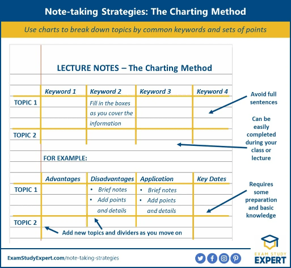
Image credit and source: Charting Notes Method Image Link1
What is it?
- If the lecture format is distinct (such as chronological), you may set up your paper by drawing columns and labeling appropriate headings in a table.
When to use
- If your test for the class focuses on both facts and relationships. Class content is heavy and presented fast.
Pros and Cons
- Pros: Helps you track conversation and dialogues where you may be confused and miss relevant content.
- Cons: Learning how to use the system and figuring out the appropriate categories.
Concept/Mind Map
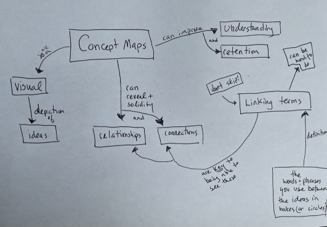
Image credit and source: Concept/Mind Map Notes Method Image Link2
What is it?
- Graphic and visual.
- Draw connections between concepts.
When to use
- Instructor moves freely with material.
Pros and Cons
- Pros: See relationships, cause and effect, etc.
- Cons: Messy, disorganized, may miss key information.
Cornell Notes
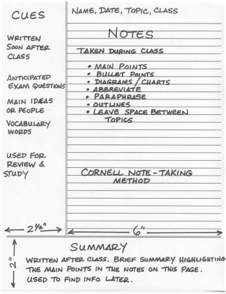
Image credit and source: Cornell Notes Method Image Link3
What is it?
- Format: a header, two columns (one smaller column on the left for cues and one larger column on the right for notes), and a footer to write a summary after.
- The left column is for cues or keywords. It consists of vocabulary words, main ideas/people, anticipated exam questions, etc.
When to use
- Any lecture situation.
Pros and Cons
- Pros: Organized, efficient, easy to review.
- Cons: Doesn’t always show relationships between ideas.
Flow Notes
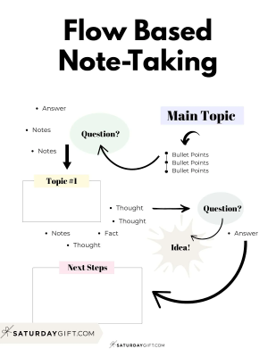
Image credit and source: Flow Notes Method Image Link4
What is it?
- Organize information spatially with arrows.
When to use
- The lecture is about review.
- Need to draw connections between ideas and concepts.
Pros and Cons
- Pros: More efficient with time since you learn and take notes simultaneously.
- Cons: Not being able to capture the session comprehensively.
Outline Method
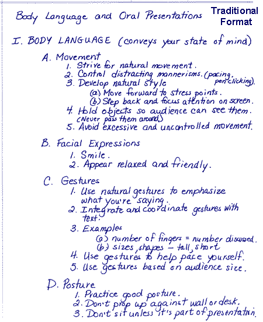
Image credit and source: Outline Method Image Link5
What is it?
- Key ideas are written to the left of the page, supporting ideas are then indented, and details of the supporting ideas can be indented further.
When to use
- The instructor is organized and the material is presented in a linear format.
Pros and Cons
- Pros: Prioritizes key material; easy to use; organized; helps review notes later on.
- Cons: Doesn’t always show relationships.
Q/E/C Method
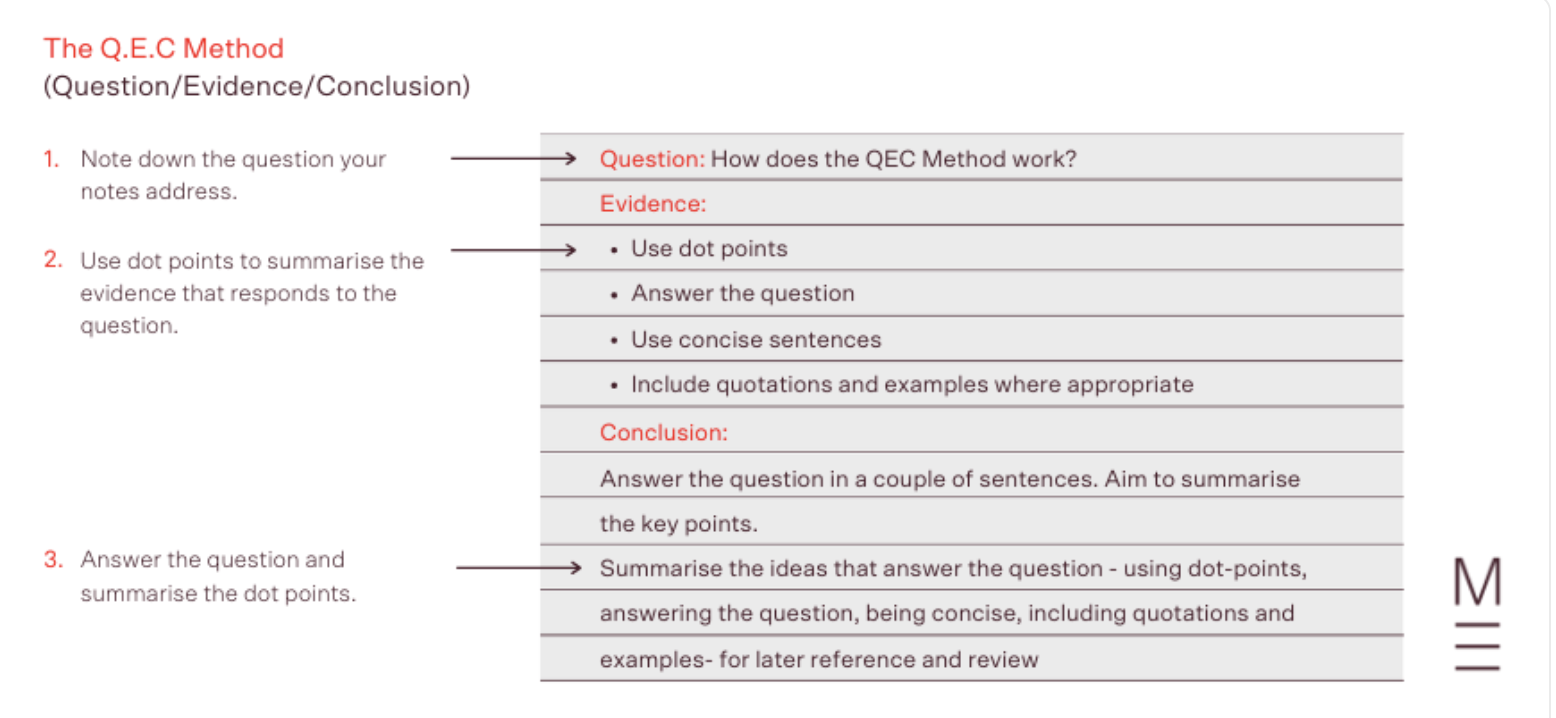
Image credit and source: QEC Notes Method Image Link6
What is it?
- Method that aids in critical analysis and connects ideas with their supporting arguments.
- Question = Begin each section with a question.
- Evidence = Information that follows is to support the Question.
- Conclusion = Functions as a summary/thesis statement in response to the Question.
When to use
- Subjects that are complex, and not technical like literature, history, and philosophy.
Pros and Cons
- Pros: Clear and concise summary of the most important aspects of every topic.
- Cons: If your class is more exam based, this may not be the best method.
Sentence Method
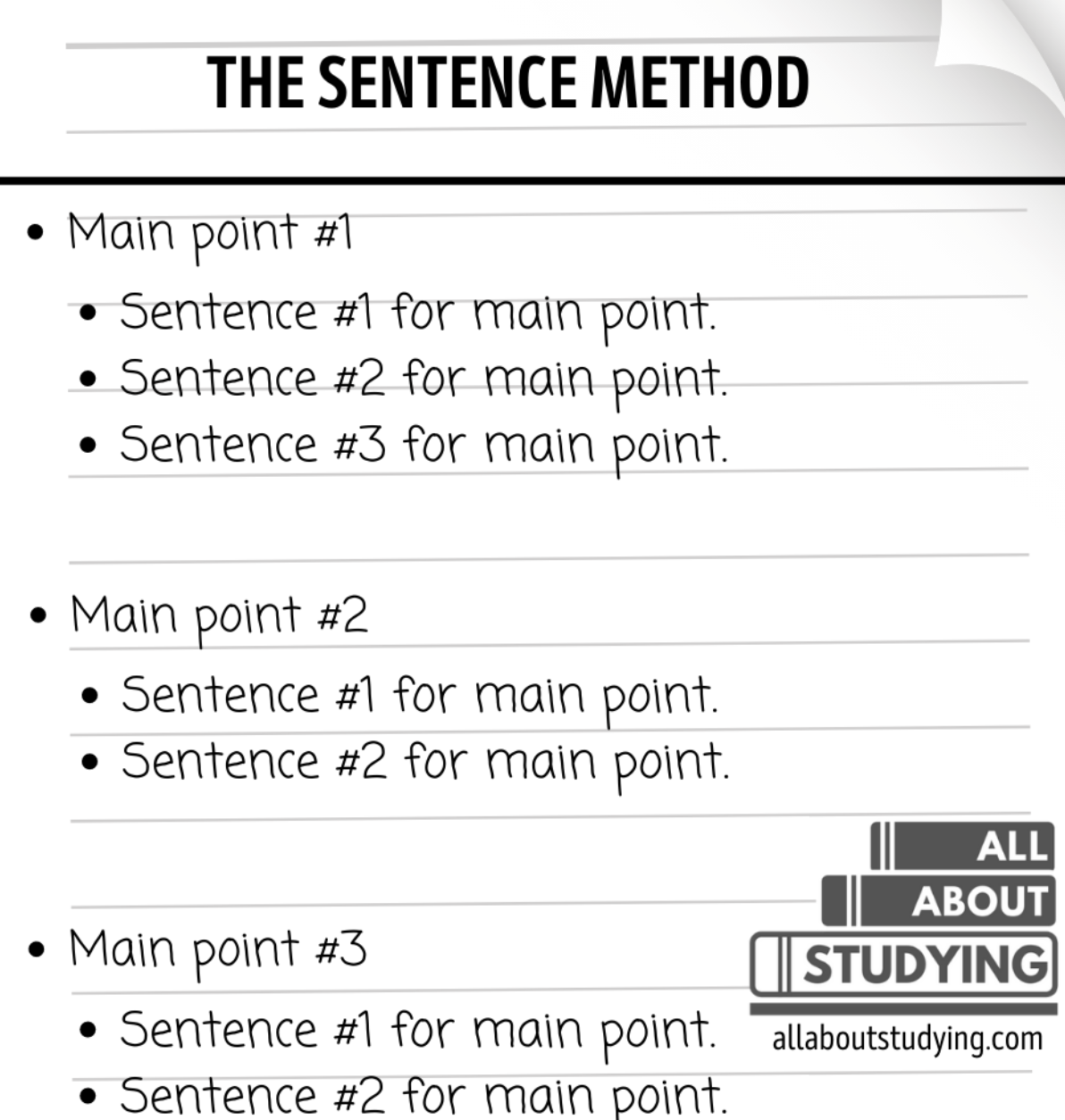
Image credit and source: Sentence Notes Method Image Link7
What is it?
- Write every new thought, fact or topic on a separate line.
When to use
- Use when the lecture is somewhat organized, but there is a lot of content and it moves quickly.
Pros and Cons
- Pros: Focuses on important information; Captures more or all of the information.
- Cons: This method isn’t as useful for classes with lots of graphs and equations. Difficult to determine major/minor points from the numbered sequence.
Split Page Method
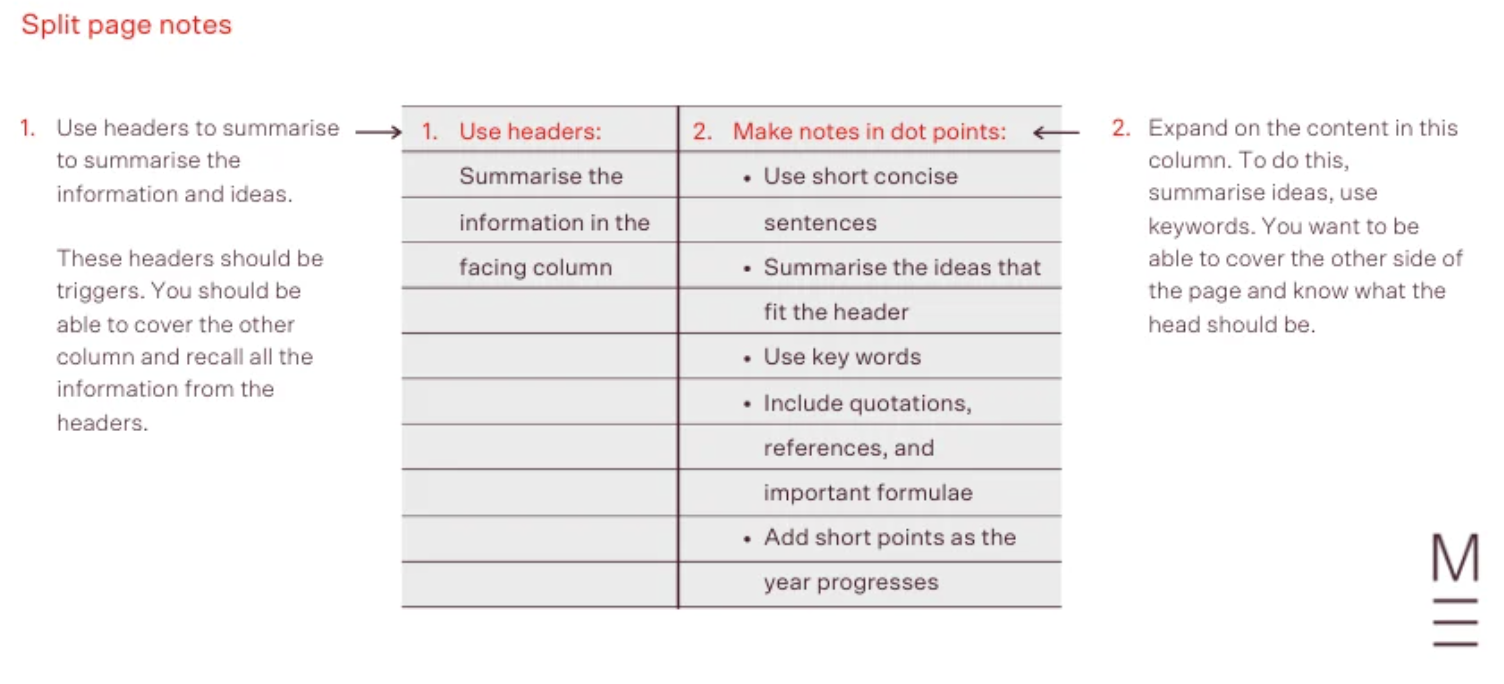
Image credit and source: Split Page Notes Method Image Link8
What is it?
- Page divided into 2 columns. Left column is for summarizing information added on the right side.
When to use
- Used for subjects that are broad and packed with detailed information.
Pros and Cons
- Pros: Format allows for studying fast, efficiently, and recalling the material. This is helpful for making study guides for your exams.
- Cons: Notes may not flow as easy due to its focus on summarization.
Need more support?
Online learning success coaches offer personalized support to help you clarify and achieve your goals, reflect on your habits, and overcome challenges.