
PCC’s Community to Careers grant turned $90K into $500K of aid, career prep and lasting impact
Story by James Hill, photos by Ric Getter.
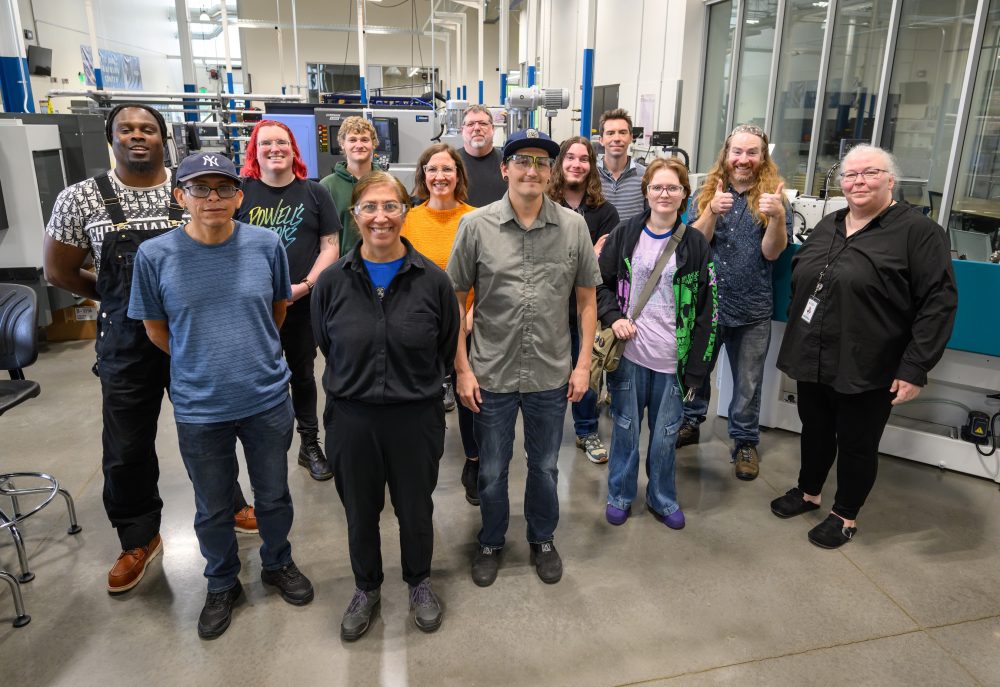
2025 CORE graduates at OMIC Training Center with Opportunity Center staff like Kali Giaritta (in yellow).
Portland Community College took modest support for career-technical education students and created an impressive return on investment.
The college turned a $90,000 scholarship goal into nearly half a million dollars in student aid, helping 321 people across the region prepare for careers in healthcare, technology and manufacturing. This caps a successful conclusion of the Community to Careers Workforce Ready Grant, a three-year, $2.2 million initiative funded by Oregon’s Higher Education Coordinating Commission. The PCC program through the college’s Opportunity Center expanded economic mobility by connecting underserved communities with training, financial assistance and career opportunities in healthcare, technology and manufacturing.
Community to Careers met or surpassed its established performance measures while building resources and partnerships that will continue beyond the grant period.
“The success of Community to Careers shows what is possible when education, employers and community organizations work together to remove barriers for students,” said Pam Hester, program dean for Community Workforce Development & Opportunity Centers. “Beyond the impressive number of scholarships, graduates and employer interviews, this initiative has created lasting pathways that will continue connecting people from underserved communities with training and family-wage careers in healthcare, technology and manufacturing.”
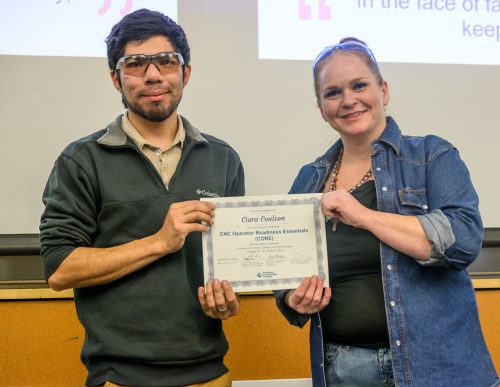
Ciara Coulson graduated from the first CORE program in 2024.
A major milestone for the initiative was the launch of the CNC Operator Readiness Essentials, or CORE, microcredential. The intensive, 60-hour program prepares participants for entry-level careers in computer numerical control (CNC) machining and advanced manufacturing. CORE achieved a 96% completion rate and graduated 98 students, most of whom continued pursuing careers in CNC machine manufacturing, providing needed skilled workers to industries that sorely need them.
The program worked with 19 employers to hold 10 interview events and facilitate 276 interviews for CORE graduates. At least 39 participants secured new employment, 13 maintained their existing employment and 19 enrolled in college. Some students pursued both employment and education, while others continued looking for work when post-program surveys were conducted.
Community to Careers also significantly expanded financial assistance for students. The initiative awarded nearly $500,000 in scholarships, which is more than five times its original $90,000 goal, to 321 students pursuing careers in healthcare, manufacturing or technology. These scholarships helped students address essential educational expenses that might otherwise have prevented them from beginning or completing their studies.
Education and career workshops formed another important part of the initiative. Through 92 workshops, Community to Careers served 532 students with workshops that included topics like computer basics, career exploration and guidance and practical AI tools in manufacturing. The sessions helped participants strengthen foundational skills, explore career possibilities and better understand the training required to enter high-demand fields.
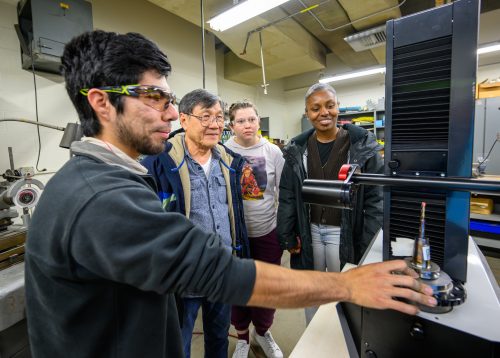
Pablo Jimenez, Machine Manufacturing Technology instructor, shows the inaugural 2024 CORE class his shop’s equipment and tools.
Community to Careers training and education staff also served as liaisons to 19 community-based organizations across Washington, Multnomah and Columbia counties. Partners included Central City Concern, HomePlate Youth Services, Community Action Team, Native American Youth and Family Center and Adelante Mujeres.
The liaisons introduced community organizations, their staff and participants to training and educational opportunities through information sessions, customized events, community fairs and four professional-development programs for partner organizations. Approximately 480 community members referred by community-based organizations accessed college and career preparation services during the grant period.
According to Program Manager Kali Giaritta, the initiative’s success reflects both its measurable outcomes and the relationships developed among students, employers and community partners.
“In under two years, students have graduated from CORE with the confidence and skill set to thrive as CNC operators,” Giaritta said. “Whether they launched right into new careers or continued their education at PCC, every single student proved something powerful: they are capable of learning new skills and conquering big challenges.”
To learn more on the CORE program, visit pcc.edu/opportunity-center/jobs/cnc-operator/
About James Hill

James G. Hill, an award-winning journalist and public relations writer, is the Director of Public Relations at Portland Community College. A graduate of Portland State University, James has worked as a section editor for the Newberg Graphic... more »