
PCC Economic Impact Study shows $2.7 Billion contribution to regional economy
Story by James Hill

PCC training supports 25,097 jobs across the college’s primary economic impact region, equal to one out of every 58 jobs.
Portland Community College continues to serve as one of Oregon’s most powerful economic engines, contributing $2.7 billion in added income to the regional economy each year, according to a new Lightcast Economic Impact Study reflecting fiscal year 2023-24.
The study highlights PCC’s far-reaching impact on workforce development, student mobility and community prosperity. PCC activities and its students support 25,097 jobs across the college’s primary economic impact region, equal to one out of every 58 jobs. The largest share comes from PCC alumni, whose increased earnings and contributions to the businesses that employ them generate $2.2 billion in added income.
“Portland Community College’s economic impact is measured not only in dollars, but in opportunity,” said Acting PCC President Dr. Katy Ho. “Every student who gains a credential, every graduate who enters a high-demand field and every employer who hires PCC talent strengthens the economic future of our region.”
PCC’s annual operations spending adds $396 million to the economy and supports 3,046 jobs. Student spending contributes $82.5 million and supports 1,137 jobs, while construction spending generates $24.8 million and supports 191 jobs. In FY 2023-24, PCC served 35,213 credit students and 18,339 non-credit students and employed 2,575 people.
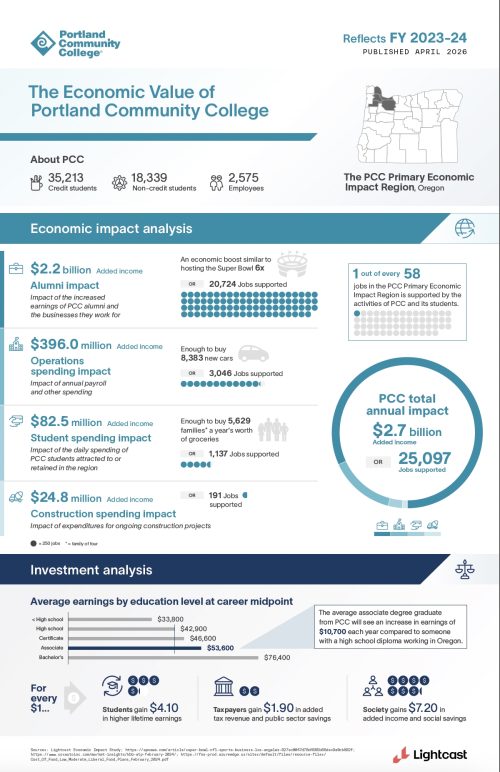 The report also underscores the long-term financial value of education. At career midpoint, an associate degree graduate in Oregon earns an average of $53,600 annually, compared with $42,900 for someone with a high school diploma — a difference of $10,700 per year. For every dollar invested, PCC students gain $4.10 in higher lifetime earnings, taxpayers gain $1.90 in added tax revenue and public sector savings, and society gains $7.20 in added income and social savings.
That impact is visible across PCC’s students, graduates and programs.
Stephen Zeller’s return to PCC is preparing him to meet a critical local workforce need in healthcare. A pre-nursing student with a 4.0 GPA and oncology experience at Oregon Health & Science University, Zeller plans to become a registered nurse, bringing resilience, recovery advocacy and lived experience to a field vital to patient care, community health and the Portland-area economy.
“PCC has given me purpose,” he said. “It has given me direction. And it is helping me build a life I once believed was impossible. What I found at PCC was my own value.”
PCC also secured nearly $1 million through the Healthy Oregon Workforce Training Opportunity Grant Program to strengthen Oregon’s emergency medical workforce. By covering tuition, fees and support services for Emergency Medical Technician students, the program reduces barriers to training, connects students with ambulance employers and helps communities fill critical emergency response roles that support workforce stability and regional economic resilience.
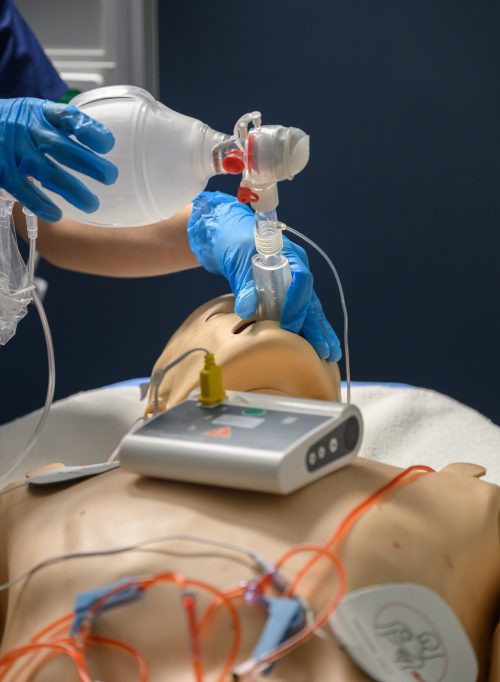
PCC’s recently renovated Health Technology Building is keeping the region’s healthcare workforce and local economy healthy.
In advanced manufacturing, PCC’s $1.2 million semiconductor grant is expanding access to high-wage career training and helping employers meet urgent workforce needs. The investment supports Quick Start, dual-credit pathways, student supports and industry partnerships that connect more students to semiconductor jobs. With nearly 650 Quick Start graduates since 2022, PCC is helping grow a diverse talent pipeline for one of Oregon’s most critical industries.
The college’s physical infrastructure is also driving workforce readiness. PCC’s recently renovated Health Technology Building represents a major investment in the region’s healthcare workforce and local economy. The $37 million west-side voter-approved bond renovation modernized 66,000 square feet and expanded hands-on training for nursing, medical imaging, radiography, medical assisting, exercise science and other in-demand fields.
“By modernizing our instructional spaces and expanding access across multiple healthcare disciplines, PCC is ensuring that our programs are aligned with the needs of our students and regional employer partners,” said Janeen Hull, dean for the Healthcare & Emergency Professions Pathway. “We are equipping the next generation of healthcare, emergency and fitness professionals with the skills to lead and the hands-on experience to succeed from day one.”
About James Hill

James G. Hill, an award-winning journalist and public relations writer, is the Director of Public Relations at Portland Community College. A graduate of Portland State University, James has worked as a section editor for the Newberg Graphic... more »