
CTE Month: New Labor Department-funded scholarships help PCC fast-track ‘work-ready’ talent
Story by Misty Bouse. Photos by Ric Getter.
A new U.S. Department of Labor-funded scholarship initiative is helping students move faster into high-demand semiconductor, advanced manufacturing and welding careers. at Portland Community College.
The grant-funded scholarships will support 40 PCC students with 10 each across four technical areas, aligned with the region’s workforce needs. The goal is to train for the roles employers are struggling to fill and invest in people who already live in the community.
“Those companies don’t just need workers: they need workers with the specific, high-level technical training found in our Electronic Engineering Technology and mechatronics programs,” said Christiaan Desmond, dean for the Advanced and Applied Technologies Pathway.
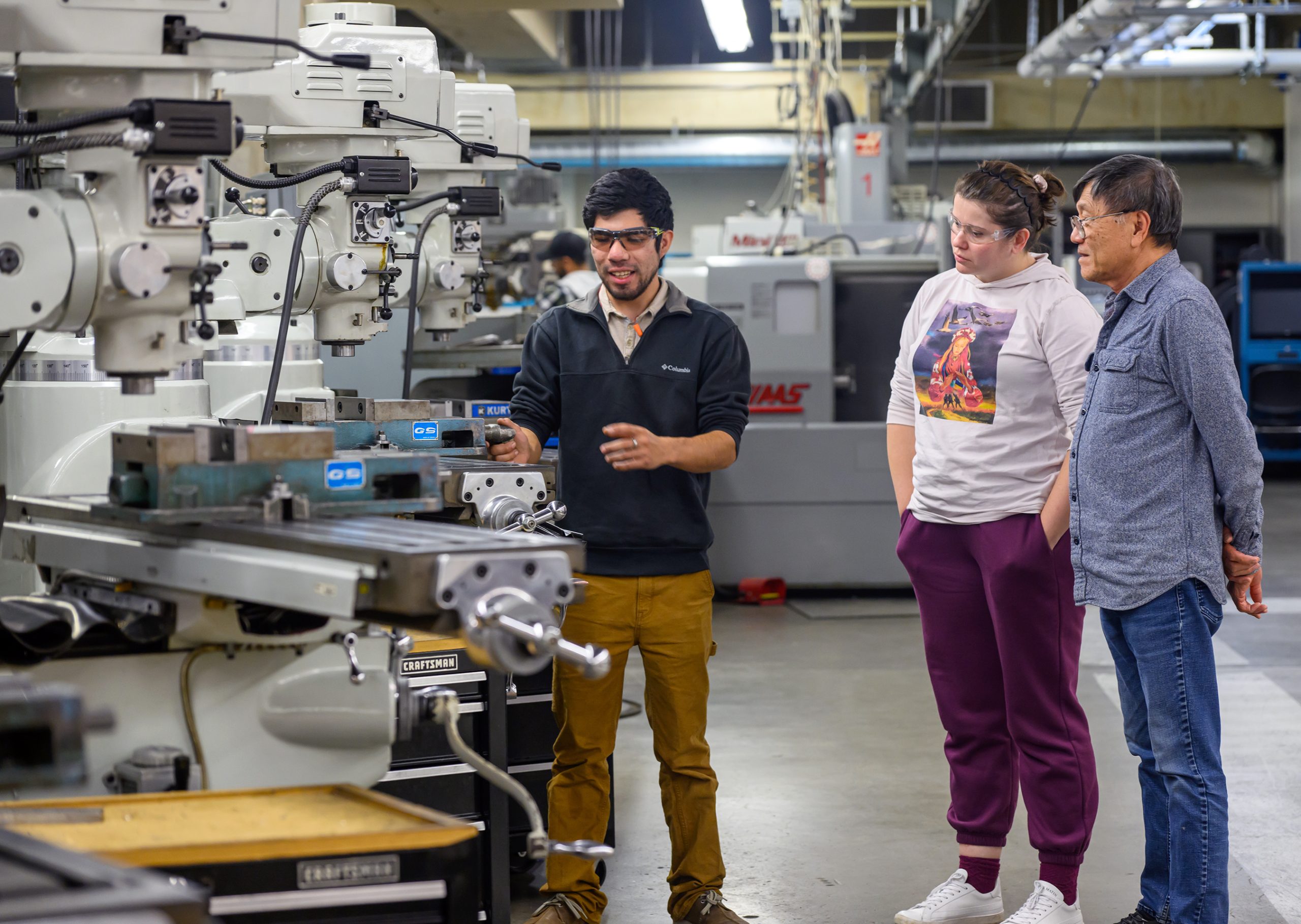
It is CTE Month!
Community colleges like PCC are committed to filling high-demand jobs in their communities with the skills and training necessary for success in industries. Community colleges are strong partners to local business and industry, utilizing workforce professionals to guide programs through advisory committees.
Desmond said PCC’s approach targets a regional labor shortage that is expected to intensify as semiconductor and advanced manufacturing investment expands.
“By funding 10 students in each of these four disciplines, we are delivering a balanced, work-ready cohort that hits the ground running,” he said.
This initiative provides critical financial support to help students access up to 13 college credits in high-demand technical fields aligned with Oregon’s semiconductor and advanced manufacturing workforce priorities. As a result, this fall, those 40 students were notified that they have been selected to receive awards of $2,062.50 each to support tuition and fees.
Scholarships were distributed evenly across four programs: Electronic Engineering Technology, Machine Manufacturing (MCH), Mechatronics, and Welding, with ten students in each area receiving funding. In the Mechatronics Program, student-machinists use computer-aided manufacturing software to control, manipulate, and manage precision computer numerically controlled machines in the production of precision tools for high-tech manufacturing.
The Mechatronics, Automation, and Robotics Engineering Technology area of concentration is a unique area within PCC’s historically strong EET program. The training develops skilled technicians for jobs in tech, telecom, and manufacturing, and with pathways to bachelor’s degrees, focusing on hands-on activities with electronics, digital systems, and automation.
“Partnerships like this with support from the Department of Labor are at the heart of how we respond to workforce needs in our region,” said PCC Executive Director of College Relations Sage Learn. “By working closely with employers and investing in targeted training, PCC is helping students move quickly into high-need, high-wage careers while giving local industries the skilled talent they need to grow. These scholarships are about opportunity for students, for employers and for the long-term economic health of our community.”
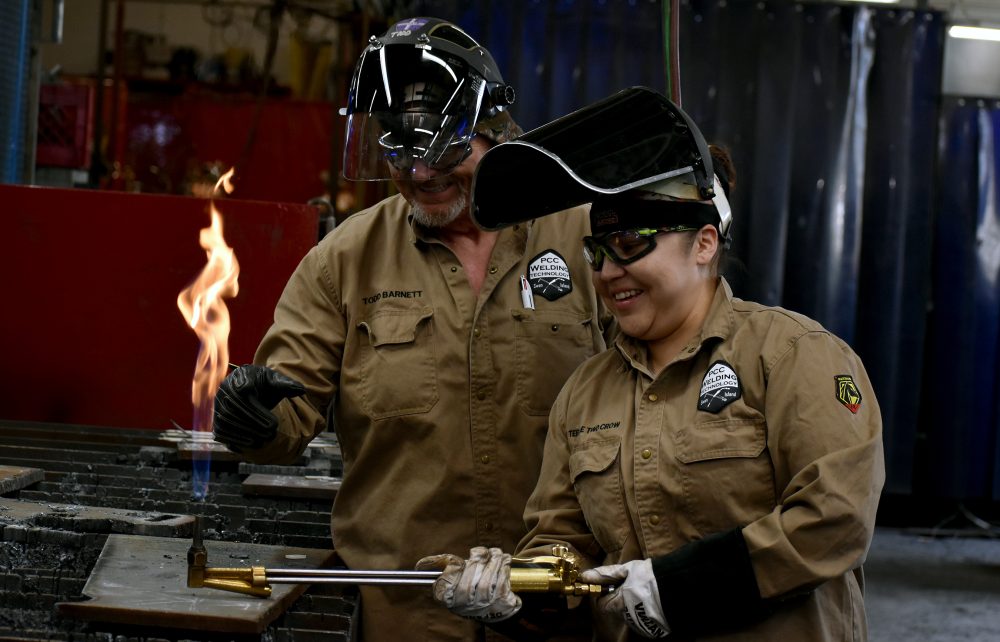
Instruction at the Swan Island Maritime Welding Center.
Budget Cuts Looming
Oregon’s worker shortage is documented; the state itself has identified chronic shortages in key sectors (healthcare, construction, IT, manufacturing, childcare). More than 80% of Oregon’s general fund budget comes from income tax and higher incomes (gained through workforce development) that equal more state money. But the Oregon Legislature is considering cuts to the budgets of community colleges mid-biennium due to the poor economic forecast.
Community colleges are where Oregon trains many of the high-demand roles highlighted in the state’s own Talent Assessment report. An economic impact analysis shows that PCC generates $2.3 billion in added income and 25,314 jobs in the region from its training and graduates. The same study found students see about $5.10 in higher future earnings for every $1 invested in their education.
Any deep cuts could impact PCC’s celebrated Career Technical Education (CTE) training and workforce development.
Why does PCC have such a major impact and why it is so important? Despite funding challenges, the college’s programs are built around hands-on, industry-aligned coursework designed to prepare students for technician and production roles, including critical support positions that keep manufacturing operations running safely and efficiently.
Some of PCC’s semiconductor-focused programs have historically posted very high hiring outcomes. Microelectronics Technology Program graduates see a nearly 100% hiring rate with employers that include Intel and Lam Research.
Earnings are also a draw. These PCC technical programs note that starting salaries for graduates are generally between $56,000 and $65,000 per year, according to Desmond. He also shared that there are work-life balance benefits to consider. Many of these roles utilize compressed work weeks with three 12-hour shifts, which allows for high earning potential with significant time off.
“This is considered a major draw for modern tech workers,” said Desmond.
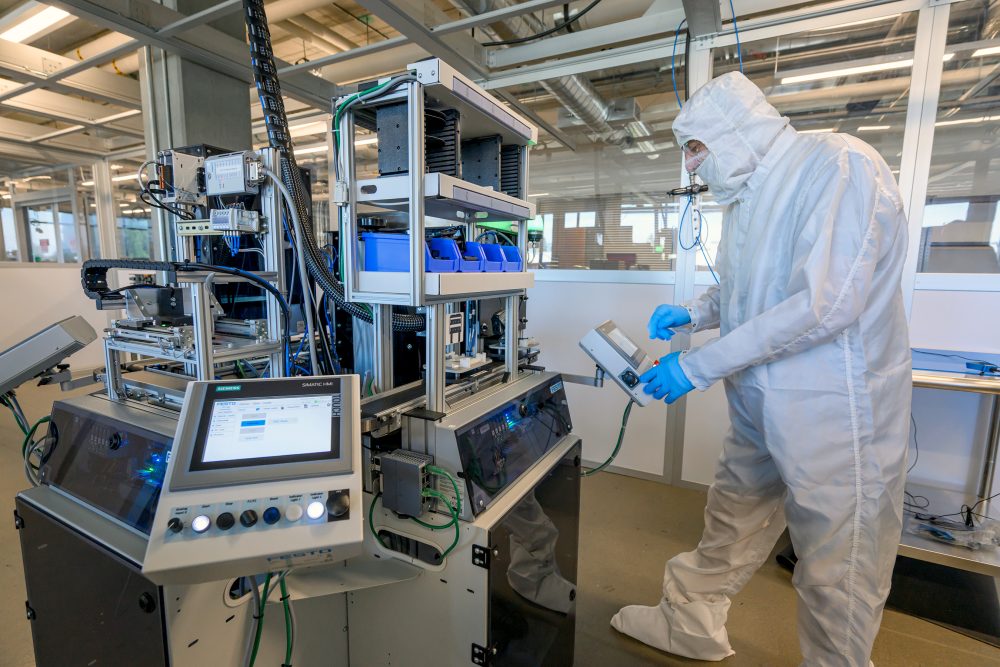
The new clean room at the Willow Creek Center.
Meeting Fast-Growing Workforce Needs
The region’s expansion in semiconductor and advanced manufacturing can create a “talent vacuum” if training pipelines don’t keep pace and if appropriate levels of state funding are not maintained.
At the current rate, PCC leaders estimate the college is providing about 44% of the technicians needed for these roles. The grant-backed cohorts are intended to accelerate 40 highly qualified students into a sector expected to grow significantly in the next several years, according to Desmond.
Beyond tuition help, the scholarships can remove a major barrier for students entering technical programs: the upfront cost of required gear. Matt Scott, a PCC welding instructor and high school liaison, said the funding made an immediate difference for the students he works with.
“This was a super cool scholarship for welding,” Scott said. “The students that received tuition scholarships in the morning welding class then bought tools, and I know of two others who got the Department of Labor grant funding that actually were able to attend this winter term for additional training.”
He added that students are required to purchase their own personal protective equipment in his program. Working with the PCC Bookstore, Scott said they assembled an “all-in welding tool and PPE kit” that typically ranges from $1,300 to $1,600, covering all of what students need for the up to two-year program.
“The students can easily use their financial aid or grants and they get it so quickly,” said Scott.