
Alumni Spotlight: Jess – Building a New Blueprint for the Trades
Posted by katie.weibel
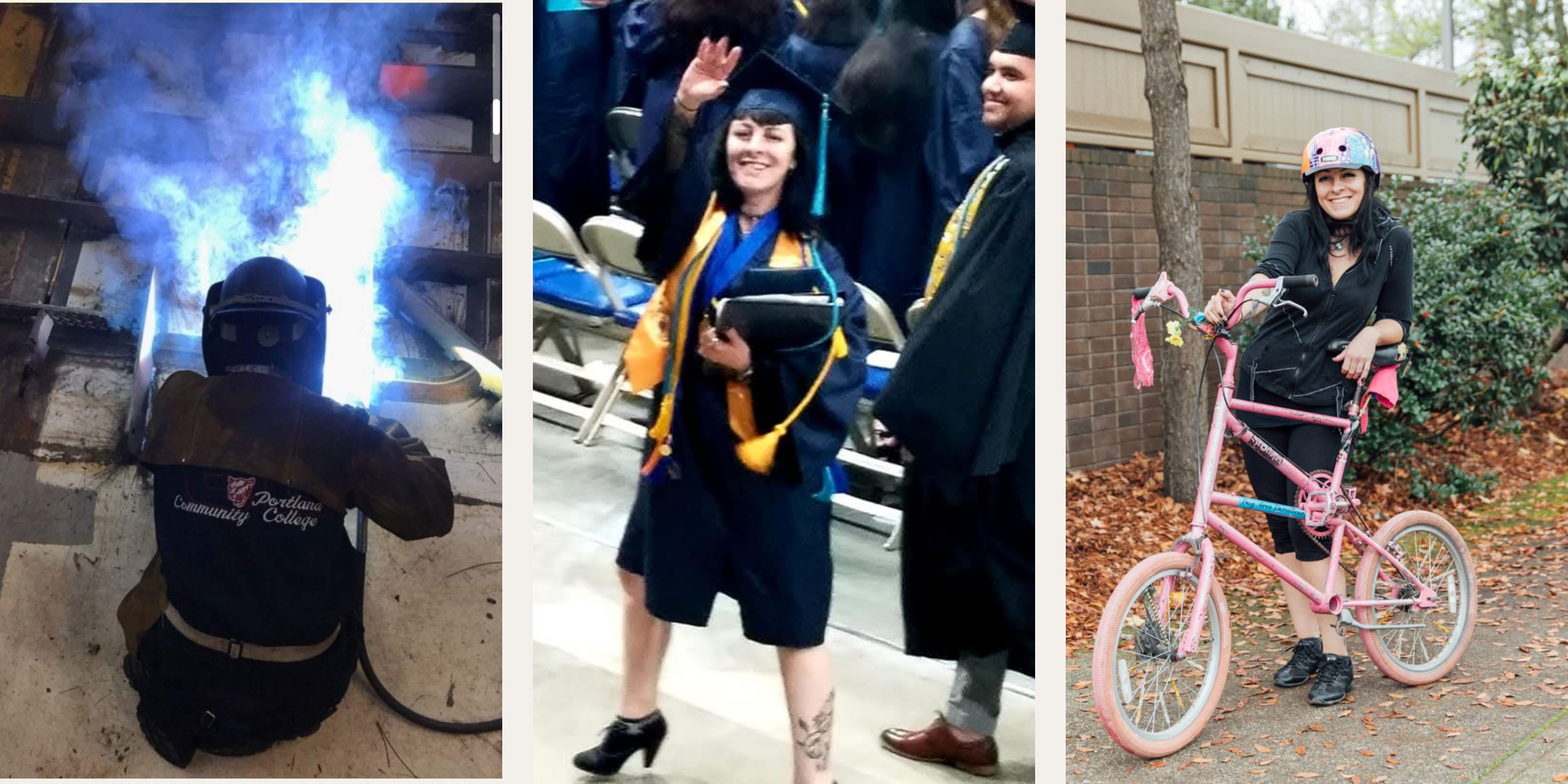
When Jess enrolled in the Welding Technology degree program at Portland Community College (PCC),
she couldn’t have imagined where the journey would take her — from welding bicycles for a dance
group, to working on cruise ships in France, to now leading the next generation of skilled workers as a
coordinator for a new apprenticeship program in Oregon.
But her story isn’t just about welding. It’s about resilience, reinvention, and re-imagining what blue-collar
work can be.
From Bicycles to Boilermakers
Jess’s journey into the trades began in an unconventional way, but the most Portland way…she was part
of a bicycle dance group called The Sprockettes that needed small bikes that were solid enough to do
acrobats and tricks on. “I initially learned how to weld in order to make kid’s bikes I got from garage sales
danceable,” she recalls. That hobby sparked a passion.
After starting the PCC welding technology program, a friend invited her to a shipyard in western France,
Saint-Nazaire, where many of the largest cruise ships are constructed on a massive scale. “It felt like
working on a high-rise building, but on the water,” she says. “It was enlightening to see how EU workers
are treated — strong unions, free education and healthcare, and a minimum of 30 days of vacation per
year by law. It made me think about the value we place on workers back home. Our ideas on what
worker and individual rights look like vary drastically. We often forget that we work to live, not live to
work.”
This global perspective shaped Jess’s commitment to completing both her associate’s degree and
apprenticeship — credentials that are recognized internationally, unlike journeyman status alone. “That
was part of the strategy — to create a path where I could eventually work overseas, if I chose to go
back.”
That’s where Jess’s welding education went full speed ahead. After coming back to the states, she joined
the Boilermakers apprenticeship, worked to complete her welding degree at PCC, and got a job working
at Vigor. She spent the next decade building a reputation as a highly versatile employee.
Welding a Career at Vigor
After graduating from PCC in 2019 — where she was selected as the student commencement speaker
— Jess went on to work in many different roles at Vigor Industrial.
“My education and apprenticeship taught me more than just welding — I learned to read blueprints and
understand code. I was able to work on Navy ships, in the office as hot work coordinator, then WAF
coordinator, doing layouts, and working on the deck plates. That flexibility made me really valuable.”
Her skillset and leadership didn’t go unnoticed. Just three years ago, Jess was asked to teach the
apprenticeship program after her former instructor retired. While still working at Vigor, she began
teaching at night — a role that eventually led to a new opportunity: becoming the coordinator for a new
Boilermakers apprenticeship program in Oregon.
Resilience, Reinvention, and Representation
Jess’s road to welding was shaped by more than passion — it was also deeply personal. Originally from
California, she moved to Oregon to work in marketing before a serious accident left her with a traumatic
brain injury. “I had to learn how to walk again,” she shares. “It was life-changing. I stayed in Portland for
rehab at OHSU, and it made me reevaluate everything.”
That reevaluation led to union organizing, starting a nonprofit, and eventually welding. Even as she
prepared to give her graduation speech in 2019, life threw another curveball — a work-related accident
just weeks before her speech. But Jess’s message of perseverance has remained constant: “Life
happens. You can start over. It’s never too late to make your life better.”
Her commitment to the trades extends far beyond technical skills. Jess is a mentor with Oregon
Tradeswomen and a strong advocate for unions, workers’ rights, and diversity in the trades.
“When I started at Vigor, there were only a few women welders. Now, there are over a dozen. We’re also
seeing more LGBTQ+ folks entering the trades because they feel safe. Diversity makes these jobs safer
and better for everyone.”
The Bigger Picture: Manufacturing in America
For Jess, promoting blue-collar work is more than a career — it’s a calling. “Manufacturing is the
backbone of any successful civilization. We build and maintain the infrastructure that keeps our society
stable and growing,” she says. “There’s a lack of skilled labor in the U.S., and we need more people to
value this kind of work.”
She wants to shift the perception that skilled trades are less prestigious than white-collar careers. The
trades provide a well-paying option to many people from all walks of life. “This isn’t a skill that’s going to
become obsolete with the latest technologies. I can work in a shipyard, build homes and skyscrapers,
build and maintain bridges, among many other applications. These are lifelong, transferable skills that
cannot be unlearned.”
Goats, Community, and Giving Back
As if her story weren’t unique enough, Jess is also the founder of the Belmont Goats, a beloved Portland
nonprofit she started after an encounter with a herd during a recovery walk in 2012. “The first set of twins
born in the herd just turned 12,” she beams. “It was a choice made out of wanting to do the right thing,
that is one of my proudest accomplishments.”
Looking Back, Moving Forward
Jess credits much of her success to the support she received during her time at PCC — especially from
her academic advisor, Darcy. “She guided me to find the best route for my goals, and really pushed me to
do get through the tough times. I don’t think I would’ve made it without her and others that pushed and
believed in me.”
Now, as a leader, educator, and advocate, Jess is helping to shape a more inclusive and respected future
for skilled trades in Oregon and beyond.
“While my journey is unique, it proves that you can overcome obstacles regardless of circumstance.
Decide the future you want to see, both as an individual and a society, and work towards that while
trusting the process.”
Quoting Nelson Mandela, “Start by doing what’s necessary, then do what’s possible, and suddenly you
are doing the impossible.”