
Information session presentation
Fontaine Roberson, MT Admissions Specialist: mt-advising-group@pcc.edu
 Overview
- What is microelectronics?
- Why might I be interested in microelectronics?
- What difference does having a degree make?
- What does a career in the semiconductor manufacturing industry look like?
- What does a technician do?
- How can PCC help? How am I going to pay for this?
- How do I get started and what are the next steps?
What is microelectronics?
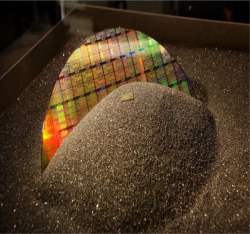
- Microelectronics is a field of electronics dedicated to the design and development of microchips.
- Microelectronics makes it possible to manufacture inexpensive, lightweight electronic products.
Why might I be interested in microelectronics?
You might be interested in microelectronics if you:
- Like hands-on problem-solving, have mechanical skills, and are good at troubleshooting.
- Are interested in technology. You don’t have to be tech-savvy – you will be trained to do the job.
- Enjoy group projects and teamwork, and have strong communication skills.
- Are looking for a pathway to engineering or for continued training and education. If you choose, you can transfer to approved area schools with “junior” standing.
Manufacturing and equipment technicians
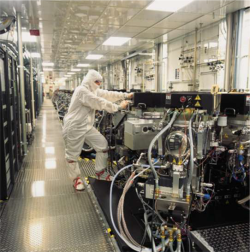 (titles vary company to company)
- Operate and maintain automated machines and systems.
- Critically evaluate and troubleshoot equipment errors and malfunctions.
- Interpret technical documents.
- Communicate and work effectively in a team-based environment.
Job environment
- Clean, structured atmosphere
- Compressed work week: 3 days on, 4 days off or 4 days on, 3 days off
- Work 6 months out of the year
- Competitive salary and benefits:
- Starting base salary: ~$55k+ per year
- Health and PTO
- Tuition assistance
- Many others depending on company
What difference does having a degree make?
- Past: Most companies required a 2-year degree or equivalent military experience.
- Current: There are substantial staffing shortages, and these requirements have been relaxed. So why should you seek additional training and education?
- Do you want to advance your career?
- Do you want to gain a better understanding of the equipment and the process?
- Earn higher entry-level wages.
- Have a better chance for internal promotions.
- Earn more for the same position compared to co-workers without the educational qualifications.
Microelectronics Technology at PCC
Associate of Applied Science (AAS 2-year degree):
- Analog and digital circuits
- Process equipment
- Quality control methods and statistics
- Vacuum technology
- RF and plasma systems
- Semiconductor processing
Transfer options:
- BS in Electrical Engineering Technology (OIT)
- BS in Manufacturing Engineering Technology (OIT)
- PSU/OSU (work with your advisor on these schools)
Why Microelectronics Technology at PCC?
- Industry partnerships
- Hands-on training
- Compassionate, experienced faculty
- Classes scheduled around compressed work week
- Employment assistance
- Mock interviews
- Internships
- >98% job placement
Getting started
Where is the program offered?
- Most Microelectronics Technology classes have a lab component and must be taken at Rock Creek.
- General education courses in writing, math, physics, chemistry, etc. may be taken at any PCC campus.
When can I start?
- You can start taking credit classes that apply toward a Microelectronics Technology degree at the beginning of any term.
- First-year sequences must start in fall or winter terms.
- Second-year sequences start in the fall term. Most first-year courses must be completed before starting the second year.
What are the costs of the entire program?
With fees, the program costs about $2,000 per term, and books cost about $500. The AAS comes to about $13,000, and books cost about $1,300 to $2,100.
Can my MT credits apply towards an advanced degree?
- Yes, up to 58 credits can apply toward a four-year baccalaureate degree.
- Graduates of the MT program may also transfer to Oregon Institute of Technology (OIT) to pursue a bachelor’s degree in Electronic Engineering Technology (EET). This allows the possibility to complete a bachelor’s degree in two additional years.
- Upper-division OIT courses are offered at OIT’s Wilsonville Campus.
Have other questions?
Email mt-advising-group@pcc.edu with any questions you have about the MT program.
First-term classes
- MT 101-103: Intro to Semiconductors (4-week class)
- MT 111A: DC and AC Intro
- MT 151: Hand Tools and Mechanical Assembly
- MT 106 or MTH 96
- WR 121: College Composition
History of the Microelectronics Technology program
- 1990: At the request of Intel, PCC created the MT program and updated the curriculum to fit Intel’s requirements.
- 1990 to 1995: The MT program was offered at Intel’s Aloha Campus, except for chemistry and physics, which were held at PCC.
- 1995: The MT program was moved from Intel to PCC’s Washington County Workforce Training Center (Capital Center) and was opened to the general public in addition to Intel employees.
- 2005: The MT program was relocated to the Rock Creek Campus as part of the Advanced and Applied Technologies Division.
What’s the difference between MT and EET?
Microelectronics Technology
- Located at PCC Rock Creek Campus
- Degree and certificate options – MT
Electronic Engineering Technology
- Located at PCC Sylvania Campus
- Degree and certificate options – EET
Contact us for more information
Contact mt-advising-group@pcc.edu for more information.