
Optician Assistant, non-credit training
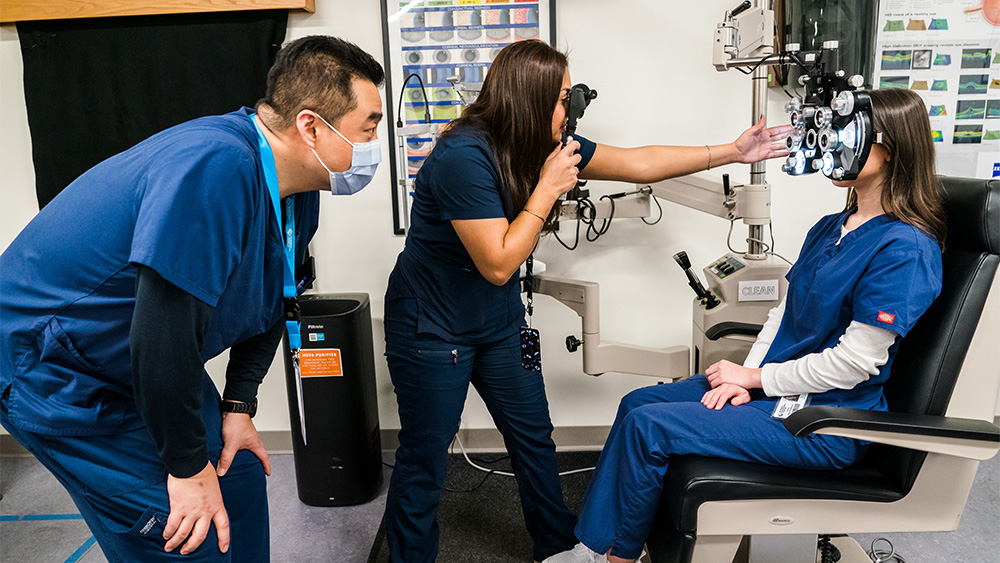
Why choose the Optician Assistant non-credit training program at PCC?
Salary
Optician Assistants were paid an average wage of $40,172 per year in 2025, according to ZipRecruiter.
An optician assistant designs, measures, fits, and dispenses corrective lenses for the correction of a person’s vision. It requires a keen eye for fashion and attention to detail, combined with great communication and people skills. Optician assistants are trained to be “ophthalmic lens experts.” Through evaluation of the eyeglass prescription, in conjunction with the patient’s vocational and avocational visual requirements, they recommend specific lenses, lens coatings, and frames.
Train online, with three Saturdays in a classroom, toward becoming an optician assistant working directly under the supervision of a dispensing optician.
Enroll in the optician assistant non-credit training program to gain the skills and know-how to prepare you for this fun and fulfilling career.
Time commitment and cost
This course is one term in length (10 weeks). Sessions are delivered through live, real-time online lectures that allow for instructor–student interaction. In addition, the course meets on Saturdays for hands-on skills training with the instructor, and office hours are available for additional support.
- Duration: 1 term (10 weeks)
- Classroom hours total: 27
- Webinar hours total: 18
- Total instruction hours: 45
- Tuition: $1199 total, excluding books
- Federal financial aid does not apply to non-credit courses. Students are required to pay in full once they are notified of their acceptance into the program.
Course materials
- Recommended book:
- Brooks & Borish: System for Ophthalmic Dispensing, 3rd ed. This book is not sold at any of the PCC bookstores, so we encourage you to shop around to find the best price.
- Required materials:
- Access to the PCC online learning course
- Computer headset or applicable audio device
Instructor
Get in touch
Contact Bem Hanamoto if you have questions about Optician Assistant non-credit training.
Andrew S. Bruce, LDO, ABOM, NCLEC, began his optical career in his home country of England, before immigrating to the United States in 1987. He is a Washington State licensed dispensing optician and contact lens fitting specialist, with a Master’s in Ophthalmic Optics. He’s an advanced-level approved speaker for the American Board of Opticianry Continuing Education Programs. His educational papers in his field of expertise have been published in the USA and Europe. Bruce is also an approved speaker for both the American Optometric Association CPC Continuing Education and the National Contact Lens Examiners.
His written works are used as instructional and reference materials by Highline Community College’s Dispensing Optician program. He is a regular contributing writer for Jobson Publications and has written Continuing Education programs for both the National Academy of Opticianry and the Opticians Association of Washington. He serves as the Technical Education Consultant for VSP Optics and University.
When he isn’t instructing, he is practicing photography and training for marathons.
Award information
| Award | Length (attending full-time) | Financial aid eligible | Currently accepting students? |
|---|---|---|---|
| Non-credit Training: Optician Assistant | Less than 1 year |
Learn more about Eye Technician and all 2 awards available »
Locations
 CLIMB Center
What will you learn?
PCC’s Optician Assistant training program consists of online “live” lectures, onsite classroom instruction, and onsite lab hours for practical training. It will provide a solid foundation of the skills required for an entry-level position as an optician assistant. On the last day, we’ll arrange a visit from local business owners for an optical job fair. This will provide you with the opportunity to personally hand off a physical copy of your resume to a prospective employer.
You will gain a basic understanding of:
- Optical principles and terminology
- Frame measurements used in making eyeglasses
- Informational markings on frames
- The anatomical measurements needed to fabricate eyeglasses
- Ocular anatomy
- Ophthalmic lens dispensing
- Math for opticians
- Important cosmetic considerations in frame selection
- Procedures to order and verify prescriptions from an optical laboratory
- Professional practices and privacy policies (HIPAA)
Upcoming courses
What will you do?
As an optician assistant, you will:
- Combine a reasonable level of math and science to measure, fit, and dispense corrective lenses.
- Utilize a keen eye for fashion when assisting customers with frame selection.
- Align the customer’s style with attention to the functional detail of vocational and avocational prescription requirements, including specific lenses, lens coatings, and frames.
- Fit and repair eyewear to provide optimum comfort and function by molding and reshaping frames using appropriate tools.
- Interpret written prescriptions, take facial measurements, and determine correct frame sizes.
After completion of the program, you will be able to:
- Create work orders for ophthalmic laboratory technicians, providing information about the lenses needed.
- Describe ophthalmic lens design and apply basic math formulas related to ophthalmic lenses.
- Measure the interpupillary distance (PD) and optical center heights (OC).
- Measure multifocal heights for lenses and understand the variations depending on multifocal style.
- Insert lenses into different types of frames.
- Adjust frames to “standard alignment”.
- Custom-fit plastic and metal frames to provide both functional and comfortable eyewear.
- Adjust temples and nose pads for maximum comfort.
- Explain how the principles of reflection and refraction are applied in ophthalmic lenses.
- Explain how lens curvature is used to correct vision.
- Understand practical applications of eyewear adjustments and repairs, including the use of specialty eyewear tools.
- Perform basic frame repairs.
If you are seeking an entry-level, front-line position within a health and retail setting, this program may be for you.
Who will hire you?
On the last day of class, we’ll make arrangements enabling you to physically hand your resume to local business owners! You’ll enjoy this career path if you think guiding customers to make both functional and style choices would be fun, and are motivated to excel in customer satisfaction.
Next steps
Applying to PCC is free and only takes a few minutes.Apply now
Not quite ready to apply?
We can help you get the information you need.