
Portland Community College’s SBDC and partners celebrate 20 years of ‘Getting Your Recipe to Market’
Story by James Hill. Photos by Ric Getter.
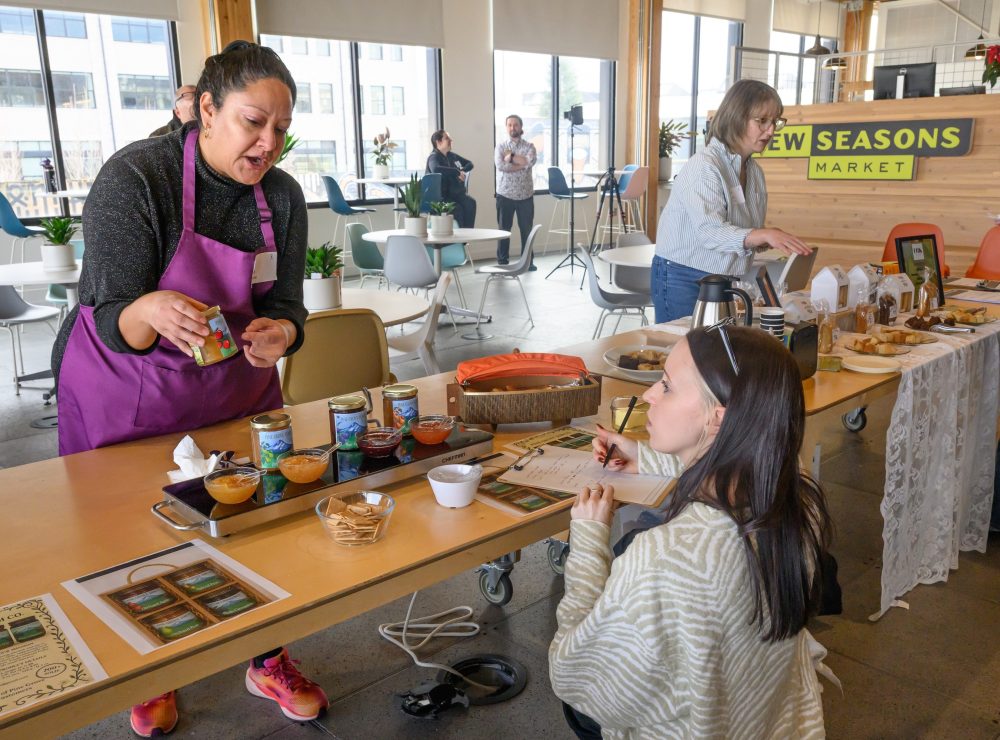
Moriah Krussow presents her delicious jams to a New Seasons taster.
Where has the time gone? It seems like only yesterday that the Portland Community College Small Business Development Center (PCC SBDC), together with partners Oregon State University’s Food Innovation Center and New Seasons Market, launched “Getting Your Recipe to Market” or simply known as GYRM.
Now, two decades later, the partners and the college are celebrating the program’s 20th anniversary as a signature training program that helps local food entrepreneurs transform a promising recipe into a commercial-ready consumer packaged goods product.
Since the first cohort launched in fall 2006, GYRM has guided hundreds of aspiring food entrepreneurs and early-stage food businesses through the complex work of developing, producing, packaging, pricing and selling food products. Over the past two decades, the partnership between PCC SBDC, New Seasons Market and the Food Innovation Center has created a robust pathway that blends business advising, food science and product development expertise, and real-world retailer perspective.
Read about one student’s first-person account of experiencing GYRM’s sampling event at New Seasons.
“Twenty years is an amazing milestone,” said Tammy Marquez-Oldham, director of the SBDC. “It’s incredible to think about how many food entrepreneurs have walked into their first session with an idea, and walked out 12 weeks later with a product and a plan, all supported by experts and a community that wants them to succeed.”
The three-month training program is designed for pre-business and early-stage entrepreneurs who have a complete, consistent recipe and want to determine whether that recipe can be transformed into a viable, shelf-ready product.
“This partnership reflects New Seasons Market’s commitment to building a strong, sustainable local food system,” said Chris Tjersland, director of brand development at New Seasons. “By supporting small food producers at the earliest stages of their journey, we’re helping create economic opportunity, strengthening our regional food community, and ensuring our stores continue to showcase local food made with care, integrity and purpose.”
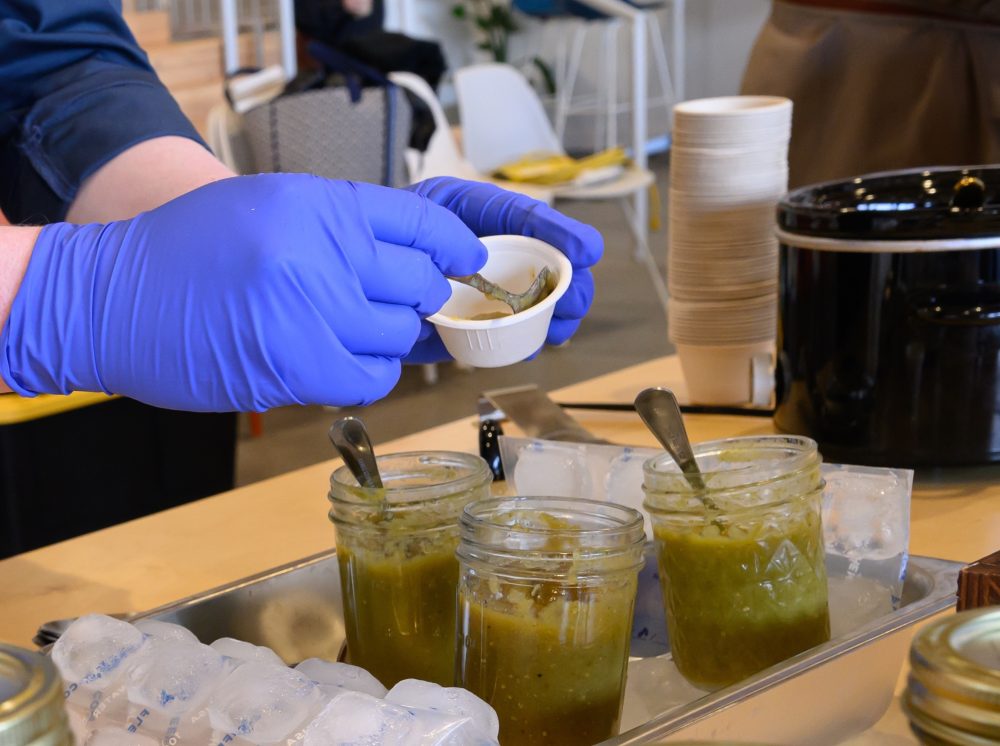
A tasty and spicy verde sauce.
The program culminates in an opportunity for participants to pitch their products to New Seasons Market buyers, strengthening connections between makers and the local retail ecosystem. Graduates of the program stand out when pitching to buyers, said New Season’s Local Finds Manager Lori Hunter.
“They show up retail-ready and understand the nuances of label compliance, shelf life, cost of goods and distribution,” Hunter said. “Wholesale isn’t intuitive or easy to access, so from a buyer’s perspective, this course is incredibly valuable. Our 20-year partnership with GYRM continues to grow and evolve, and we truly love working with brands that have completed this class.”
GYRM recently hosted an in-person pitch and sampling event for its students at New Seasons Market’s new headquarters last term. These local food entrepreneurs pitched directly to New Seasons buyers, received real-time feedback and showcased products at various stages of development, from refined shelf-ready concepts to innovative prototypes.
This experience is a hallmark of the program, offering participants an opportunity to learn what retailers look for, ask questions, and refine their approach before launching to market.
“It is common to not know where to start or where to put your energy in learning how to launch a food business,” said GYRM instructor Jill Beaman. “We developed the course to help entrepreneurs determine their product’s feasibility and understand the steps to launching.”
Elisa Wickstrom, a GYRM graduate who launched a product line and returned to co-instruct the course, said there are processes that are required to ensure viable shelf life that impact the final look, feel and taste of certain products. Sometimes there is a gap in the marketplace because a recipe truly is a labor of love and only makes sense on your own kitchen table.
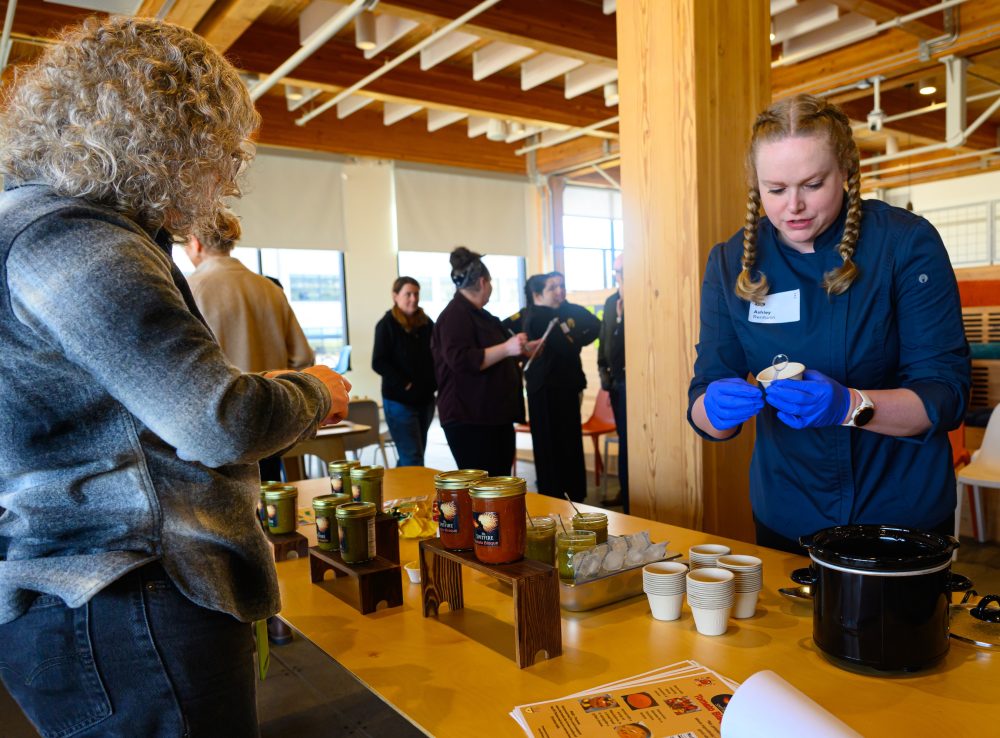
Ashley Renforth, owner of the Ms. Spitfire food brand of sauces, said GYRM helped her figure out her labeling, sales sheets and calculating cost of goods.
“We help entrepreneurs navigate the process of figuring out how to transform their recipe and where they fit in the marketplace,” she said.
Through the program, participants learn to avoid common and costly food science, packaging and costing mistakes. For Ashley Renforth, owner of the Ms. Spitfire food brand of sauces, the experience helped her figure out her labeling, sales sheets and calculating cost of goods, as well as networking opportunities.
“That was super helpful,” said Renforth, who was showcasing her tomato bisque and verde sauces at the sampling. “And, I made a lot of great connections in the class.”
Emily Cupo Roat is owner of Emily Ruth’s Kitchen (ERK), which specializes in Italian treats. After several years in operation, she said the program helped professionalize her business and take it to another level.
“This class allows us to get into more stores, get more confident with our product and see what they would look like on the shelf,” said Cupo Roat.
Offered during spring and fall terms, the program has helped more than 500 graduates and supported more than 300 new business owners, contributing to a thriving regional food economy and expanding what shoppers can discover on local grocery shelves.
“Watching makers transform kitchen-table experiments into grocery-store-ready brands has been truly inspiring,” said Sarah Masoni, director of the Product and Process Development Program at OSU’s Food Innovation Center. “Celebrating 20 years of ‘Getting Your Recipe to Market’ fills me with immense pride and gratitude, and I’m excited to see the remarkable products the next 20 years will bring.”
For more information, visit: https://www.pcc.edu/small-business/getting-your-recipe-to-market/
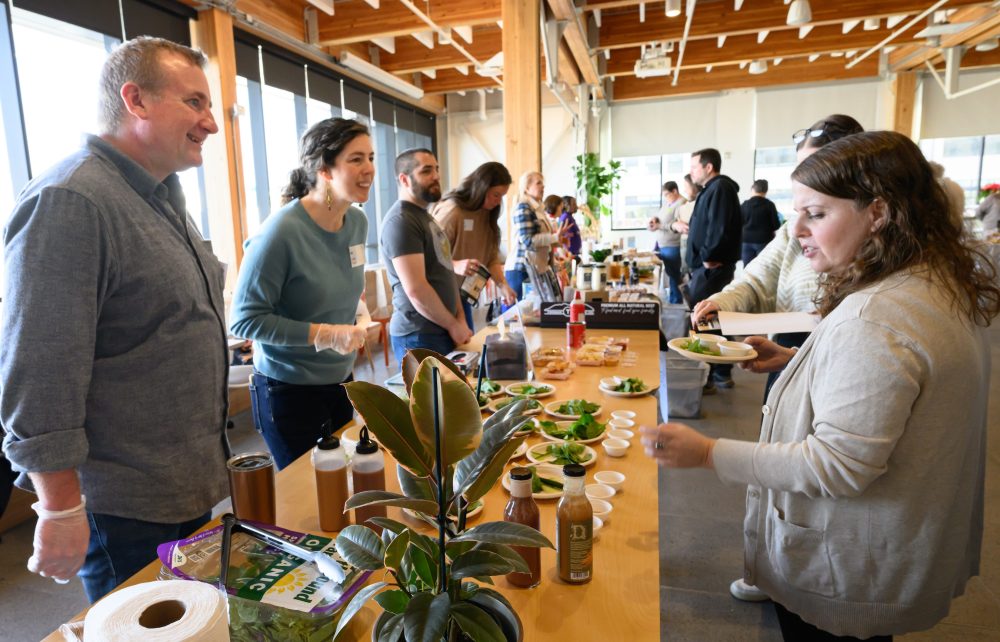
Students in GYRM received real-time feedback on their products.