
Let’s Talk! MSA Student Activists
Hosted by Miri Newman. Produced by the Let's Talk! Podcast Collective. Guest speakers Alena, Max, Liam, and Harper. Transcript editing by Miri, Asher, and Julie. Audio editing by Miri Newman. Web hosting by Eugene Holden.
Let’s Talk! MSA Student Activists
Summary: Student leaders of the Save Music and Sonic Arts movement come together, to tell us about their studies, their goals, their backgrounds, and what keeps them motivated to fight for their education.
- Hosted By: Miri Newman
- Guest Speakers: Alena, Max, Liam, Harper
- Produced By: Let’s Talk! Podcast Collective
- Audio Editing: Miri Newman
- Web Hosting: Eugene Holden
- Released on: 2/5/2026
- More resources at our home website.
Episode Transcript
Transcript edited by Miri, Asher, and Julie
Preamble
Miri: In Spring 2025, Portland Community College announced that it was running an internal evaluation of its programs. Three of them — Russian, Gerontology, and Music and Sonic Arts — did not meet the school’s expectations, and were intended to be cut. This announcement garnered both surprise and outrage from the student body and the local community alike. Since then, there has been a grassroots movement led by some Music and Sonic Arts students to bring awareness to their program, and gather support from the community in opposition of the program being shuttered. With signs pointing toward the ultimate fate of the program being on the docket of an upcoming PCC Town Hall, I reached out to talk to a few of these student leaders.
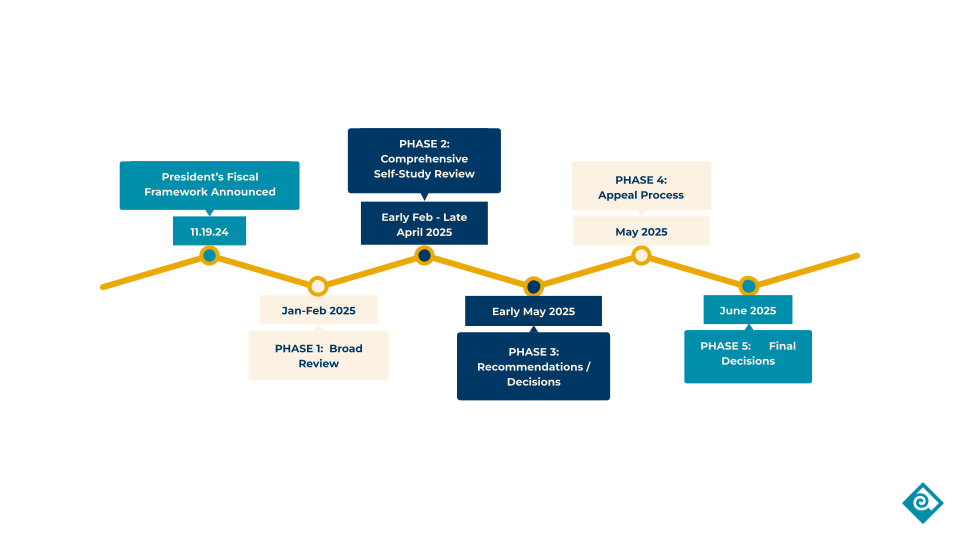
Roadmap of PCC’s 5 Phases of Fiscal Sustainability
Guest Introductions
Miri: Okay, so I’ll ask everyone to introduce themself and we’ll just go clockwise.
Harper: Alright. I’m Harper Treadway. I’m been part of the MSA program since winter of last year.
Liam: My name is Liam Grouell. I’ve also been a part of the music program since winter of last year. It’s my second year here, term two. I’m hoping to transfer to PSU next year, so.
Miri: Congrats!
Alena: My name’s Alena. I use she/her pronouns. I started at Music and Sonic Arts way back in Winter 2023, so I’ve been here since then.
Max: My name is Max he/him pronouns. I am an audio visual artist studying creative coding in the Music and Sonic Arts program here at PCC. And this is also my second year. And yeah, we’re here to talk about the program and all the things that are happening at PCC right now. So, yeah.
Miri: Which there’s only a, a few of, you know, only a, maybe two —
Max: Just a few minor things. Only a couple things
Miri: — at most.
Max: Three worth noting. Yeah.
Miri: A hundred things.
Max: Right.
Getting to know the contestants
Miri: Um, so you two are pretty close to finishing the program then, right?
Alena: Yeah.
Miri: Gonna be, is this your last capstone coming up next term?
Alena: Yes.
Max: Yes.
Miri: Nice. Um, do you know what you guys are doing yet?
Max: No. No idea. I would love to incorporate something with surround sound. I have some tracks that I’ve worked on in Ableton that I’d love to just like completely pan apart and split and gut, and strip down and spread across a room somehow and do some cool stuff with that. But, other than that, the capstone is still, yeah, it’s still pretty up in the air. Yeah. But, um, I’m sure we will come up with some pretty fun stuff.
Alena: I have like this idea of incorporating dancers and having some type of, like, tracking function where like they follow the hands and feet and the head and the middle of people’s bodies, and then we have sounds that happen with each movement of those. I think it’d be really fun to have that incorporated into it. I also have no idea how to do it.
Alena: And I’m excited to learn and see if I do have an opportunity to learn how to do that.
Miri: Oh yeah. I mean, there’s a, definitely a P5 library for that. I’ve, uh, used that a couple times. And this is gonna be your guys’ first, capstone this year?
Liam: Uh…
Harper: Be honest. I don’t know what a capstone is.
Miri: Fair enough. Yeah. It’s, it’s the, it’s the piece of an arch or a doorway that goes in the very top and keeps the whole thing pressurized downward. Um, which —
Max: We’re talking about like a literal capstone
Miri: Oh yeah. Wait, what did, what did you think I was talking? Uh, yeah, it’s, it, it is a. the culmination of everything you’ve learned so far. Like sometimes it’s at the end of each year, like in this program, sometimes it’s the end of your whole schooling, like, for a lot of film schools.
Liam: It’s like an event.
Miri: Yeah.
Liam: Yeah.
Alena: It’s the event that happens every spring over at the Paragon, where they invite Music and Sonic Arts students and creative coding students to get their own separate thing going. And then they have a project that they show in spring over there where people can come and check it out.
Harper: Gotcha.
Miri: And it’s always super cool. I remember, I always go obviously as an alum of that program, but it’s always some super cool stuff. I went, uh, before I started the program when I was just thinking about it the first time and there was this real time rendered spaceship thing where you could go into warp drive by pushing an actual giant physical Oh, sweet. Like, lever all the way forward, and it would go and the lights would speed up.
Max: Oh, that’s awesome.
Miri: It was super cool. I just remember that. That’s really sweet. That one thing, like most specifically. Yeah. And having worked on two of ’em, that’s still the thing I remember most, which is from when I was not there.
Liam: Jessie, last term was showing us some videos of like, the previous capstones. It looked really cool. Like all these different sort of interactive installations.
Max: Well, what’s cool is like, you’re, you’re a guitarist, right?
Liam: Yeah.
Max: You’re a musician. I mean, we can incorporate — with the creative coding stuff — live music into our installations, so it’d be cool to work with musicians in the MSA program to do stuff like that. Yeah. Like, I know Renee plays a lot of instruments,
Alena: Yeah.
Max: It’d be cool to have her come in and, and maybe play for us or something.
Miri: I mean, it’s a program that gives everyone the opportunity to mix doing live music with performance art, with, you know, machine learning programming.
Max: Right.
Miri: All done on your laptop.
Max: Literally. It’s mind blowing. It’s — it’s truly magic. It’s fun and exciting.
Miri: So what brought each of you into this program specifically?
Harper: Well, I was originally gonna do computer science in college, because I was in the mindset of, “Oh, I need to do something that’s a little more stable.” And then I realized the computer science industry is not stable and that I don’t really want to do computer science, so I just did music. ‘Cause I’ve already been working on music for around five years now, or I guess six years actually since it’s 2026, which feels weird to say honestly. But, um, yeah, I don’t know. I just did the program ’cause I wanted more formal training, I guess, in like, compositional techniques and stuff. And just developing my skills.
Miri: And now you get a little bit of bonus computer technology.
Harper: Yeah. I mean, now I’m, I’m taking like audio programming and uh I wanna take like microcontrollers and stuff. It’s really cool.
Miri: And what about you?
Liam: So for me, all throughout, later in middle school and high school, I’ve been doing all sorts of music and just being, self-taught and just fiddling around. And, my si — older sister Carissa actually went through this entire program, she’s now graduated from PSU, and it really inspired me to do this program. Usually music was just kind of a hobby, but I decided to fully commit to it, and yeah, I joined this program because it was just a really good option. And it was close to home, it wasn’t terribly expensive. That was mainly the major thing was the — was the expenses, but, you know, Chris had told me that, you know, this is a really good way to connect with people. Really cool community, really diverse community. So yeah, that, that’s, you know, why I joined the program. You know, it’s been great so far. I’ve gotten to meet a lot of really cool people, this class has been great. All of our professors are great — shout out Sarah — uh…
Alena: Sarah!
Miri: Everyone loves Sarah.
Liam: Yeah. Everyone loves Sarah. Our president, our leader.
Harper: Sarah G Gaskins.
Liam: Yeah.
Harper: Our
Max: leader.
Liam: Our leader,
Max: yes.
Liam: Um,
Miri: Putting the G in O.G.
Max: Yeah.
Miri: Stands for Gaskins.
Liam: Yes. Yeah. Uh. But yeah, uh, that’s my, that’s why I joined the program.
Miri: What about you?
Alena: Um, for me, I had just a wild time in my K-8 and my high school education. I was a COVID class, but I also really struggled with your typical format of education. I dropped out of high school freshman year, and then just refused to do any sort of other education besides that. And then during that time when I dropped out, I got really into producing music and just learning all about the industry. I grew up as a pianist. My parents forced me to do lessons, pick an instrument and do it for K through eighth. So I actually really hated music for most of my childhood. But then after eighth grade and going into high school, I was like, “Woah, I actually really like piano.” And then I was like, “Whoa. I actually were like recording myself playing piano,” and then I was like, “Oh, I can manipulate like the recordings of me playing piano.” And then I was like, there’s a whole thing called a DAW where you can manipulate audio and it blew my mind. And I, I personally, like, as a human being with ADHD, just could not focus on anything else except that. So that was part of my choice to drop outta school. And then I basically just got a high school diploma because I was the COVID class and they were giving it to everyone. So as hard as that year was, I was also really grateful that I was just given a diploma regardless. That being said, I realized then that maybe if there was a school that was all about manipulating audio and learning about audio, that I could be interested and get behind that. I’m originally from Seattle and I really wanted to no longer live in Seattle, just to some negative experiences over there. So I decided that Portland was close enough for me to still feel far away, but also have access to home if I need it. And then I saw this program and it was all over from there. I absolutely, I thought I was just gonna do it part-time at first. And then within my first term I was like, I want to do nothing but full-time. I wanna take as many classes as I can and I want to learn it all. And I since then have had many fun different career opportunities, and I think all of ’em are because of the foundation and the confidence this program has given me.
Liam: I think networking is one of the big things that’s not really talked about when it comes to the music program.
Cause then on top of the education and the access to resources, there’s also a really good networking.
Alena: Yeah.
Liam: Yeah. Um, and I’ve, you know, with, with Mac for example, he was able to use, by the way, just to give some context: Mac — our friend/ classmate Mac — is working on a program that’s really cool. And for beta testing, he literally just talked to everyone in class. He was able to get a whole bunch of people just, you know, to actually use it. You know, real musicians, you can give feedback directly to him. So that’s a good example of like where the program really does stand out for people.
Harper: Absolutely.
Miri: And networking is important in this, in any art field.
Liam: Yeah.
Miri: But especially in music, because you don’t get a degree and then apply for jobs in music.
Liam: No, no. Yeah.
Miri: You’re gonna
Liam: You know someone who knows someone who knows someone.
Miri: Yeah. So how did you get in this program?
Max: Yeah. So, I was studying for a year at Western Washington University in Bellingham. I really wanted to get into their production program, but I didn’t really have the confidence to like, get myself to take the classes I wanted to. I also had to take a lot of pre-reqs to get into those classes, so I couldn’t start the program immediately. I got really discouraged really fast and I decided, I’m gonna come home, I’m gonna move back to Portland and get my footing and go to PCC and see what they have to offer. And I ended up here and I’m now like a year into the program and I’m absolutely thriving. And I’m finding myself making, lasting friendships, and networking and finding other creative artists who I wanna work with. Alena and I are working on some projects right now with, other artists in the community. It’s been really great and the teachers here are awesome and super supportive and give you everything that you need to succeed and more. The resources here are unlike any other institution I’ve, been at or heard of. I know that the creative coding program here specifically is unlike any other program in the nation. And, uh, yeah, for a long time I’ve, really wanted to, accelerate my knowledge in music theory and production. And this program has definitely given me the confidence to do so. Now here I am.
Miri: So would you have have come back to PCC were it not for this program?
Max: No, absolutely not. Yeah. Um, I would’ve, I would’ve, uh, searched elsewhere for something similar But, I found myself in the right place at the right time and, luckily this program wasn’t closed before I got here. Um, you know, so I’m, I’m actually part of the last cohort, I think you guys are too. I think we’re all the last cohort.
Liam: Yeah, we’re all the last cohort that was allowed through.
Max: Right. Yeah. So, after us, nobody can join the program and complete it, so. As of right now.
Miri: Yeah. What about you? Is this the reason that you came to PCC, or this program, this kind of experience?
Alena: Without a doubt. Yeah, without a doubt. I had looked at other kind of traditional music programs where it was like performance and classical and I just could care less about those since I had so much of that as a child. Wanted to separate myself from that. And I was also just so interested in specifically all the ins and outs of what goes behind recording audio. Like it just fascinated me. I never really saw myself as a college student until I started coming here. so PSU was not an option because, you know, it’s a large financial commitment. And also I didn’t, at that point I was like, “There’s no way I’m gonna go to PCC and an actually graduate with a degree.” Like, that was my mindset when I started, was just kind of get myself settled into Portland and find a community.
Max: Right.
Alena: It wasn’t with the intent of ever graduating and immediately I just, it’s just sparks, I was just like, I actually do wanna be a college student and I actually do wanna get a degree.
Liam: Yeah.
Alena: And I actually am ready to fully commit to that. So definitely what this program has to offer, and the uniqueness of it, is a hundred percent what drew me in.
Max: Yeah. Pretty much same.
Harper: I mean, it’s, there’s not really like any other programs like this, in the country, even. I mean, I, it just music performance overall, like obviously it’s still a good program to do for some people, but like this kind of program moving forward into the digital future that we’re moving towards, like these kind of skills are so much more applicable to just anything in the art field, you know? Compared to, compared to something like taking like classical music performance, then like playing in an orchestra, like that’s awesome still, but, you know.
Max: The window for that type of career is a lot smaller,
Harper: Right, yeah.
Max: Uh, and, and more competitive than the window for the careers that are available through this program. And I think what’s really, beautiful about this program is, how accessible it is for beginners, and the level of experience that you gain from highly experienced professors at such a high accessibility, right? Like, I mean, you don’t have to pay an out-of-state tuition to get this experience, and be in a huge lecture hall where you don’t get any one-on-one interaction with a professor, like, at all. Learning about, you know, maybe similar things, but, here you’re not on your own. We are a very tight-knit community, like in our classes, we, you know, are talking to each other all the time about things outside of class, like how life is going and the outside world and, so on and so forth. And we talk about what’s going on right now in our program all the time. We talk about how our program’s getting cut, we talk about these things in our classes. We have a very unique community here. And I think that this mix of, like, highly experienced professors, along with a really intimate learning environment, gives way to this really unique path. to success in the digital creative world.
Miri: Absolutely.
Max: Yeah.
Liam: I’ve seen a lot of people, like, I remember my first term here, Theory 1 was my very first class, and there’s people in there that said like, “I have no experience with instruments or anything like that. I’m just, I just, I’m interested and I wanna learn.” And then this year I’m taking, you know, a theory four class with the same people we’re all talking about, complex theory.
Max: Yeah.
Liam: Like a different idea is like, what if we use this chord with this chord Totally. And then transition with the five seventh grade. Like, I think that’s just, that’s just incredible
Max: right?
Liam: That over the course of four terms, these people that have little to no experience with music can be just as informed on intense theory is people who have been doing music since they were five,
Miri: Yeah, definitely. And you know, you’re a metal musician
Liam: Yes.
Miri: And not a lot of opportunities to study that.
Liam: Yeah.
Miri: Unfortunately.
Liam: Yeah. There’s no screaming classes, unfortunately,
Miri: Dude, there totally should be Even if there was like an expanded vocal techniques class, sort of like, you know, week one death metal growl, week two, black metal growl, week three, screamo.
Liam: Yeah. And then we get the gutturals.
Miri: And I think they should just use the, really echoey stairwell over in the, um, yeah. Where it just bounces off all the, all the concrete everywhere. It’s the coolest sounding building.
Liam: Oh, imagine many like a death metal choir, like an or rock. Wow. Yeah.
Miri: Um, but, uh, I know a lot of people come to this program because they don’t want to play live music as their career. People come here are like, I played piano and that was kind of annoying. And then I realized that recording piano and messing with it in post-production is actually super awesome. So I want to study that, and turn that into something.
Liam: Something that I’ve noticed is like what Harper was saying you know, you can go into like a program focused on playing in orchestras, playing live music, where the program here at PCC, it’s like, “Here’s all the resources, here’s every aspect of the music, here’s the theory, here’s the recording studio, here’s the music in combination with coding.” And all these different things, and it’s splayed out in a way that you can apply those things to a lot of other topics. You can focus on the rhythm or the theory and stuff like that and you can go into music or you could take the coding somewhere and work at a game studio.
Miri: That’s what I want to do, I came into this ’cause I wanted to do game sound.
Liam: Yeah. Composing for games is like a partial dream of mine. Composing soundtracks.
Max: Sound design. I agree. Sound design. Sound design in general is so fun.
Liam: Yeah.
Miri: Yeah. ’cause a lot of other places where you can study audio production. It is either just for film, which is most of what I studied over in Chicago, and learning how to record other people’s music! And, you know, like, oh yeah, you’re gonna be a: your job is Producer. You have people come in and hire you, and they record their songs, then you make it sound good, and then you send ’em back home. And that is kind of an outdated way to do a lot of music production. Like, that’s how some big bands do it. Or if there’s a studio that you really like, you’re gonna go in there, but a lot of the time you’re gonna go in with a fully prepared, mixed, mastered demo that you recorded yourself on your couch, or you went over to your friend’s house because they have the, you know, $5,000 PC and, uh, can actually record without latency. And then, you know, that is the guy who’s making a couple hundred bucks at a time maybe. But also recording their own music and putting it out there as just a way of expression as much as a way of trying to source income. This being a program that teaches Ableton or MAX, all the things that are the musician side of the producer side of the whole industry, is super valuable compared to, I mean, not to knock pro tools, but it is the worst program ever invented by man.
Harper: Hard agree.
Miri: Awful. It’s,
Max: it’s archaic. It, it really is.
Miri: You’re like, wow. This was designed in 1989.
Max: Yeah, right.
Miri: Good job! Did you, have you like, updated it since then? No? Interesting!
Max: And it’s, it’s really interesting that they’re trying to strip us of programs that will give the community technology literacy, software literacy, whatever, like those things are incredibly, increasingly important, becoming increasingly important. Especially for musicians, a lot of the new ways of production, like you said, are completely digital. It’s like, oh yeah, dude, like, send me those samples that you made. I’ll chop ’em up and make ’em into something else.
Harper: I mean like, like bedroom pop, hyper pop.
Max: Totally. Yeah.
Harper: Those genres are completely defined by being digital format.
Max: Absolutely. Super independent, creative.
Miri: Often in non-traditional DAWs
Max: Totally. Yeah. Yeah, yeah. Absolutely. And so a lot of these skills are taught here. A lot of these skills are very accessible at PCC through this program. We have access to, so much technology and so many resources, it’s a shame that that’s being overlooked. Yeah.
Miri: So you’ve been kind of taking a leadership role in this, uh, this. Revolution is not quite an accurate term, but
Alena: I would say so. I would absolutely say so, because this is never, specifically what’s going on and the pushback from both directions has never happened in the history of PCC. So I do see it as a Portland Community College revolution without a doubt. And I don’t, I don’t think there’s any other word for it. The year it was announced that the program was closed, I took a little gap year break because, my boyfriend wanted to go to nursing school. So I was in Kansas when they announced the program closure and it helped make my time feel miserable. Prior to the program closure, I had been participating in music club and being a leader in music club, with some of past students who’ve done it, and through leading music club, I just realized how not only the program and the education I receive here and how important it’s to me, it also got me really connected with students and leading and organizing music students. And that began to be really special to me. So then when I was in Kansas and I started getting these emails about the program closure, a lot of panic set in that, one: I couldn’t be there, but two: I think that really fueled my fire, then, to as soon as I get here, to help get business rolling, and to be there for my student community. I’ve always really enjoyed leadership positions. that being said, also, like this program truly means the world to me. And to see it be threatened, um,
Miri: activates that instinct,
Alena: activates my mom a bear instinct though. Please get your hands off my program.
Alena: Um, so I have not a single problem leading. And in fact, it helps, soothe my mama bear being able to be in control and help motivate students to also take charge and speak up for their program.
Max: Yeah.
Miri: So what was the town hall like last week?
Alena: It started off with a rally. We had faculty and we had community members and students, and it was powerful. The amount of people that showed up to rally prior, before the board meeting, I think spoke volumes to how much this impacts not only the students, but the community as a whole. It felt good to make our presence known and to let them know that we’re not gonna let up, and that this is going to continue and it’s not gonna stop anytime soon. Then, during the board meeting, a lot of my classmates spoke like Max.
Alena: I’m very proud of everyone who spoke and I felt like we all communicated our thoughts and feelings. I particularly in the past, have felt intimidated by the board members, but I’m really starting to refresh myself of they’re just people. And I wanted to come at them with the angle of, “I’m just a person too,” and just to get grounded. And that felt nice. The board meeting, and specifically the part that didn’t feel great, was after public comment. Tiffani Penson, the chair of the board, wanted to make a comment to the public speakers, for non agenda items, work for Music and Sonic Arts, and she addressed us with a phrase of,
Tiffani Penson: So listen, I can talk to you or you can leave. It’s one or the other. So, so what I do wanna tell you is that I know it’s hard and sometimes we have to do things that are hard, but I am just saying we appreciate all. I’ve seen all of your emails and I’ve asked you guys, if there’s information that you have that we are missing, to forward it to the administration and forward it to myself, and I’ve never received anything. So again, I do thank you. I thank you for your, um, compassion. I thank you for your commitment, but this will be the last conversation around this. [Crowd Noise].
Alena: You can’t really hear it in the audio that is included but the room immediately broke into frustration. You can hear bits and pieces of that in the background. There were some things that were not only unprofessional, but that were hurtful and directed to the Sonic Arts program. So that did leave a lot of students feeling flustered, but I think it also left a lot of us feeling that fighting back is the right thing to do and that there is a reason why we need to fight. And she gave us a reason to fight.
Miri: Reinvigorated.
Alena: Yes.
Miri: Yeah.
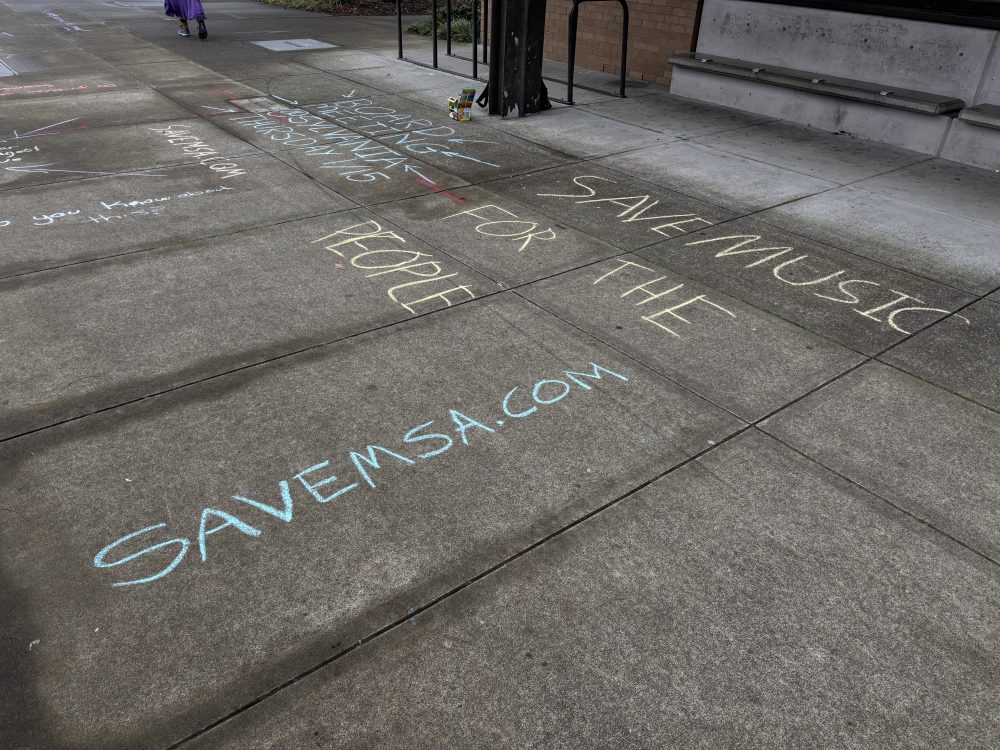
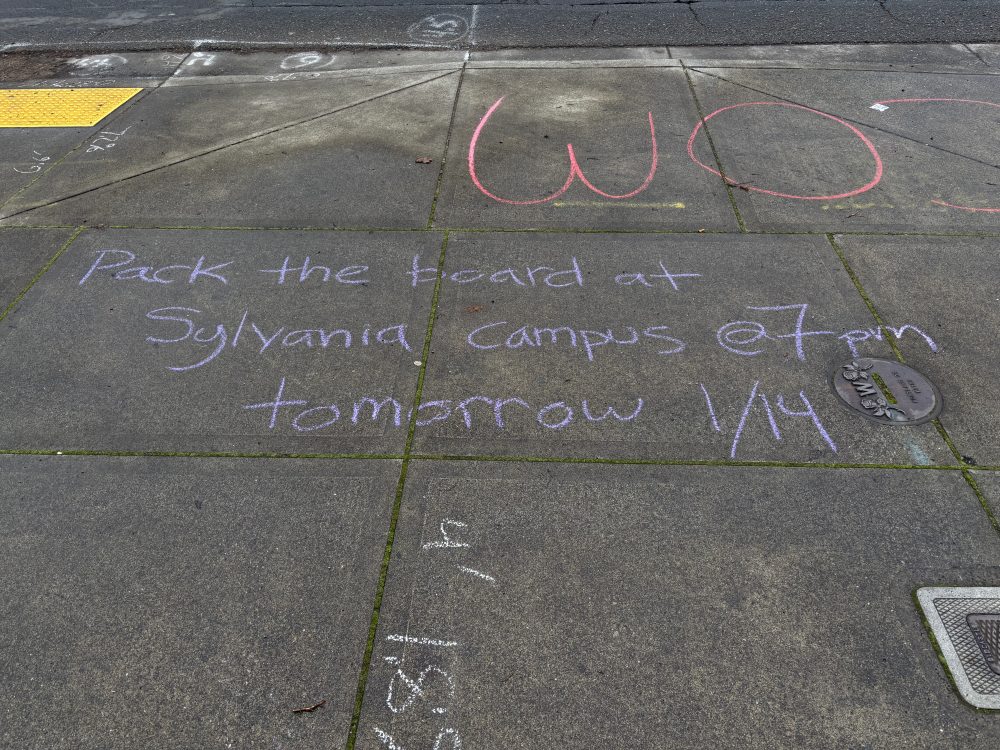
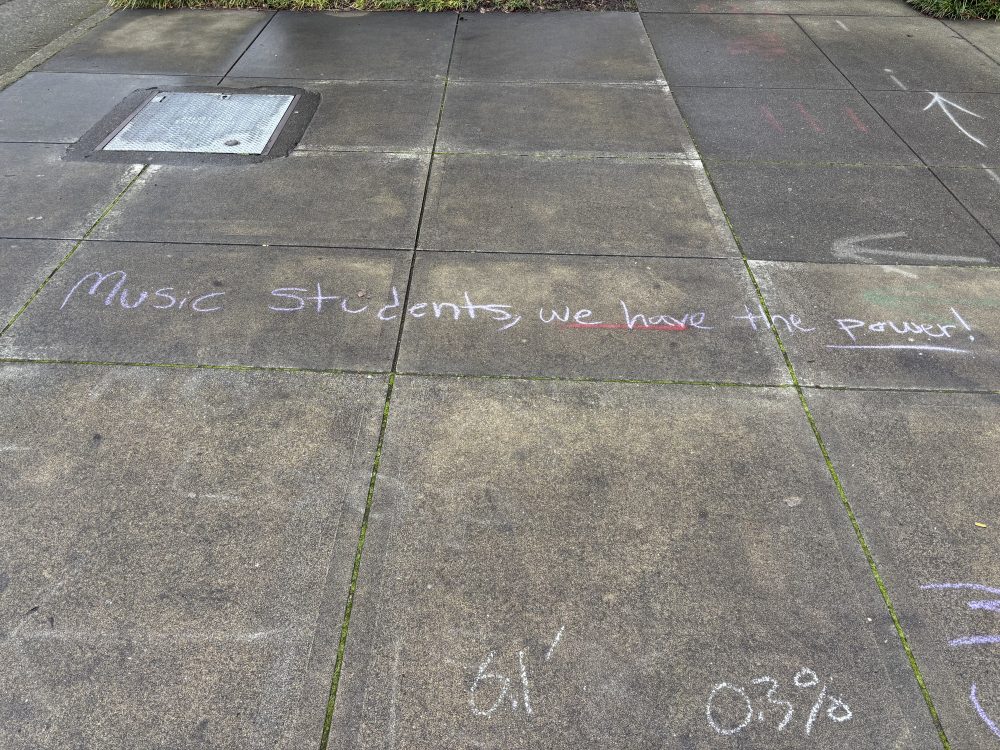
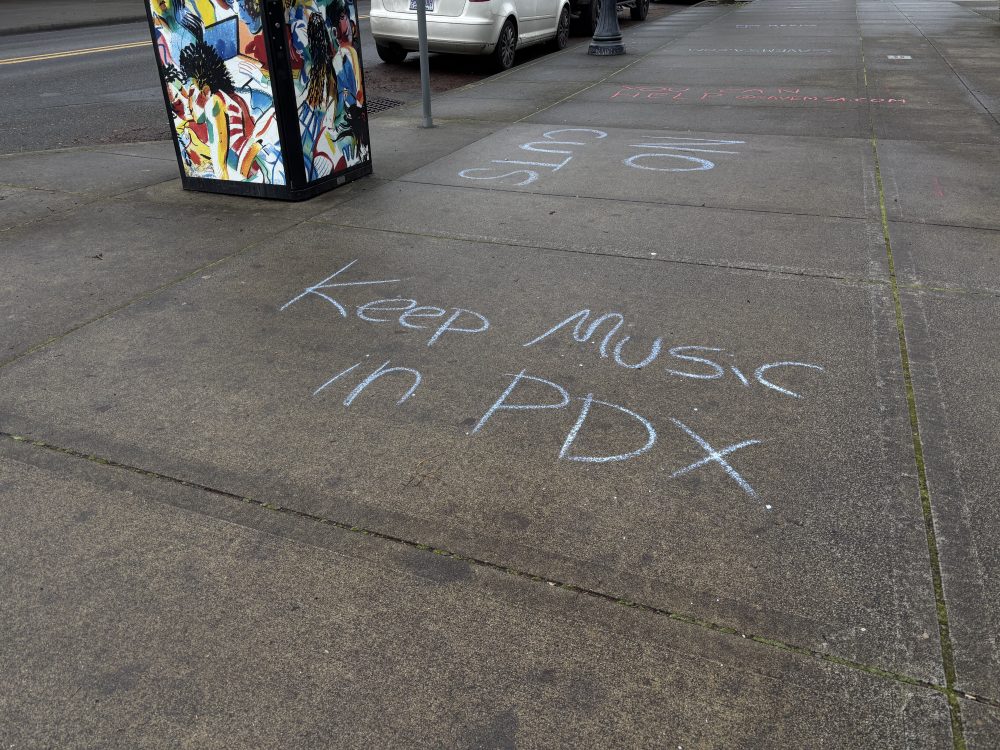
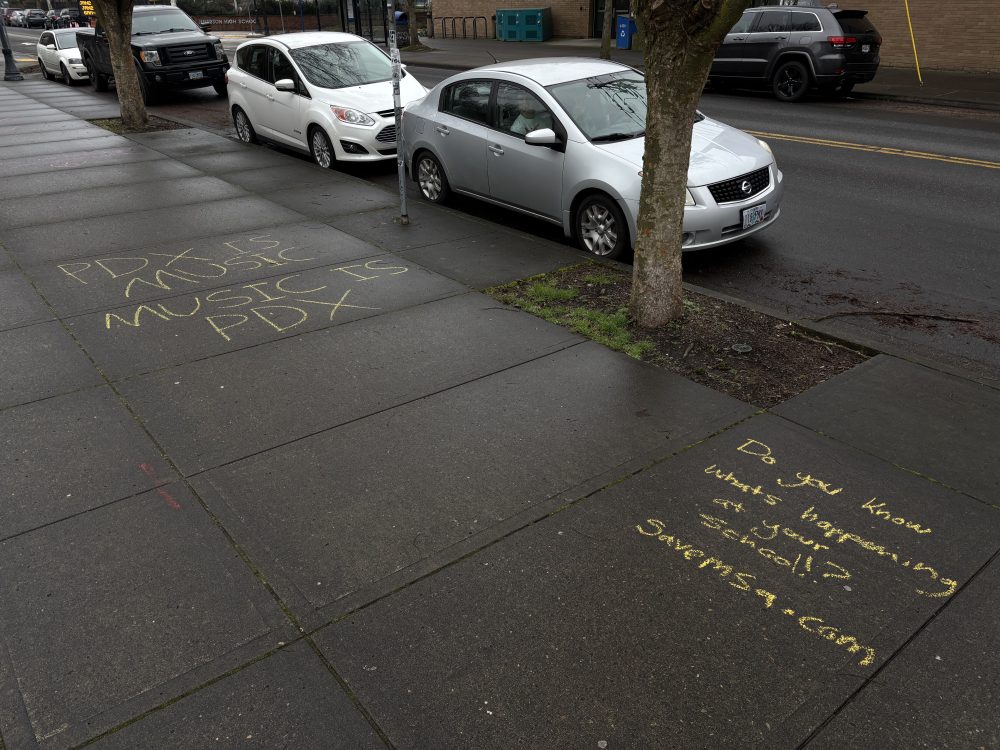
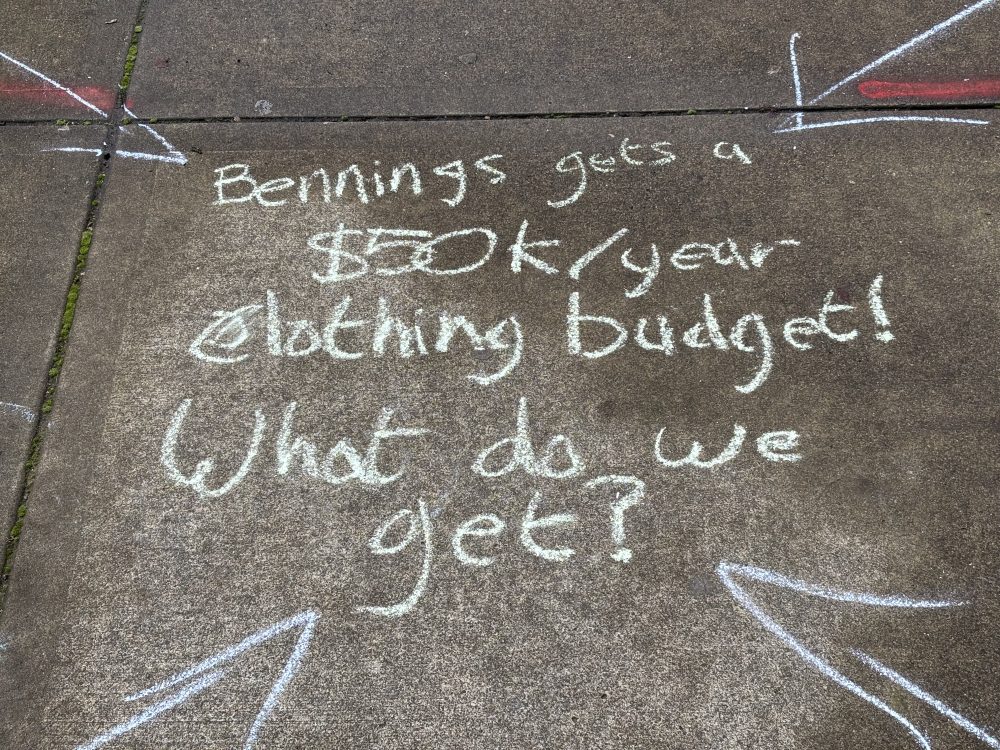
Alena: We then utilize what we have control of, which is we can do chalk on campus at Sylvania, at the specific areas we’re given, and we can also do chalk all around public ground. So then that was a great way to go out and do that. I ended up that night going to every single campus and writing about the Save MSA website on every single campus. And I hope that students go and check it out, savemsa.com. And that will have all of our facts and then some actions that the public can do to help support the program. So I think it, yeah, it, reinvigorated is just a great word to describe. As difficult as it was, I think, a big push came from that.
Miri: Yeah. I know a lot of people both students of this program and, employees and students at large in PCC felt like there had been a shocking lack of transparency and,
Liam: oh, yes. Yes.
Miri: Um, like explanation of decisions or even just that decisions haven’t been made.
Max: Yeah.
Miri: For a lot of things. So what do you guys think about that, and how should they communicate the ideas behind decisions that are made?
Max: Yeah. Um, well, as of right now, there’s really no foundational trust between students and administration. Um, there’s no foundational trust between the public and administration. The trust isn’t there between the faculty and the administration. Their intentions are vague, and often kind of behind a curtain. And a lot of their decisions to cut this program have been based on false data. So, you know, these cuts feel targeted in a way. Um, they do feel very intentional and it doesn’t make sense. This is a big program with high enrollment and high graduation rates. You know, there are a lot of part-time faculty here that are on payroll that, if were to be gone, would probably save the school some money. So it does feel a little targeted. At the heart of this really, there’s a lot of emotion and we’re all really embarrassed by this. The community’s embarrassed. Faculty are embarrassed. Alena and I spent a lot of time, between classes writing chalk, writing messages and chalk around campus. Just savemsa.com, save Music and Sonic Arts. And uh, actually the maintenance team was hastily ordered to scrub it clean the next day, and they were embarrassed as well. Uh, we talked to them directly and they were all, uh, quite embarrassed to be ordered to do something that went against their good nature is good people. ’cause, you know, getting an order from the top, when you’re at the bottom to do something like that to other people who are also at the bottom. Is, uh, quite demoralizing as a person, just as a human, you know, so. Having to watch that too, as just another person, sucked, you know?
Liam: Yeah.
Max: Seeing these guys that were just like, “Yeah, I’m, I’m off in like an hour and I have to do this for the rest of that time.”
Alena: Just the act of trying to spray chalk in support of the music program and being told specifically, we clarified with them it was not just on school grounds. It was anywhere including public grounds where there was chalk in support of our program to spray it,
Miri: Which I noticed coming in today, that a lot of it had been redrawn over.
Alena: Yes.
Miri: And clearly removed in some more forceful way than had been expected, especially because it was on the sidewalk and other things that I didn’t know that PCC was in charge of cleaning.
Alena: Yeah, they’re not. Um, so we have, we, I, I have looked through the laws of Portland chalking, and educated myself on the school policies and where our boundaries lie. Like we are an urban campus, therefore there is an aspect of public accessibility that happens when you have an urban campus. So the fact that they were going beyond what the school is in charge of to try and silence students, I think speaks volume to this being a targeted attack.
Liam: Yeah. Even one of the security officers walking around, he was telling us that he talked to when he was out observing the chalk, and he said openly to the security officer that he thinks that some degrees are more valuable than others,
Max: That’s right.
Liam: And that art isn’t valuable at all.
Max: Right.
Liam: Especially the art degree or, and just any art. So,
Max: So basically just to make this clear, the head believes that, uh, the arts and music are not valuable in society, and therefore are not worthy of funding from the school. From the school. Yeah.
Liam: Yeah. You have that. Correct.
Alena: And therefore any pushback should be silenced
Max: Yes.
Alena: Via power washing chalk.
Max: Yes. Right.
Liam: Yes.
Max: And, yeah. All of the school security officers that we talked to also thought it was nonsense that they wanted to scrub the chalk, or that they want to cut our program in general. So they’re all on our side. It’s crazy. It’s like, how could you not support our program? It’s like we’re a bottom up grassroots movement. We are in the community working with the community to make the community better. Cause they’re trying to take our community away.
Liam: Yeah.
Max: Like from the top, that’s what is happening, and we can’t avoid it any longer. We can’t dance around it. You know?
Liam: I’ve talked to strangers at concerts, like, on like, you know, an underground punk show and you, they’re like, “Hey, my best friend’s at the PCC program.” Yeah, yeah, yeah. For, you know, you know, just meeting other people and, you know. Totally. It’s, it’s a lot bigger than people think. It’s a lot more ingrained in Portland than people think.
Max: Yeah, yeah, yeah, yeah. Exactly.
Miri: This show is broadcast on, on KBOO the third Friday of every month, so. You know. Shout out to us, I guess. Um, but, you know, it’s a completely volunteer organization, and every time that I go in regarding this topic, the people there are like, “Oh yeah, I studied at that program”, or “Oh yeah, you know, our, our, our sound guy right now he’s from that program.” That kind of thing. So it is just completely coincidentally, constantly encountered out in the wild in my job, which isn’t even music based anymore. You know, this is a, a volunteer radio station that just is two thirds people who have gone through this program.
Max: And that really just highlights like how deeply embedded into this community this program is and this school is. I mean, there are four different campuses. Four or five different campuses around four, four different campuses in each corner of the city.
Miri: And the CLIMB Center,
Max: Uh, yeah. Sorry, sorry, my bad.
Alena: Also the, uh, one in Beaverton, Mill Creek.
Miri: Right!
Alena: Mill Creek. And they got chalk too! I chalked their campus.
Miri: I remember Mill Creek. My wife taught there for a little while, so
Harper: Yeah, I remember, I remember when they were still pretending that it was because there weren’t enough careers coming outta this program.
Max: Oh my God.
Harper: Uh, Ben Tyler, it was like last year I was taking one of Ben’s classes and I remember he gave us a story about how he went and played the band for like a Ted Talk, whatever. And he said that he literally saw one of his students running sound for the event. And I’m like, if that’s not the greatest example of this thing creates careers, this program creates opportunities for people.
Max: Well, there’s a,
Harper: oh my god,
Max: there’s a projected like what, 20,000 jobs in the state of Oregon for audio?
Alena: Yes.
Max: Engineering, live audio, live sound.
Alena: Yeah. Specifically also, I would like to speak to like my own career encounters. So I, when I started school, one of the jobs I picked up to support myself at PCC was teaching something called EMC. It’s a local Portland group, we teach at afterschool clubs at Portland Public Schools, and we teach Ableton to kids. That alone is like my why of like, why I’m ready to fight because every year I like to introduce myself to kids as a student before I’m a teacher and let them know that I’m also a music student and I’m also studying Ableton and music production. And every year I get a kid who says something like, “Maybe I’ll go to school with you one day, miss Alena!” And every year, except this year, I’ve been like, “Yes, heck yes! Like, maybe I get to teach you!” I would honestly love to teach at PCC and specifically teach some licensing or music business, which is a class that they’ve shut down in the past, that I would love to bring up once I graduate. That being said, this year it breaks my heart because the schools also I’ve taught at so far this term have been SUN schools, which are publicly funded schools for low income families. These are the students who need a community college. These are the students who will not afford PSU, and these are the students who do not see themself in any other college except something that’s accessible and that is their interest. These are students who have been using GarageBand since they were five, and these are students who are going to stay fascinated, and I can see the passion from day one, and it’s not gonna go anywhere. And it needs to be able to go somewhere in order to support them in a career when they’re older. That alone there is one of my whys of why I’m fighting and why I’m pushing back is for those students who are going to rely on having the accessibility to a program like this. I’ve also worked for Marmoset, the large commercial licensing company in Portland. They’re all over what’s going on, and they are without a doubt in support of saving the program. They’ve hired many, many, many, many, many students from here, and just that company alone has brought in multi-millions of dollars into Portland and Portland musicians. I also, currently, right now I’m in an internship at a publishing company, the only publishing company in Portland called Radio Tower Music Group. They have actually come to the board meetings. They didn’t come to the most recent one, but they came to the last one. They’ve also all sent emails to the board members, and they’re just baffled w’all that’s happening. Also one of our people from Radio Tower and who is helping mentor me, he started a company with one of his friends called Crystal Creative, which is another music licensing company. They just did the Superman trailer. They, they, like, they, they, they also bring in multimillions of dollars for Portland and local musicians. And I think it’s an absolute lie that there’s no jobs and no money for people in sound and audio and music.
Liam: Yes, thank you. I have to go, everyone.
Miri: And thank you for joining us.
Alena: Thank you, Liam.
Liam: savemsa.com!
Max: I think the hardest part about watching these cuts unfold is how we are losing as artists, the connection to the outer communities, and losing the trust of the outer communities. This city is run by artists and musicians, and it’s what keeps this city alive. And without these super niche programs and pathways to niche career opportunities, we wouldn’t have as diverse of a creative spectrum, I guess. Sorry. I’m trying to, trying to articulate, uh, my thoughts better.
Miri: Yeah.
Max: We don’t, you can cut this if you want.
Miri: No, I think that’s an important point that, that, you know, that creative culture and environment of Portland is objectively heavily influenced by what the people in this program have done.
Max: Yeah.
Miri: Whether the teachers or the graduates or the current students, everyone who’s gone through this program has made something that nobody else would ever have been able to make because it was them in this program.
Max: Right. It’s, uh, yeah, it’s, um, it’s definitely. Kind of a tragedy, you know? And, uh, that’s why we’re fighting.
Miri: So what kind of transparency would you want from the school? So, this most recent winter break, the college was completely closed. Employees were not allowed to do work during the break period, which has not happened before in the entire time that PCC has existed. Four and a half straight weeks of nothing. Advisors weren’t allowed to reach out, a lot of lower level admin stuff was shut down, like the accessibility offices and all the resource offices. And the thing that has been frustrating, a lot of people in my department is, nobody knows why. Because everyone asks. You know, my boss asks, my boss’s boss asks, and they just don’t tell us. Which is so much worse than being like, “Well, ’cause we save, you know, $250,000.”
Alena: Right.
Miri: Because if they told us that, then we’d be like, “I mean, that sucks, but fair.” But not telling us is like, It makes people feel like children. Like we’re being treated like, treated like children who are being treated badly.
Max: Well, it also means that like they expect us and they expect the faculty to bend to whatever will that they have in that sense. So like, if they want to shut down the school and not pay their employees for a month, that’s, uh, something that they, they’re just gonna have to deal with. Like, it’s, it’s like you said, it’s like a child. It’s like a parent child relationship, and it’s not, it’s not fair. It’s also not fair as students to not have access to our resources for a month.
Miri: Exactly.
Max: If I am working on a project that I’m preparing for the next term, if I wanna get ahead of myself and like start preparing a project for like, Creative Coding 2, because I’m carrying my, project from creative coding one into the next term, into my next class, and I need help from my teacher, they’re not supposed to talk to me or like, I can’t email them and they won’t respond. Or if I can’t, like, get in touch with, uh, my advisor or whatever.
Miri: Or if you’re a student with a mobility impairment or a learning impairment or anything,
Max: Totally.
Miri: Trying to reach out to someone, being like, “Hey, is this a class that I can physically take?”
Max: Yeah.
Miri: And then if it’s just gonna be silence for two weeks, then you know, that could either be a few hundred dollars wasted or just a bunch of undue stress of not knowing. What kinds of transparency do you want? If they come out tomorrow and say, “Stop talking. We are shutting down the program no matter what, and this is why”. What would you want to hear from them if that is their decision instead of just ghost?
Alena: Yeah, that’s a great question. The respect I think we’re looking for is regarding specifically the facts for our program closure. A lot of the different points and facts and data that was gathered originally from our program closure, we’ve all proven they’re false. If you wanna look deeper into them, you can look on savemsa.com. But to speak to some of them specifically, some of the claims were that we had a low graduation rate. Since 2023 ‘ the MSA program has a 27.5% graduation rate. The average PCC graduation rate is 18%. We’re significantly higher than the average graduation rate at PCC, so we know that to be false. There was a lot of claims about specifically for the graduation rate, we know we looked into the data that the administration did originally supply us, and it was including all students who originally signed up for the MSA degree. But there is a large number of students who signed up for the MSA degree and who did not actually start a single class. They included that in the, the statistic, which then is going to give us incorrect data. In order to feel respected as a student, I would like to have data of students who are actually participating in the class. I feel like that would give more valid data to actually what’s going on.
Alena: They’ve also claimed that there’s not enough students, we have empty classrooms. There’s 137 full-time students right now in our program. That’s also significantly more than other programs. So, once again, does it make sense that the claims that they’re making? Lastly, one of the claims that they’re making is that CTE programs are required to have a direct correlation with specific careers or job opportunities. That is nowhere. We, we’ve searched the PCC CTE requirements on the actual website of PCC.
Miri: And CTE means what, sorry?
Max: Career technical education.
Alena: Yes. Um, there’s 40 other programs that are considered CTE programs at PCC. None of them have like a specific job that you’re gonna get lined up and go to, so for administration to make a claim that: Music and Sonic Arts lacks that, therefore we should be shut down, I think is an absolutely ridiculous claim. So if they were to say, “Hey, this is why we’re closing the program,” I think I would like them to exclude the CTE point because we’ve proven it’s false, we all know it’s false, and then I would like to see actual data that is from students who engage in the program. And also just to like, come to our school and see what we do, and then make a choice after actually seeing with their own eyes of what’s going on. That’s, that’s the way that I would feel respected.
Miri: Yeah.
Alena: Yeah.
Harper: They, they treat our program like, it’s like a high school administration where they would actually have the, the power to just do whatever they want, but then they forget that we are all adults that go here, who can do things.
Miri: And pay for it.
Harper: And pay for it. So. I mean, I literally, my high school, I went to a high school up in Canvas and literally almost the same thing happened to my high school. Not closure of the high school, but like $6 million in budget cuts which were discussed. And the entire school protested. And unfortunately it just went through because there just wasn’t enough support against that large of budget cuts. But like, it was just a lack of respect for the program because like other schools in the area, our school was like a relatively newer school, and more modern, I would say, due in part to being a pretty recent school, like we got like $6 million in budget cuts compared to the public high school that was, I would say, a more traditional high school that’s existed for longer. Nothing, or at least very much less. It’s just a lack of respect, and that’s exactly what’s happening here. It’s a lack of respect for the program.
Max: Yeah. It’s tough to see the board be so divided about this, at this point. It’s clear that a lot of the board members are embarrassed that they have to sit there with other members who don’t support the program. For us as students, it’s imperative that we see a direct relationship between us and those who represent us. We want to see them walking our halls. We want to see them stop into our classes and see what we’re learning.
Miri: Come to the capstone.
Max: Come to the capstone. We want to see them come to events that we put on, at the school, led by students.
Harper: It’s like arguing with like a corporation.
Max: Right? No, it does. And that’s, that’s another thing.
Alena: Can I speak to that really quick? So actually something that Greg, one of the chair members, a comment he made after Tiffani Penson announced, “Hey, the conversation’s closed,” and then Music and Sonic Arts people walked out. And then if you watch, it’s posted on the PCC website, the whole entire board meeting. They then go into actual like policies and procedures and, you know, some of the. the stuff that they’re distracting themselves with, I would call it. And beforehand, most of the people participating in those conversations do make a statement regarding what’s happening. Greg, the chairman —it cuts out when it first starts, but he goes into discussing that he went and visited the jazz performance at the fall term. And that he went and saw the choir and talked about how good they are. And I think, some of them want to support, but they just don’t understand that Music and Sonic Arts is completely different from music performance. So I do agree that they should come specifically to our capstone. They should come specifically to Cascade Campus, and see our program and not just generalize us and bunch us in with music.
Max: Right. I, I absolutely agree. It is clear that the administration wants to run the school like a business, but PCC is not a business. It’s an institution of education for the public, designed for the local communities. For people who either cannot afford to go to a four year state school, or just need a one-off class experience. I, I know PCC used to offer beginner technology classes for like elderly people who didn’t know how to check their email. It’s stuff like that that, like, I know things like that might not be getting cut elsewhere in the school, but, this program in specific is really the future of Portland art. I mean, it is. Especially over here on the east side where we’re surrounded by lower income areas. There’s nothing else like this in the city for these communities.
Harper: And for a city with such a massive underground scene, in general, and local scene, it’s insane to say that a music program is not good for the, like,
Max: so much good local music has been recorded on this campus, in the studio here. Local band Gonzalez, Harper and I recorded their recent —
Harper: That was incredible.
Max: Yeah. We recorded their recent demo release that just came out in November, and it was kind of incredible. It was one of the coolest things I’ve ever done in my life.
Harper: First time I’ve ever gotten an opportunity to do something like recording a band like that, and it, it was — If I, if this program didn’t exist, I don’t think I would’ve ever been able to do something like that. You know?
Max: No, never. And to say that I did that, and to have my name be on the back of their mix tape when it comes out, like, it’s like, “Oh my God, holy Shit” you know? I can keep that for the rest of my life and be proud of that. And that kind of exceeds any sort of superficial career opportunity that I might get, or whatever idea of that that the board has that this program is “clearly missing.” The experiences that I’m getting are also giving me those opportunities, these experiences of recording bands, and learning how to set up interactive, audio visual experiences in a performance setting or a gallery setting. Those are really niche areas of the creative world and the digital creative world right now, but they’re very important and they’re becoming more important. And I think they’re also kind of key to helping us move forward as a society, creatively philosophically too. Integrating these types of things into different parts of our world and daily life is what’s next, I think.
Harper: And also just creating more accessible means for people to be creative like this. The skills you learn in this program, obviously we mentioned how applicable they are at everything, but also just the fact that this kind of compared to music performance, these kind of skills are much easier for someone who maybe doesn’t have an insane budget to spend on a studio. It’s a lot easier to apply these skills in their life, you know?
Max: I think that the board probably sees this program is about like live music performance or being a musician, playing guitar, singing, playing piano, singing, It’s so much more than that. And even then, not everybody has the talent or desire or really just the energy or motivation to want to perform live. Because it’s kind of a chore sometimes to perform live. It’s very enjoyable, but I have tried my hand at it. I don’t think it’s for me. I’d rather be behind the scenes, working to put on the production. And there’s so many opportunities for that, career wise.
Miri: Do you all know, Dillon?
Max: I don’t think so.
Miri: He is — current? Former? Both? — You know, students at PCC tend to have kind of a tenuous relationship with being a full-time student. Because you know you’re full-time for a term and then you’re like, “Oh, I’m outta money, I gotta take a term off.”
Max: His name is Dillon?
Miri: Yeah.
Max: Is he Deaf?
Miri: Yes.
Max: Yeah, yeah, yeah.
Miri: Yes.
Max: He was in my microcontrollers class last year.
Miri: Yep! He is absolutely insanely brilliant.
Max: Yeah, he’s super smart
Miri: And is a Deaf man in a music course.
Max: Right?
Miri: Because he is developing machinery and —
Harper: Literally a modern Beethoven
Max: Dude, it’s actually, no, it’s actually so cool. I remember what he was doing when we were in microcontrollers. It was this like frequency glove thing that like played a… I can’t put good words to what he did. It’s probably so much better than what I’m saying. I think it allowed him to sense whatever frequency was being played really accurately or whatever, and he could like learn the notes of the frequencies and, and, and such.
Miri: Yeah. And he has been able to develop multiple software and hardware pieces of technology in this program that facilitate his ability to create music as a Deaf person.
Harper: Yes! Thank you for putting better words to that.
Miri: I’ve talked with him a few times, so.
Alena: I loved your interview with him.
Miri: Oh yay! I’m glad. It was so loud in that room that day. Oh man. Um, but yeah, he, uh, he’s brilliant, and I know is not having a good time with the program being shut down and is being a very vocal, supporter of the program continuing and is a huge advocate for both hearing students and for what this program and the sort of technology developed in this course could mean for not just Deaf people, but other people with disabilities, whether vision loss or mobility impairment, anything, of being able to experience a more well-rounded and rich and colorful environment and life and way of interacting with the world.
Max: It’s incredible. Truly, truly incredible.
Miri: He is fantastic and would be. Such a shame to drop the ability for people like him to pursue the things that he is pursuing in the way that he’s pursuing them.
Alena: Yeah.
Miri: By shutting down a music technology program that isn’t just focused on music performance.
Alena: Yeah. In my composition class during fall, we had a guest speaker come in, Molly Joyce. She’s an advocate for accessibility in Music and Sonic Arts. She’s a disabled individual herself, and a lot of her music is about her experience with her disability. But she’s also an absolute modern day pioneer with advocacy and creating tools for disabled individuals to still have access and engage and specifically to express themself through art. Art is a birthright, and I think what Dillon’s doing, as well as Molly, and specifically the tools that this program offer, do give students an opportunity to advocate for that expression and make it accessible.
Miri: Yep.
Alena: Yeah.
Miri: So what is the next step? What is the next step for both students and for how listeners can get involved in this?
Alena: So a couple things. For listeners specifically, the small step you can do is check out our website. It’s savemsa.com, one of the instructors from Sonic Arts, Erica made. It shout out to Erica. On this website, you can find links of specifically contacting the board members. Tiffani Penson at the last meeting made a comment that no one has sent her any emails, has shown any data, and she invites us to. So I would like to invite you to utilize some of those. We have all the board members emails, but specifically to send Tiffani the facts that we have documented from the website. You can be as simple as just copying and pasting and then putting it in her name and sending that off. If you’re a music professional, any backing from music professionals in Portland or just anywhere, who can advocate to us and also send an email to the board would be helpful.
Miri: Which I’ve heard you’ve got a lot of support from.
Alena: Yes, we’ve had hundreds. Hundreds! we’ll keep on doing it. I would love for it to be thousands.
Miri: Billions, even.
Max: Would it —
Alena: Yes. We’ll make it undeniable. What were you gonna say, Max?
Max: No, no, no. I’ll say it after.
Alena: Okay. Um, then the next couple steps, the two other biggest things I would like to put out there, February 12th at 1:30, we’re gonna have a school wide walkout. It’ll be hosted at Cascade. We’re gonna have free food and drinks and as well as Sonic Art students are gonna perform some live music. February 12th, it’s a Thursday at 1:30 PM. It’s going to be also advertised via chalk at every and all campuses as well as student gov. So there’s the be the walkout. Any and all participation there is gonna be great. We’re gonna have media come out and the thing we want to do is to show a large number of people who are in support because I think taking the angle of specifically digital support, hasn’t been loud enough. So I would like to show physical support and physical volume of being loud. And as well, have it stream on multiple platforms. We have KOIN-6, as well as other medias and journalists coming out who are gonna help document it as well. The other event that is coming up is the February 19th board meeting. We haven’t confirmed yet, but we are still in the works of getting our proposal for our program on their agenda. I’m feeling hopeful about it from the most recent updates that it will get on their proposal. That being said, that’s the meeting that we really want to pack and fill.
Miri: On February 19th?
Alena: February 19th at Sylvania campus at 7:00 PM. I invite anyone to sign up for public comment. As of right now, we haven’t gotten any news if it’s an agenda or non agenda item, but that will guide you of specifically how you sign up depending on all that. Those are the two big events that are coming up in February that are going to be a necessary part of showing student support. I think they’ve heard a lot about it, but this is going to be the showing of it.
Miri: And as always, the capstone at the end of the year, which is just always a good experience, you know, whether or not you’re trying to protest anything.
Alena: Yes, yes.
Miri: Um, what about, what is next for students, for you guys?
Alena: What’s next for students is I’ve been in contact with student gov. We officially have really started to connect and start to problem solve of, what can they do? What do they feel comfortable doing? What are their plan B’s? What are their plan C’s? I think they have felt, from what I’ve heard, they would like to advocate for students and that they’re feeling sick and tired of what’s happening to students regarding all these budget cuts. So we’re exploring their freedom of expression. And once again, just falling back on, if there’s no rules, then there’s no rule to break, so we might as well just do it. I’m gonna have the student leader Fareeha, she’s coming in tomorrow, into campus on Cascade, and she’s gonna be joining me in class. I’m gonna introduce her to all the students, and just show her around campus, which I’m really excited about. And then they will be coming next week. They would like to make a survey to fill out students and they would like to bring the data of the survey to the Capitol, which will also be going on February 12th. The student gov got invited to go speak at the Capitol, and they’d like to speak about our program being closed.
Miri: The Capital-Capital! Like in Salem?
Alena: Salem, yes.
Miri: That’s impressive!
Alena: So that our, our No our next, our next steps is to bring. the capital into this. I think, specifically the claim of that Tiffani Penson hasn’t been sent any emails we all know is incorrect. We are also looking into giving a government audited email on her, because she is a public servant, so therefore her emails can be audited, and therefore we can disprove her and hopefully put it on posters for the February 19th board meeting, and of her email inbox and all the facts she has received. So that’s for students. And then it’s just the walkout. I’ve been inviting students via my email list for doing chalk around campus, and just getting loud. Get noisy.
Miri: Awesome.
Alena: Yes.
Miri: You are doing some absolutely fantastic work.
Alena: Thank you.
Miri: And you and all of you should be very proud of yourselves, both for fighting for this and for the work that you do in the class regardless of this. You know, creating music and technology and putting them together and turning something that is the inkling of an idea in your head into something physical there in front of you is just one of the coolest things that a human being can do. It’s the thing that makes us human.
Harper: Absolutely.
Miri: As opposed to anything else.
Harper: Yes.
Miri: So, uh, thank you all so much for coming in and talking to me today.
Alena: And yeah, thank you for giving us the space to speak.
Miri: Yeah. Oh, always. That’s what, uh —
Alena: Thank you for continuing the conversation.
Miri: Yes. That is what we at Let’s Talk! are here for.
Postamble
Miri: Thank you for listening to Let’s Talk! As you heard in this episode, most of the frustration is held against the school’s apparent lack of transparency, and a refusal to, at least seemingly, consider what comes from the voices of others. It’s a tough time for colleges all across the country right now, with pressure from federal budget cuts, active soldier mobilization, and a rising anti-intellectualism all combining to create an incredibly stressful environment for educators. But the solution to that, at least I think, is rather than shut out students, faculty, and the community, to invite them in to be a part of decision-making and mutual support. With a student body of over 50,000, and an alumni body that is truly uncountable, Portland Community College is one of the most powerful, influential, and beloved community colleges in America. This is the time for us to take on that role, embrace that role, and show students and educators across the country that; in these dark times, not only is it possible to survive, but to have our students and our communities thrive. All we need is each other, and it’ll all be okay. Thank you for listening to Let’s Talk.
A Timeline of Lost Trust
Article by Miri Newman
This photo, and the other eight in this slideshow, are examples of chalk art that student activists created in support of the MSA program.
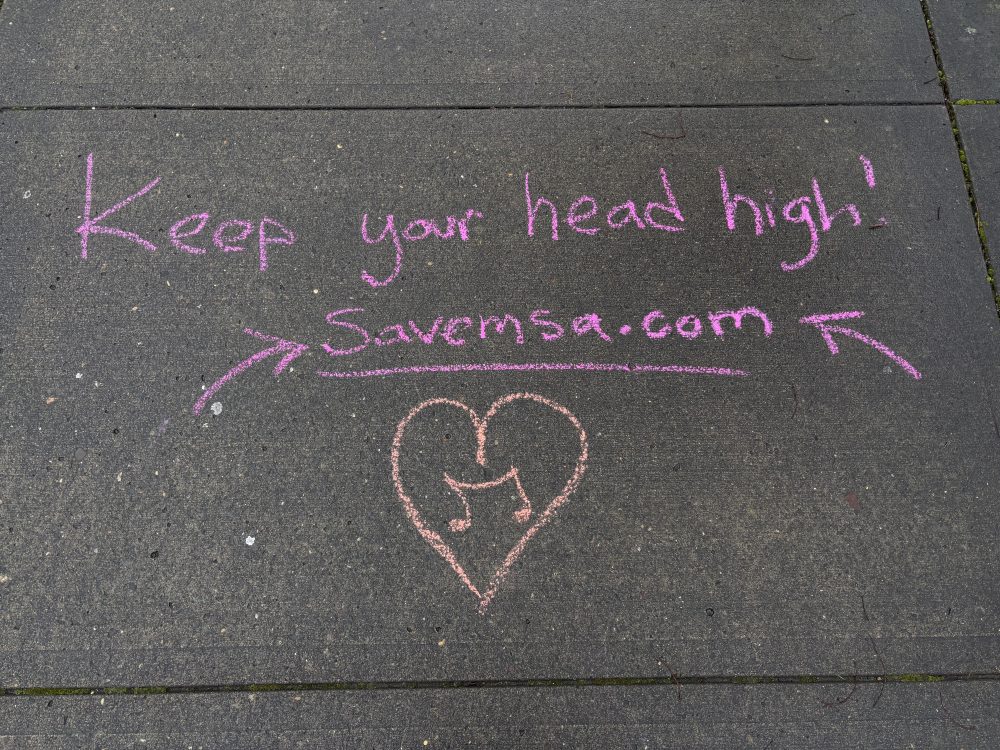
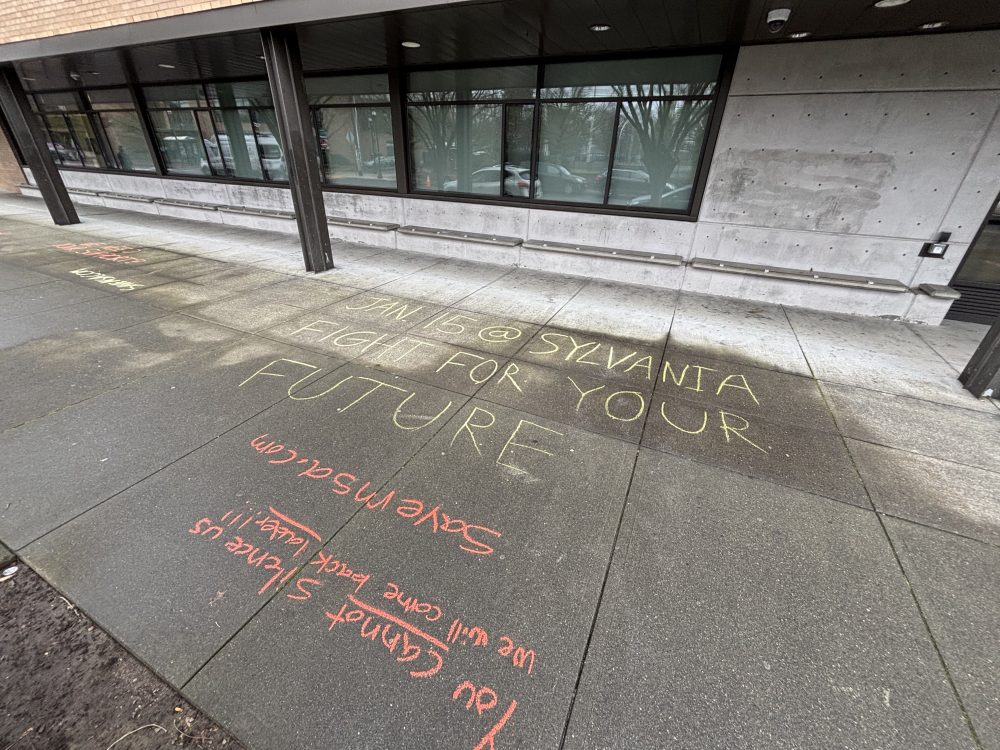
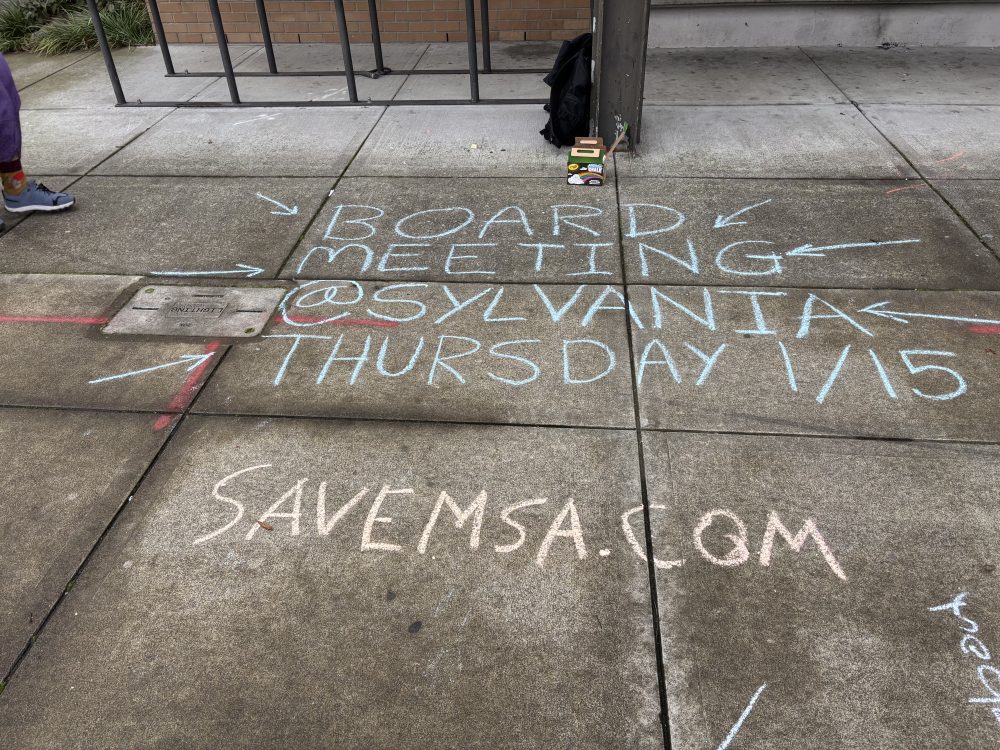
Author’s note: Some of this information, along with additional resources, can be found via savemsa.com, with other specifics coming via email or PCC’s website. A collection of sources will be made available down below, as well as linked at the start of each applicable date.
April 29, 2025
[1] The Office of the Vice President and Academic Affairs sends out an email listing results of Self-Study results, stating that the Russian, Gerontology, and Music and Sonic Arts programs “may be closed as a result of this review process”. The reasons given were:
“(1) Russian – plan was accepted as written/proposed by faculty,
(2) Gerontology – we are recommending closure to this CTE program due to lack of evidence of entry-level jobs at the Associate or Certificate level, but we are committed to continuing with transfer-level programming in this area,
(3) Music & Sonic Arts – we are recommending closure to this CTE program due to lack of evidence of entry-level jobs at the Associate or Certificate level, but we will conduct an industry-driven backward design process to evaluate whether some of these courses could be offered at the transfer level and/or in collaboration with the Music department.”
April 29, 2025
[2] (That same day) – Vice President of Academic Affairs sends out another email just to the MUC-faculty-staff mailing list, stating:
“Dear Music and Sonic Arts,
“We are writing to notify you of the results of the Self-Study. After a thorough review, we will not be accepting your plan and have instead provided you with an alternative plan that you are being asked to implement. We imagine that this is hard information to hear, and we aim to support you through the changes and updates we would like you to make. We also know this was a lot of work to think about, compile, and create the report,t [sic]and we appreciate your efforts.”
June 13th, 2025
[3] VP of Academic Affairs sends out an email regarding the program appeals, specifically referencing Music and Sonic Arts and Electrical Engineering Technology. It reads, in part: (edited slightly for brevity)
“After careful consideration by the President’s Cabinet (excluding Drs. Ernst and Paez), both original decisions will stand. […]
“The AAS and certificate programs in Music & Sonic Arts will be discontinued. A full teach-out plan will be put in place to support currently enrolled students through approximately 2027. […] While the currently offered credentials did not demonstrate alignment with state and federal CTE employment standards, we recognize the program’s high value in preparing students for entrepreneurial, project-based, and transfer-oriented careers.”
October 17th, 2025
[4] The Office of the President sends out an email to the populace, signed by Dr. Bennings and cabinet, containing a particularly controversial line:
“Think about how Costco sells their rotisserie chickens at a loss. They can do that because they will make up the loss by charging more for other goods. But if Costco sold everything in their store for the price of a rotisserie chicken, no amount of chicken sales would be able to compensate for losing money on the products that cost them more to keep in stock. They would go out of business.”
November 14th, 2025
[5] Board Chair Tiffani Penson sends out an email to MUC/MSA recipients regarding the situation, stating in part that:
“No one is arguing that the skills students learn here matter. They do, and we know that Portland’s creative economy depends on them. But offering something as a Career and Technical Education program isn’t about whether the skills are useful or meaningful. It’s about whether the degree or certificate itself is something employers actually require to get a job. In the case of Music and Sonic Arts, the skills matter, but the credential isn’t needed to work in the field.”
December 10th, 2025
[6] PCCFFAP (Federation of Faculty and Academic Professionals) posts an open letter to the President, the PCC Cabinet, and the PCC Board of Directors. In the letter, they outline a multitude of grievances, including a dissolution of trust between the administration and the rest of the school body, the massive rise of management roles while many teaching positions have been cut, and the college’s representatives neglecting to meet with FFAP’s bargaining team.
Ultimately, they call for: “a show of good faith from the President and the Cabinet, [which would be to]:
- Stop the cuts to courses and programs that meet student demand.
- Instruct the College bargaining team to provide substantive responses to our proposals.
- Publicly respond to this letter by Monday, January 5th.”
January 5th, 2026
[7] President Dr. Adrien Bennings posts an open reply, sent out to the school body via email, refuting and giving counter examples to points raised in FFAP’s open letter. Both this response and the original letter will be available to view in full in links below.
January 14th, 2026
Student activists chalk — in accordance with the PCC and Portland chalking guidelines — Cascade campus in support of the MSA program. These are power washed by facilities by the next week.
January 15th, 2026
PCC’s board meeting is saturated with supporters for the MSA program. Many are signed up as public commentators, with even more appearing to stack the room. Chair of the Board Tiffani Penson states: “I’ve seen all of your emails and I’ve asked you guys, if there’s information that you have that we are missing, to forward it to the administration and forward it to myself, and I’ve never received anything. So again, I do thank you. I thank you for your, um, compassion. I thank you for your commitment, but this will be the last conversation around this.” A petition begins to audit her email to check the veracity of her claim.
January 21st, 2026
I sit down with four members of the Music and Sonic Arts program, and we talk for nearly two hours about their experiences at PCC, their efforts to save their program, and the shattering of the trust between the student body and the PCC administration. Their passion, frustration, and outrage are palpable, but their strength and resolve in the face of apparent hopelessness is awe inspiring. They believe that they — we — can save this program.
And I do too.
Sources
- Self-Study Updates and Next Steps“; Jennifer Ernst, Portland Community College Vice President of Academic Affairs, 2025 (ret. 2/4/26)
- “Self-Study Evaluation Results: MUC”; Jennifer Ernst, Portland Community College Vice President of Academic Affairs, 2025 (ret. 2/4/26)
- “[All College Staff] Program Appeal Outcomes: Music & Sonic Arts“; Jennifer Ernst, Karen Paez, Karen Sanders, Office of Vice President of Academic Affairs, 2025 (ret. 2/4/26)
- “[announce] A Note on Course Scheduling Decisions“; Dr. Adrien Bennings, President, and President’s Cabinet et al, 2025 (ret. 2/4/26)
- “[All College Staff] Fwd: MSA Board Response“; Tiffani Penson, Board Chair and Zone 2 Representative, 2025 (ret. 2/4/26)
- “Open Letter to PCC Leaders“; Executive Council of PCCFFAP, AFT-OR Local 2277, 2025 (ret. 24/26)
- “Open Letter Response 1-5-26“; Dr. Adrien Bennings, President, 2026 (ret. 2/4/26)