Robert Dozono
ROBERT DOZONO (1941-2025) was born in Katsuyama, Okayama Prefecture, Japan. At 13, he and his younger brother and their father moved from Yokohama to join his mother and sister in Portland, Oregon, where Dozono attended Buckman Elementary and Benson High School. He entered the University of Oregon as an architecture major but switched to art after auditing a class by visiting artist Herman Cherry, who encouraged him to pursue art as a degree. Dozono received his Bachelor of Science in Fine Arts from the University of Oregon in 1969 and his Master of Fine Arts from Pratt Institute New York in 1971 where he studied with Jacob Lawrence. Dozono returned to Portland in 1973 when he began a long and distinguished career in the art department of Portland Community College (Sylvania Campus) teaching basic design, watercolor, and life drawing, and ultimately chairing the art department until his retirement in 2001.
As a teacher, Dozono inspired and mentored students as well as colleagues. An energetic and forceful presence in the classroom, he drew alongside his students, often making gestural, life-size drawings of the figure. He encouraged his students to be free and explorative. “It is important to make works just to make them,” he told his students. “The ultimate freedom is the freedom to make bad works. We do not learn by having answers given to us. It is (the student’s) right to discover, not the teacher’s.”
As an artist Dozono exhibited his drawings and paintings at the Portland Art Museum, Pacific Arts Center (Seattle), Willamette University, Maryhill Museum, Oregon History Museum, Clackamas Community College, Mt. Hood Community College, Lane Community College, University of Oregon, Clark College (Vancouver), Rockford College (Illinois), Marylhurst University, and Newport Arts Center. His longest gallery affiliation was in Portland with Blackfish Gallery, an artist’s co-op, where he was a member from 1986-2001.
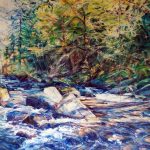
Dozono’s paintings often demonstrated his commitment as an environmentalist by incorporating plastic garbage directly onto the surface of his paintings. “The natural environment is very important to me. I have reused objects that one cannot recycle – plastic items, wiper blades, rubber bands, toothpaste tubes, and hairdryers into my work to foreground what we are doing to our natural resources.” Examples of these landscapes, both with and without these recycled objects, can be found in the PCC Art Collection. Dozono’s longtime friend and colleague George Johanson said of this work“…he overlays it all with an atmospheric landscape that is both at odds with the junk field and completely interlocked with it. One reads both separately then simultaneously. It is a dizzying display.”
Sometimes in teaching the figure Dozono would draw with his charcoal on the end of a long stick and make his drawing sprawl across paper on the floor or the wall, his body agile as a dancer’s. Much of his work in drawing and painting can best be experienced by sensing Dozono’s physical relationship to the work surface and to the gestures of his body conveyed in the mark. “Every bend or twist in my body shows up in my work. It is not an illusion of movement. Because I move, the energy is recorded.”