
Program and Discipline Fiscal Sustainability Review Process
Phase 2 Activities
Gratitude
Academic & Career Pathways managers would like to extend our thanks to faculty and staff for their thoughtful contributions to the Program/Discipline Fiscal Sustainability plans. Every PCC program submitted a plan. The thoughtful reflection and purposeful contributions of each team were evident, and we are incredibly grateful.
Fall 2025 – Winter 2026 Actions
- Facilitated a 10-session Community of Practice to support Program Deans in guiding disciplines through the Category 1 and 2 planning processes.
- Achieved 100% compliance in plan submissions for Category 1 (57 programs) and Category 2 (14 programs).
- Monitored Category 3 plan implementation, resulting in the successful submission of progress reports from all 14 participating programs.
- Integrated the Fiscal Sustainability (PDFS) process directly into the 2025–2026 Academic Program Review cycle.
- Developed a standardized administrative response template to streamline Dean feedback on Program Reviews and Fiscal Sustainability Plans.
- Identified departmental cost-saving strategies for every program, establishing a clear focus for the 2025–2026 and 2026–2027 academic years. Each program provided suggestions for cost savings in their report.
SUMMARY (Note – this is a duplicated number because some programs suggested more than one cost saving strategy).
| Cost Saving Strategy | # of Programs |
| Increase fill rates | 36 |
| Reduce part time budget needs (e.g. reduce reassigned time, reduce overloads) | 21 |
| Increase course caps | 30 |
| Strategic scheduling | 48 |
| Other | 7 |
Project Plan – Phase 2
2025 – 2027
Beginning in Fall 2025, we transitioned to Phase II of the Program/Discipline Fiscal Sustainability Process. The Phase II goals are:
- Plan implementation for all Category 3 programs. (See summary of final decisions.)
- Implementation of all Category 2 program-created plans.
- Implementation of standard cost saving measures across Academic & Career Pathways (ACP).
- Track savings for FY26 and FY27 across ACP.
- Determine how best to integrate the PDFS work with an ongoing, institutionalized ‘Program Review’ process.
- Provide regular and ongoing communication to key stakeholders and the broader college community.
This project continues to align with the values, goals and objectives of PCC’s Fiscal Sustainability Action Plan as well as the following ACP 2025-2026 Imperatives:
- Guided Pathways Implementation
- Continuous Improvement in ACP Operations
- Innovative Workforce & Economic Development
- Inclusive Teaching & Learning
- Leadership Effectiveness
The PDFS ongoing project work honors the following guiding principles:
- Student-Centered Focus: Every aspect of the planning and actions taken will be designed with the students’ needs and success at the forefront.
- Values-based: Criteria, metrics and decisions will be grounded in the following institutional values: Fiscal responsibility and sustainability, advancing economic development, access to quality education & training and academic excellence.
- Accountability: A commitment to regular communication through clear and regularly shared documentation and updates.
- Data-informed Decision Making: Decisions made at all steps in this process will be informed by data from a variety of internal and external sources.
Completed Work – Phase 1
2024 – 2025
On November 19, 2024, the President’s Office sent out a Fiscal Sustainability Framework & Action Plan outlining the College’s approach to fiscal sustainability for the next three biennia – through FY2031.
Embedded in the plan, and for Academic & Career Pathways specifically, is a Program/Discipline Fiscal Sustainability Review (PDFSR) Process. Understanding that significant academic program reductions (i.e., reductions, mergers, redesigns) take time to implement, this process began in winter 2025 – in order to result in savings in FY2026 and in the 2027-2029 biennium.
Phase I of this process took place between January and June 2025. It included the following steps:
- Broad Review using a set of institutional data of all 90+ programs and disciplines
- Comprehensive Self Studies by select programs/disciplines
- Appeals process
- Final decisions
Phase II (2025-2026) will focus on the implementation of cost saving measures across all programs/disciplines with the support from Pathway Leadership.
Accountability Measures for Academic Affairs Leadership
In an effort to be more clear and transparent, the Academic Affairs Leadership is committed to the following accountability measures throughout this process:
fa regular fa file lines
1. Clear Documentation
We will maintain detailed records throughout the process. This includes feedback collected, responses to feedback, scoring rubrics, and rationale for decisions made.
We will update this webpage with additional information and documentation at each phase of the process.
fa solid fa pen to square
2. Regular Progress Updates
We will schedule regular updates (e.g., at least one update per phase of the project) to share progress with faculty, staff, and others.
We will use these updates to highlight milestones reached, challenges encountered, and next steps.
Progress throughout the process will be tracked and recorded on this webpage and linked to the Fiscal Sustainability website.
fa regular fa comments
3. Feedback/Inquiry Mechanisms
We will implement channels for faculty, staff, and managers to gather information and provide feedback on the process, both during and after the program self-studies.A Questions/Inquiry form will be provided with each communication. We will provide a response directly to each submitter if an email is provided with the question.
Time with leaders will be offered to impacted programs/disciplines at the end of the comprehensive deep review and post-appeal, and by request at any phase/time of the process.
Archive of Completed Work (2024 – 2025)
Understanding that significant cost reductions to academic programs and disciplines (e.g., redesigns, mergers, closures, etc.) take time to implement, a Program/Discipline Financial Sustainability Review process was enacted in winter and spring terms (2025) to result in savings in the second year of the biennium (FY26) and for the 2027-2029 biennium.
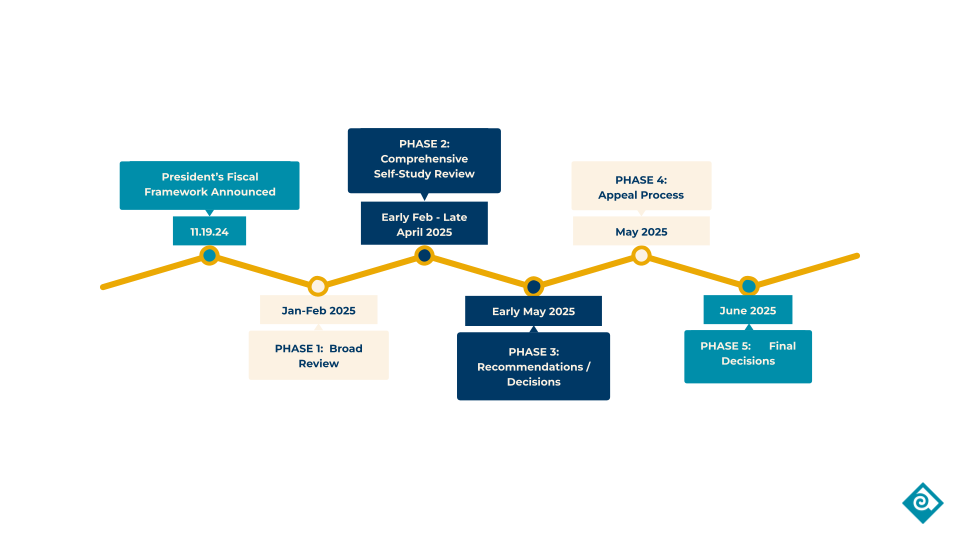
Summary of Program/Discipline Cost Reduction Phases & Timeline
A left to right timeline diagram with 6 phases or milestones along the timeline, each labeled with a date or date range and description. The first label is President’s Fiscal Framework Announced on 11.19.24. The second label is PHASE 1: Broad Review from Jan-Feb 2025. The third label is PHASE 2: Comprehensive Self-Study Review from late February – early April 2025. The fourth label is PHASE 3: Recommendations/Decisions early May 2025. The fifth label is PHASE 4: Appeal Process in May 2025. The sixth label is PHASE 5: Final Decisions June 2025.
Phase 1: Broad Review (January – February 2025)
Key Actions:
- Compile data for the initial broad review and communicate the process to Academic Affairs program/discipline employees.
- Prepare evaluation materials, including instructions and training resources for Pathway and Program Deans.
- Conduct a norming session with Pathway and Program Dean evaluators to align understanding of evaluation criteria.
- Evaluate data, compiling scored rubrics and qualitative feedback.
- Hold Pathway-specific meetings with evaluators to identify programs for comprehensive in-depth review.
- Document final decisions and rationales regarding programs to be reviewed further.
- Notify all programs of the outcomes of the broad review: (1) identified for self-study, and (2) not identified, but encouraged to identify cost savings.
Outcomes:
The results of the Broad review indicated that our programs/disciplines fell into these three categories:
- Programs/disciplines working toward standard cost-saving efforts: These programs/disciplines showed no major concerns, but we’ll continue working on cost savings across all programs.
- Programs with specific recommendations to implement: These programs have minor questions or recommendations for improvement, and we’ll ask them to develop a plan to address these by the end of fall term 2025.
- Programs moving to a self-study: These programs have more significant concerns or multiple questions and will be asked to conduct a comprehensive self-study to help us understand the data better and explore potential solutions. The self-study templates will be provided and are due by March 21, 2025.
A breakdown of the assigned categories is as follows:
- 67% of programs showed no major concerns (Category #1).
- 17% of programs had specific recommendations or questions to be answered (Category #2).
- 16% of programs need to complete a self-study (Category #3).
Programs in Category #3 will be working on their comprehensive self-study which was due April 8, 2025.
Phase 2: Comprehensive Self-Study Review (late February – early April 2025)
Key Actions:
- Develop training and support materials for programs undergoing self-studies.
- Provide guidance on self-study expectations, including scheduled help sessions.
- Review self-studies, scoring them according to established evaluation framework.
- Hold Pathway-specific meetings with evaluators to discuss evaluations and identify program/discipline-specific recommendations.
- Document decisions and rationale following the review meetings, compiling recommendations for the President.
Outcomes:
Self-Studies were submitted by 14 programs and evaluated using the following criteria:
- Actionable strategies
- Specific strategies
- Data-Informed strategies
- Results in a cost-savings
- Results in revenue generation
- Overall level of confidence that plan would be successful
Additionally, we evaluated each plan on their Impact to cost savings, students, and racial equity.
The results of the Self-Studies fell into one of three categories:
- Leadership accepted the plan offered by the program/discipline.
- Leadership accepted the plan with some modifications.
- Leadership did not accept the plan and provided an alternate plan for the program/discipline.
Phase 3: Decision Making/Recommendations (early May 2025)
Key Actions:
- Finalize recommendations based on comprehensive self-study reviews and present them to the President.
- Prepare communications and notifications regarding decisions, ensuring stakeholders are informed of the outcomes.
- Notify programs of decisions made.
Outcomes:
A breakdown of the decision on the self-studies based on the above assigned categories was as follows:
- Accepted the plan for 6 programs/disciplines.
- Accepted the plan with some modifications for 4 of the programs/disciplines.
- Provision of an alternate plan for 4 of the programs/disciplines.
Programs were allowed to appeal their decisions to the President’s Cabinet. Appeals were due May 12, 2025.
Phase 4: Appeal Process (May 2025)
Key Actions:
- Offer help sessions and meetings for programs/disciplines to discuss decisions and potential appeals.
- Facilitate the appeals process, collecting submissions and sharing them with the Cabinet for review.
- Cabinet reviews appeals.
Outcomes:
The appeal phase of the review process is now concluded. Two programs appealed their self-study decisions to the Cabinet. Using these guidelines, they were able to appeal under two criteria:
- Whether the appeal introduced new or missing information not available during the self-study, and/or
- Whether the original decision was inconsistent with the College’s Fiscal Sustainability Guiding Principles.
After careful review, the Cabinet determined that the appeal for each program did not meet the threshold for a full re-evaluation of the program and therefore, the original decision from the self-study would stand.
Phase 5: Final Decisions (June 2025)
Key Actions:
- Cabinet finalizes decisions regarding appeals.
- Prepare communication materials to share outcomes with the individual programs/disciplines, PCC community, and the board.
- Notify programs of final decisions.
- Conduct follow-up meetings with affected faculty/staff to discuss outcomes and next steps (including teach out plans, as necessary).
- Compile results of the entire process, including documentation of timelines and rationales for decisions.
Outcomes:
Final decisions and recommendations from the review process are now public. As you may recall, over 90 academic programs were reviewed during the broad review phase using standardized data on enrollment, completions, and instructional cost from the past three years. This initial analysis identified areas for further review and resulted in 14 programs being asked to complete a self-study. These self-studies provided the opportunity for programs to explore areas for improvement and to propose cost-saving strategies and alignment with student and workforce needs.
A summary of all self-study decisions is available. Three programs were identified for full or partial closure.
We recognize that these decisions are not easy and we deliver this news with heavy hearts. All of our programs and disciplines at PCC are valuable and provide life-changing opportunities to our students. Change of this magnitude, while necessary to support the long-term sustainability of PCC, is a loss for PCC.
As we move forward, our focus remains on supporting thoughtful implementation of these decisions, continued collaboration with practitioners and industry partners, and ensuring that program transitions center students, quality, and sustainability.