
Alchemy
Alchemy, a magazine of writing and art, is published annually as a class project by the students of Writing 246 and Writing 249, Advanced Creative Writing: Editing and Publishing I and II, at the Sylvania Campus.
The publication was started in 1973, and has survived the 52 issues it took to bring it into 2026. Alchemy seeks to empower PCC voices and includes contributions by PCC students, faculty, and alumni. In our 52nd issue, we seek not only to uplift current voices, but also to embody the effort, conflict, humor, and persistence of all the people who had ever been involved in the making of this magazine.
Latest issue: Volume 52, 2026
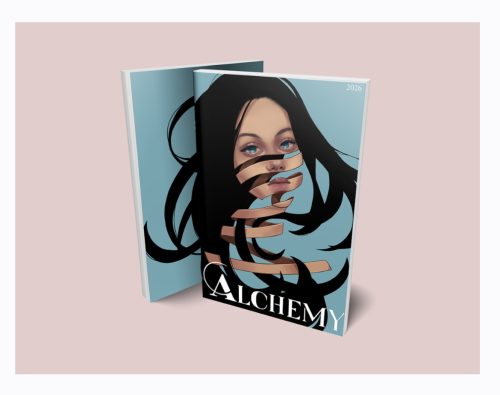
Front-Back cover of Alchemy, 2026
Download Alchemy, No.52
Times are changing fast, and so are we.
While envisioning this issue of Alchemy, we chose Metamorphosis as our theme. We thought about transformation in all forms—internal and external, chosen and imposed. Metamorphosis is a process, the in-between and all-around of a changing situation, the distance from one static point to the next static point. Metamorphosis is sometimes witnessed in the moment as it happens, but oftentimes it is only after it has become total, irreversible, and retrospectively inevitable.
Read the full introduction
Dear Reader,
It’s a fool’s errand to wrap these weeks of work into a neat little bow. We faced several unyielding obstacles this year; our backs have been up against the wall for far too long. The only way we could clamor out of this mess was collective struggle. Let our expressions– of the written word, of molded clay, of a paint-adorned canvas– be our testimony to how we stood and faced the crises of our time. Art can be a powerful cultural document, unflinching in how it says what is difficult to articulate. For many, it is a chance to speak truth to power, while others create a cathartic escape from the pain of everyday life. Let our creative output be our guide for how we traverse through this inflection point in history. Without the workers who withheld their labor to bring the administration to the bargaining table, this 52nd edition would have never made it to print. Victory was won, Dr Bennings is out the door. Even though we missed weeks of class, we did miss the lesson. But this strike should have never happened. It is a painful reminder of the backsliding our democratic institutions have been suffering. This successful strike inspired us immeasurably, not only as budding editors, artists and thinkers, but people. May future leadership take note that the young artists and writers and thinkers of PCC will always band together to create connections and community and collective hope. Remember: the algorithms don’t want you to read this. Any offline experience is a missed chance for the algorithms to turn you into a commodity. Read in healthy defiance. Let these texts and depictions bring you peace, or bring a face to those fleeting and faceless pains that haunt you. Re-mind yourself of what makes us all more human.
Power to the people.
-Alchemy Editing Team
— Alchemy Editors
Contents
- Pack Animals
Alchemy, 2026
Fiction by Jillian Clemo - Masters of Light
Alchemy, 2026
Poem by Spencer Guillot
Editorial team
- Jillian Clemo
- Patrick Donovan
- Palmer Fix
- Sophie Fuller
- Chloe Golden
- Spencer Guillot
- Ivy Mcnutt
- Camille Mounsey
- Nathania Perdido
- Autum Storms
Faculty advisor
Vandoren Wheeler
Cover design
Nichelle Ackerman
Get a copy
Alchemy is published annually in June and is available at the Sylvania Bookstore.